
 85Score
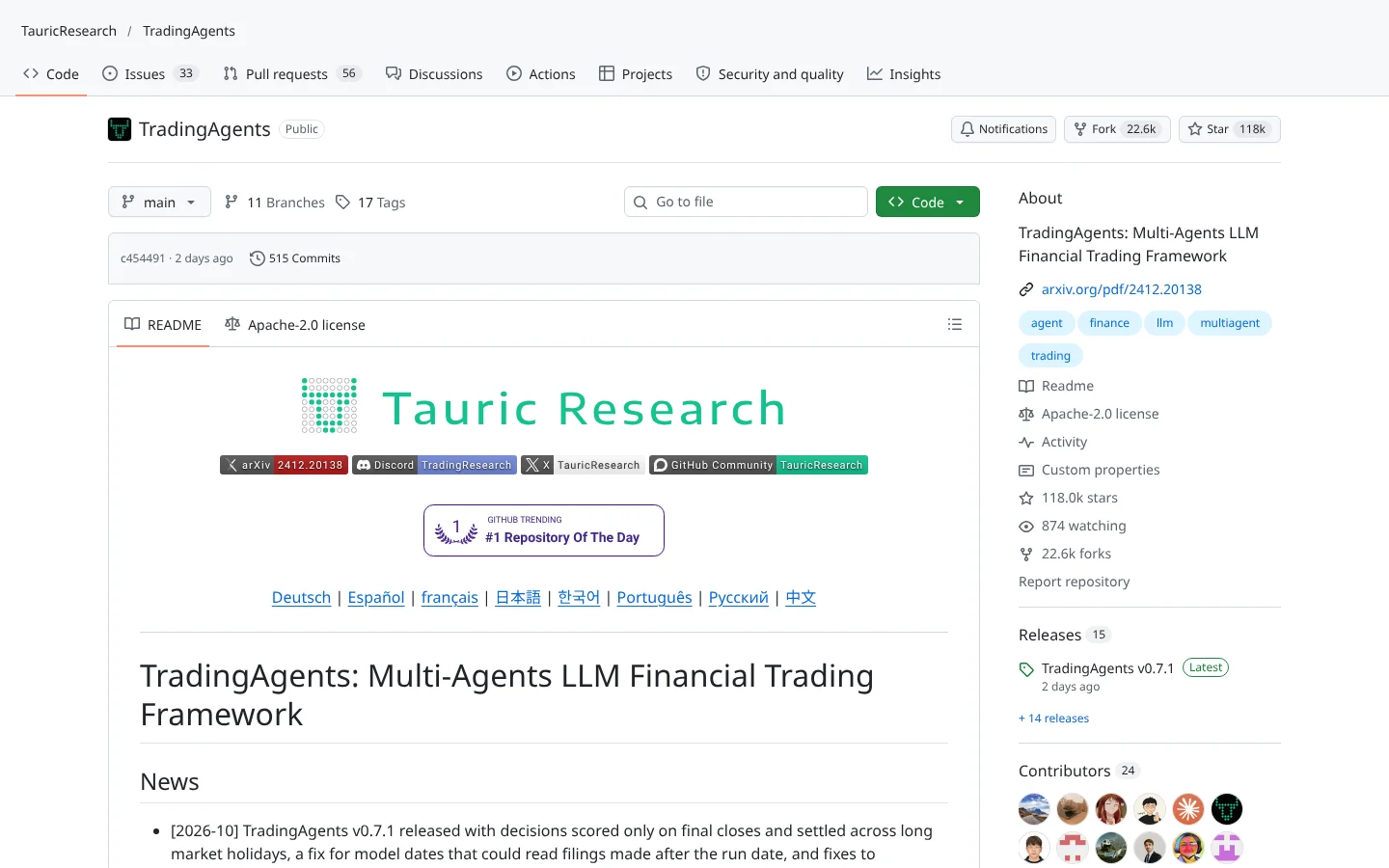
 TradingAgentsTauricResearch/TradingAgents
A multi-agent research desk: analyst agents argue the bull and bear case, a risk agent signs off before any trade idea moves.
★ 118k stars · Intermediate · updated 2026-10

AI Agents deep dive
 FinRobotAI4Finance-Foundation/FinRobot
FinRobot is a free, Apache-licensed AI agent platform from the  AI4Finance Foundation that pulls financial statements and drafts equity research reports with valuations, charts and a bull versus bear debate. It fits investors and analysts who want a first draft of company research fast. The catch: it needs several paid data and AI keys, it does not place trades, and public user feedback is nonexistent.
Think of it as a junior analyst team in a box: one pulls the filings, one runs the spreadsheet, one writes the memo, and two argue bull and bear before a judge signs off.
Give it a ticker. Get back a multi-page analyst report with a valuation, charts and a bull versus bear debate. Sounds like a Wall Street desk in a box, right? Here's the catch.
FinRobot is a free, Apache-licensed AI agent platform from the AI4Finance Foundation, the group behind FinRL. Think of a junior analyst team: one pulls the filings, one runs the spreadsheet, one writes the memo, and two argue before a judge signs off.
Five things we like.
One, it pulls real financial statements from Financial Modeling Prep.
Two, it builds a DCF valuation, which estimates what a company is worth from its future cash.
Three, the math runs in plain Python, so the AI can't invent the numbers. That's the right instinct.
Four, reports export to HTML or PDF with more than fifteen chart types.
Five, a desktop app for Apple Silicon Macs adds data from Finnhub and SEC EDGAR.
Two cautions. It needs several paid data and AI keys. And we found zero independent user reviews, so test it on a company you already know cold.
Best for long-term investors who want a fast first draft of research. It doesn't trade. Scroll down for setup steps and alternatives.
This is education, not financial advice. Your market edge starts with the right tool. Stay alpha.
FullStack Alpha Editorial Team
Reviewed by Jay Rocco, Chief Editor
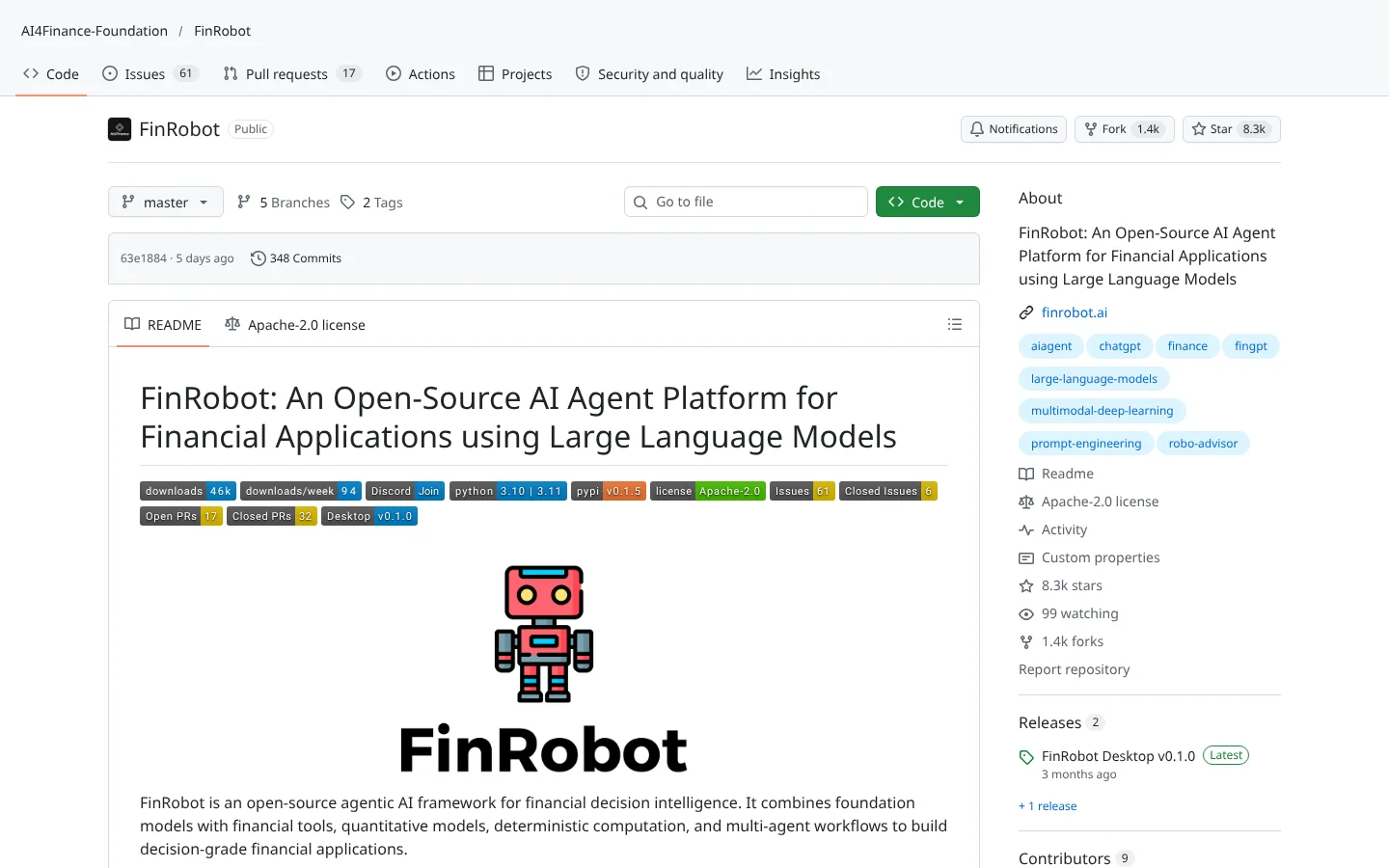
The project is a repo (a project's folder of code on  GitHub) from the AI4Finance Foundation, the same group behind FinRL and FinGPT. It uses large language models (the AI behind
 ChatGPT and Claude) as a team of agents (AI workers that each handle one task) to research public companies. Give it a ticker and it produces a multi-page report.
The workflow mirrors a sell-side desk. First it fetches income statements, balance sheets and cash flows from  Financial Modeling Prep. Then it builds three-year projections, a DCF valuation (an estimate of what a company is worth based on its future cash) and a peer comparison. Finally, specialized agents write the investment thesis, risks and valuation summary into an HTML or PDF report with more than 15 chart types.
One design choice deserves credit. The README says every financial figure comes from plain Python math, while the AI only handles reasoning and writing. That matters, because language models are notorious for inventing numbers. Keeping the arithmetic out of the chatbot's hands is the right instinct.
There are three flavors. An open-source Python framework, a web app that runs on your machine, and FinRobot Desktop, a native app for Apple Silicon Macs that adds debate agents, LBO and Monte Carlo analysis, and data from FMP, Finnhub, yfinance,  SEC EDGAR and others with automatic failover. A commercial
 FinRobot Pro lives at finrobot.ai.
Why should a retail investor care? Because the hardest part of fundamental research is not the insight, it is the hours of copying numbers into a spreadsheet before insight is even possible. Hand that part to a machine and you get more time for the questions that matter: is this business getting better or worse, and what is the market already pricing in?
Community Score
78 / 100
GitHub data checked 2026. Community read: not enough independent discussion yet.
Works with
Good fit if you are
Skip it if you are
The repo has more than 8,000 GitHub stars and about 1,400 forks (copies people build on), and its last code push was days ago. Yet our search found no relevant public discussion from users on  Reddit or
 Hacker News. No reviews, no complaints, no success stories.
That silence is common for academic and foundation projects. Developers star them to study later, few post results. For you, it means the README and sample reports are the only evidence, so judge it by running it on a company you already know well and checking every claim.
What they like
What they complain about
OpenAI key. Rename config_api_keys_sample to config_api_keys and add  Finnhub, FMP and
 SEC API keys.
A computer with Python and conda
The framework and web app run locally in a Python 3.10 environment. The Desktop app needs an M1 or newer Mac.
An AI model API key
The agents need a language model to reason and write. You pay per use.
OpenAIFinancial data API keys
Reports are built from financial statements, filings and market data.
Optional sentiment data
Adds a retail sentiment section to reports.
 Adanos
Confident prose, uncertain judgment
A polished 13-chapter report feels authoritative. The thesis is still an AI's opinion built on projections, and projections are guesses.
Key sprawl and running costs
OpenAI, FMP, Finnhub and SEC API each need their own account. Free tiers run out, and AI usage bills grow with every report.
No trading, no track record
It does not execute trades, and there is no public evidence that its reports lead to better decisions.
Desktop app friction
The Mac app is  Apple Silicon only and not yet Apple-notarized, so macOS may flag it as damaged until you run a Terminal command to clear it.
Thin public feedback
No independent user discussion was found, so bugs and limits will be yours to discover.

Keep reading across FullStack Alpha
Not ready to run code yourself? Our hands-on AI stock tool reviews on AIStockPickerApp.com score finished products on five pillars, the AI stock tools directory at AIStockPickerApps.com sorts 200+ tools by the job they do, and AIStockTradingBots.com walks through broker APIs, bot setup and backtesting step by step. Or head back to the Trading Workflows home page to match tools to your own routine and budget.
85ScoreTradingAgentsTauricResearch/TradingAgentsA multi-agent research desk: analyst agents argue the bull and bear case, a risk agent signs off before any trade idea moves.
★ 118k stars · Intermediate · updated 2026-10
 84Score
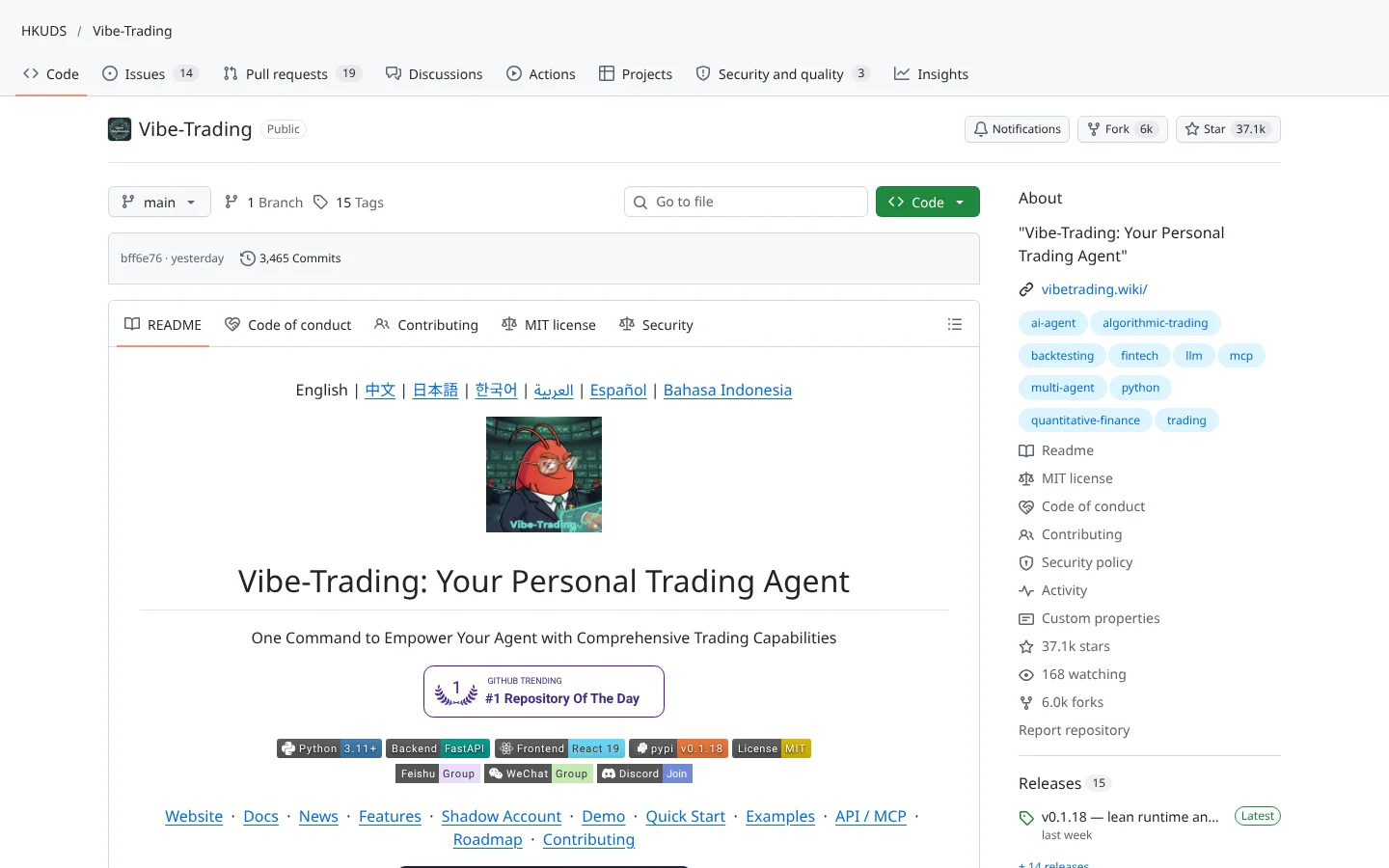
 Vibe-TradingHKUDS/Vibe-Trading
A multi-agent research workspace from HKU with built-in backtest engines and trade-journal analysis.
★ 37k stars · Intermediate · updated 2026-10
 ClaudeCodex
 Local models
 83Score
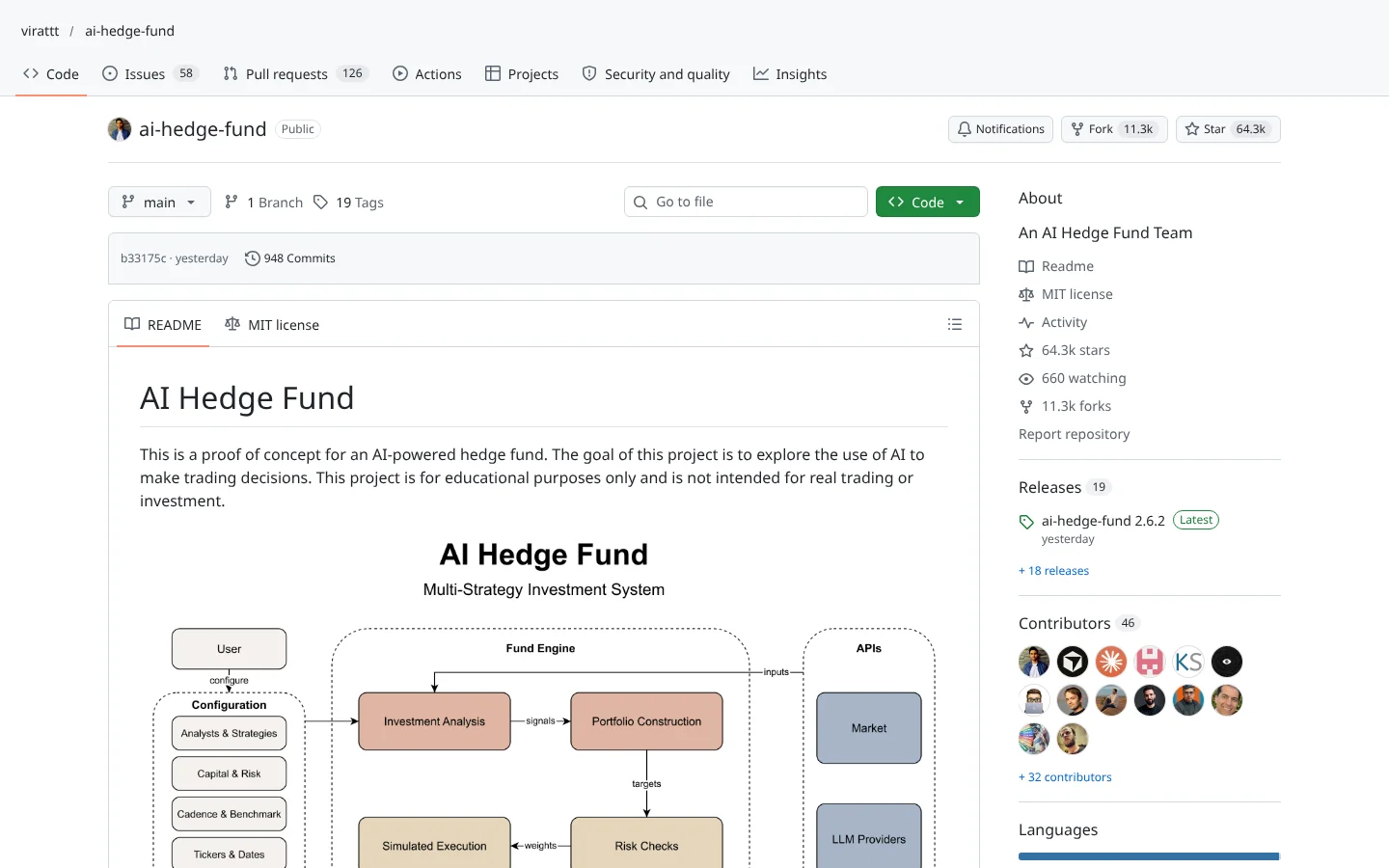
 AI Hedge Fundvirattt/ai-hedge-fund
Investor-persona agents debate a stock, then a portfolio agent makes the call. A teaching project, not a fund.
★ 64k stars · Intermediate · updated 2026-10
This is the most practical AI research tool in the AI4Finance family. It turns a ticker into a structured analyst-style report with real valuation math, and it keeps the numbers out of the chatbot's hands. For investors who already do fundamental work, that is hours of grunt work handed to a machine.
But a faster first draft is not a better decision. It will not trade for you, it costs real money in API calls, and nobody has publicly shown it improves results. Use it to build the folder, then read the filings yourself. The edge is still in the judgment, not the formatting.
A sensible routine: run a report on three companies you already own, mark every number you can verify against the 10-K, and note where the narrative overreaches. If it passes that audit, keep it in your research process as the first-draft machine. If it fails, you learned that for the cost of a few API calls.
It is an open-source AI agent platform from the AI4Finance Foundation that drafts equity research reports. It pulls financial statements, builds valuations and peer comparisons, and writes the analysis with language models.
The open-source framework is free under the Apache 2.0 license. You still pay for the API keys it needs, such as OpenAI and Financial Modeling Prep, and a commercial FinRobot Pro is offered separately at finrobot.ai.
No. It generates research reports and analysis. Its disclaimer says the code is not a recommendation for live trading.
The README names OpenAI as the model provider and says the platform supports plug-and-play use of other models. OpenAI is the only provider named explicitly in setup.
Financial Modeling Prep, Finnhub, SEC filings and yfinance, with the Desktop app adding Adanos sentiment and automatic failover between seven providers.
Incoming transmission | Free weekly newsletter
FullStack Alpha has tested 200 AI stock tools. Be honest: how many of yours do the same job, and which one did you forget you signed up for?
One email a week fixes that: which tools are worth the money, what they cost right now, and how the traders on this site wire them into a routine. Five minutes to read. Zero noise.
Inside every issue
5 MIN READ
The Verdict
One AI trading tool tested and scored. What it does well, what it costs, and the catch the sales page leaves out.
Price Watch
Price changes and live promos on the tools traders actually use, monthly and annual side by side, so you stop overpaying.
Workflow Teardown
One educator's routine taken apart: the scan, the chart, the tools, and the free swap for every paid one.
Scan of the Week
Exact scanner settings you can copy, pulled from the educator's own lesson with the timestamp.
Process beats prediction. This is the email that keeps your process honest.
FullStack Alpha Network
BestAITradingTools.com
Trading workflows, the tool matchmaker and the GitHub repo directory.
 Gemini
 DeepSeek