
 87Score
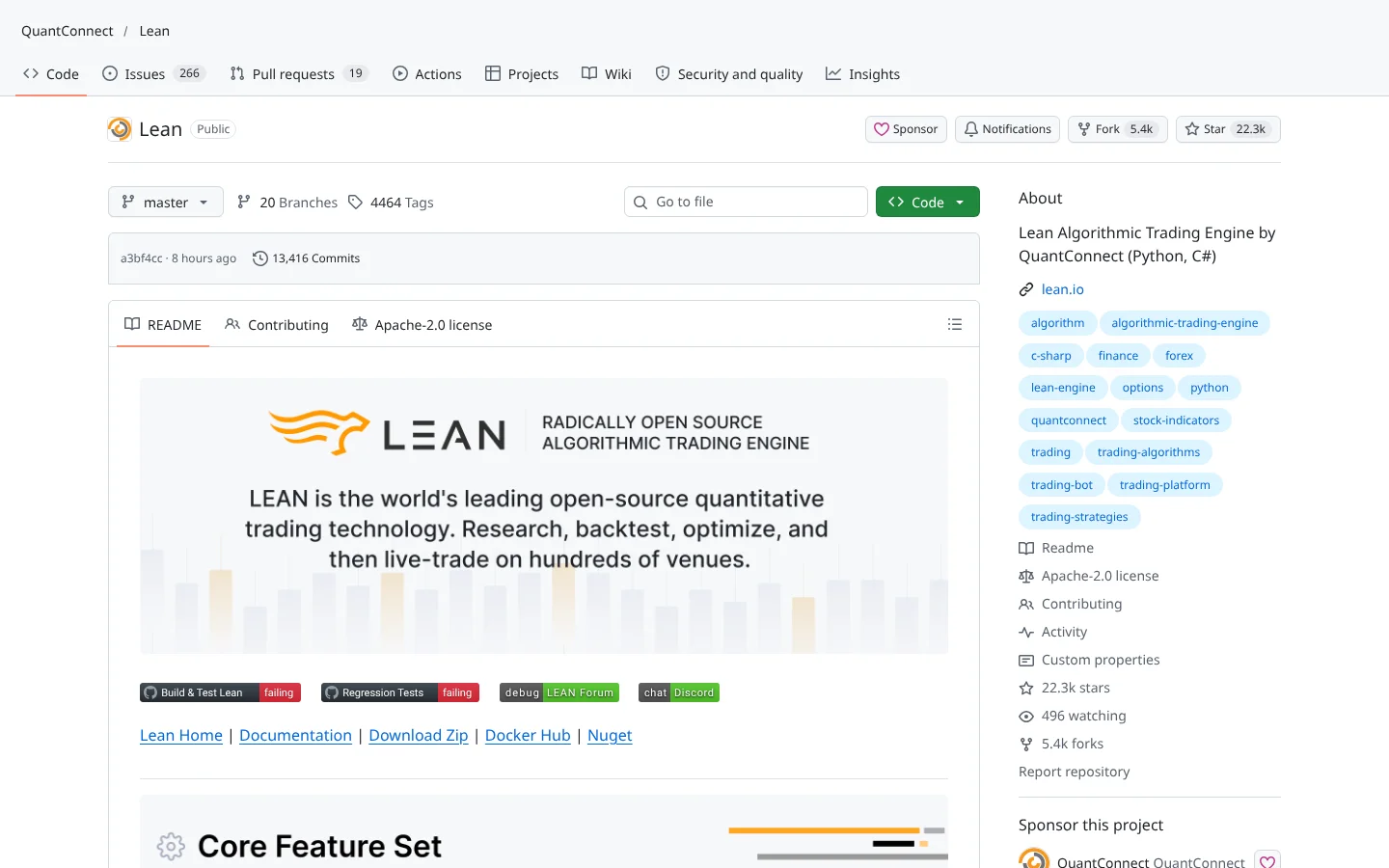
 QuantConnect LEANQuantConnect/Lean
The open-source engine behind QuantConnect. Institutional-grade backtesting in C# or Python.
★ 22k stars · Advanced · updated 2026-10

Backtesting deep dive
 Nautilus Tradernautechsystems/nautilus_trader
Nautilus Trader is a free, open-source trading engine with a fast Rust core and Python on top, built so the code you test on history is the same code that trades live. It fits serious coders trading crypto, futures, stocks or FX who want institutional plumbing without a license fee. The catch is a steep learning curve, a major version transition underway, and the fact that you still bring your own data and your own strategy.
Think of it as a professional flight simulator wired to a real cockpit: the same controls you practice on are the ones that fly the plane, but you need a pilot's training to use either.
Most trading bots behave one way in testing and another way with your money. Nautilus Trader was built to kill that gap. Here's how, in under two minutes.
Nautilus is a free trading engine with a fast core and Python on top. Think of a flight simulator wired to a real cockpit. The controls you practice on are the ones that fly the plane.
Why do pros like it? The code you test is the exact code that trades live.
Five things we like. One, it's fast. Two, same code for backtest and live. Three, a clean, modular design. Four, it covers stocks, futures, forex and crypto. Five, it's actively maintained.
It connects to Interactive Brokers, Binance, Bybit, Coinbase, Kraken and more, and pulls data from providers like Databento.
Hacker News and Reddit reviews are positive, including praise from someone at a trading firm. The common gripe is the learning curve.
Plan on a weekend just to learn how the pieces fit before you write a single strategy.
Two cautions. A major version change is underway, so expect breaking changes. And you bring your own data and your own strategy. It's plumbing, not a money printer.
Best for serious Python coders who plan to trade live. Beginners, start simpler. Scroll down for the scorecard and alternatives.
This is education, not financial advice. Your market edge starts with the right tool. Stay alpha.
FullStack Alpha Editorial Team
Reviewed by Jay Rocco, Chief Editor
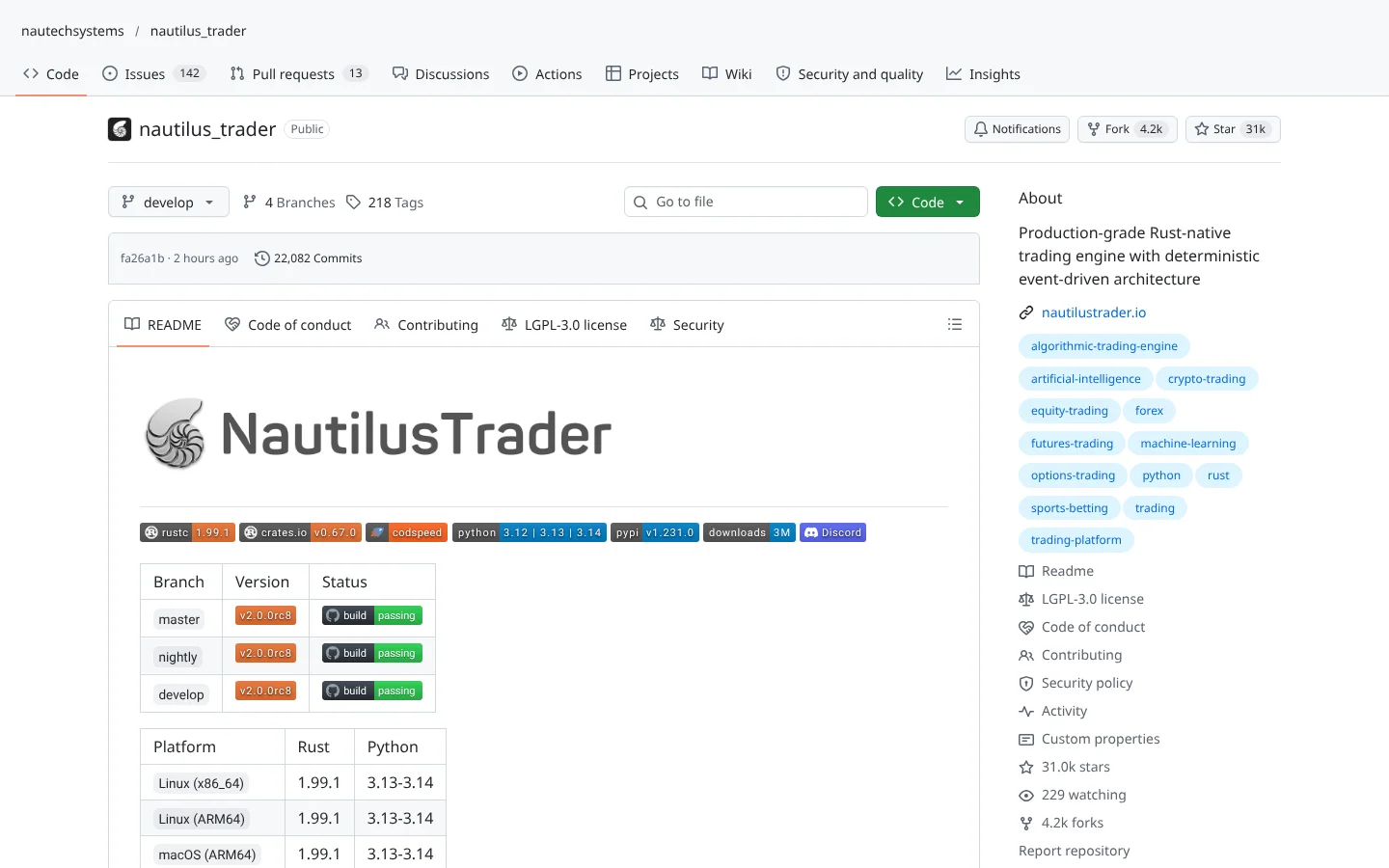
Nautilus Trader is a repo (a project's folder of code on  GitHub) maintained by
 Nautech Systems, with more than 31,000 stars. It is a trading engine: software that receives market data, runs your strategy, sends orders to a venue and keeps track of positions. The heavy lifting runs in Rust, a fast systems language, while you write strategies and settings in Python.
The headline feature is parity. Most retail setups test a strategy in one tool and trade it in another, and the translation step is where money leaks. Here the same strategy code runs in the backtester (replaying old prices to see what would have happened) and in live trading. The README is honest that live markets still add timing, connection and reconciliation quirks that no simulation copies perfectly.
It is asset-class agnostic, meaning it does not care whether you trade bitcoin or crude futures. Current integrations listed as stable include  Interactive Brokers, Binance,
 Bybit,
 Coinbase,
 Kraken,
 OKX,
 Deribit,
 dYdX,
 Hyperliquid,
 Polymarket and
 Betfair, plus data providers
 Databento and
 Tardis. Backtests can run several venues, instruments and strategies at once with tick and order book data at nanosecond resolution. There is no app, no strategy store and no hand-holding. You get the engine.
Community Score
92 / 100
GitHub data checked 2026. Community read: positive.
Works with
Good fit if you are
Skip it if you are
Practitioner sentiment here is positive, and it comes from people who build systems for a living. Threads on r/algotrading and  Hacker News praise the fast Rust core, the clean modular design and the promise that backtest code and live code are the same. One Hacker News commenter at a trading firm said simply that they use it and are happy with it.
The complaints are about effort. Users describe a steep learning curve, real work to wire it into a broker's order system, and the reminder that you still need a separate data provider. It shows up often in comparisons with  QuantConnect's LEAN engine, where Nautilus Trader wins on control and loses on convenience.
“We use NautilusTrader, very happy with it.”
vinzenzu, Hacker News, 2026What they like
What they complain about
 Binance adapter, for example, supports Testnet and Demo environments. Keep API keys in environment variables, such as the adapter's BINANCE_TESTNET_API_KEY, never in strategy code.
A broker or exchange account with API access
The engine sends orders through adapters; you need an account and API keys on a supported venue.
Market data
The engine does not include historical data. Backtests are only as good as the data you feed them.
DatabentoTardis CoinAPI
A capable computer or server
Live trading needs an always-on machine on a supported OS; Redis is optional for caching and messaging.
 Redis
Strong Python skills
Every strategy, config and adapter setting is code. There is no visual builder.
Version transition risk
The project is moving from v1 to v2, and the README warns of breaking changes between releases. v1 now gets only critical security fixes, and v2 release candidates are not recommended for real capital.
Backtest is not live
Code parity reduces surprises but does not remove them. Live trading adds latency, partial fills, outages and reconciliation issues the simulator may not reproduce.
Integration effort
Users report real work getting broker order flows right. A bug in your wiring can send wrong orders, so test every path in a practice environment first.
Data costs and quality
Professional tick and order book data usually costs money, and cheap data produces confident but wrong backtests.
Steep learning curve
This is institutional-style software. Expect weeks before your first trustworthy result, not an afternoon.

Keep reading across FullStack Alpha
Not ready to run code yourself? Our hands-on AI stock tool reviews on AIStockPickerApp.com score finished products on five pillars, the AI stock tools directory at AIStockPickerApps.com sorts 200+ tools by the job they do, and AIStockTradingBots.com walks through broker APIs, bot setup and backtesting step by step. Or head back to the Trading Workflows home page to match tools to your own routine and budget.
87ScoreQuantConnect LEANQuantConnect/LeanThe open-source engine behind QuantConnect. Institutional-grade backtesting in C# or Python.
★ 22k stars · Advanced · updated 2026-10
 84Score
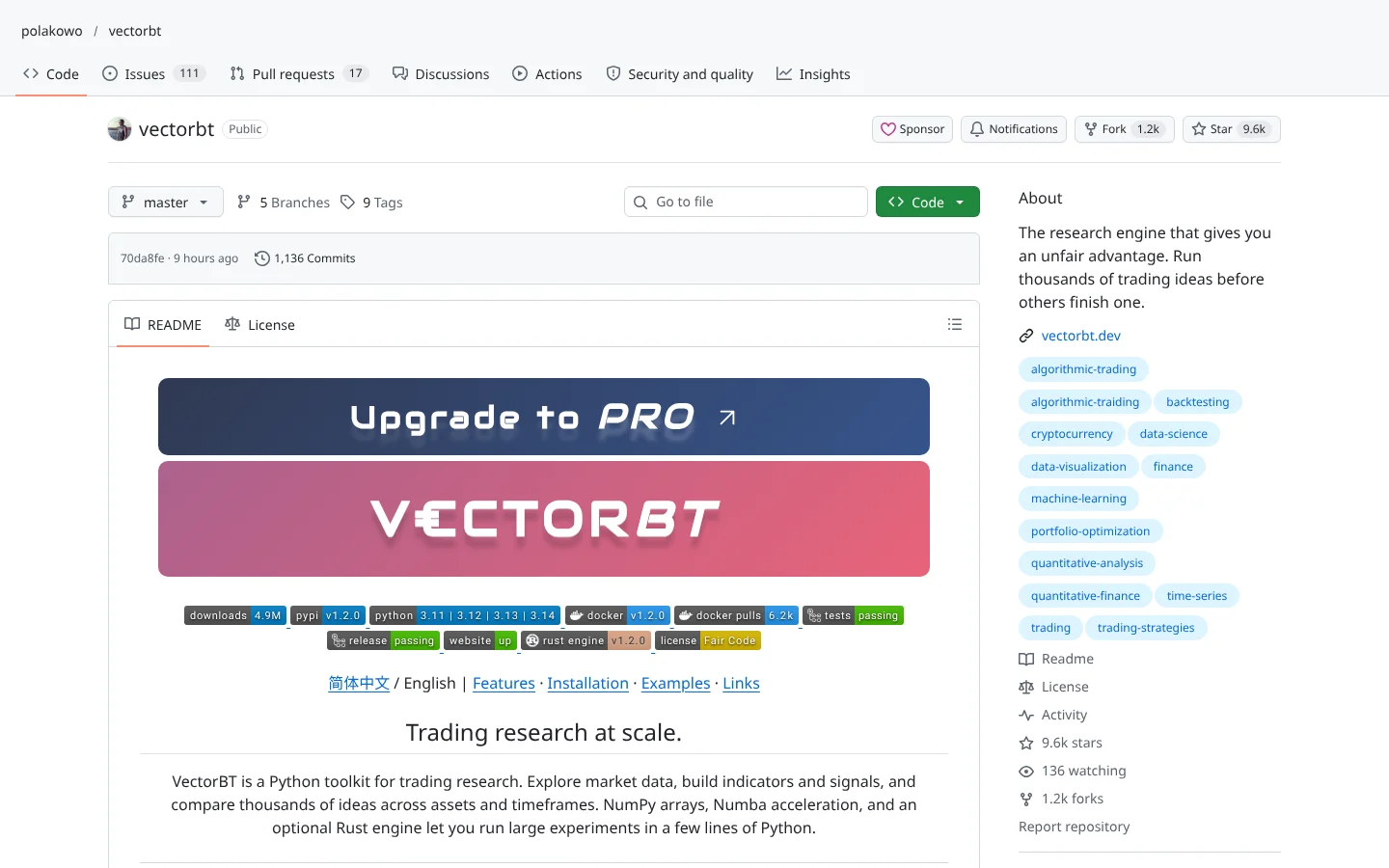
 vectorbtpolakowo/vectorbt
Vectorized backtesting that tests thousands of parameter combinations in seconds.
★ 9.6k stars · Intermediate · updated 2026-10
 80Score
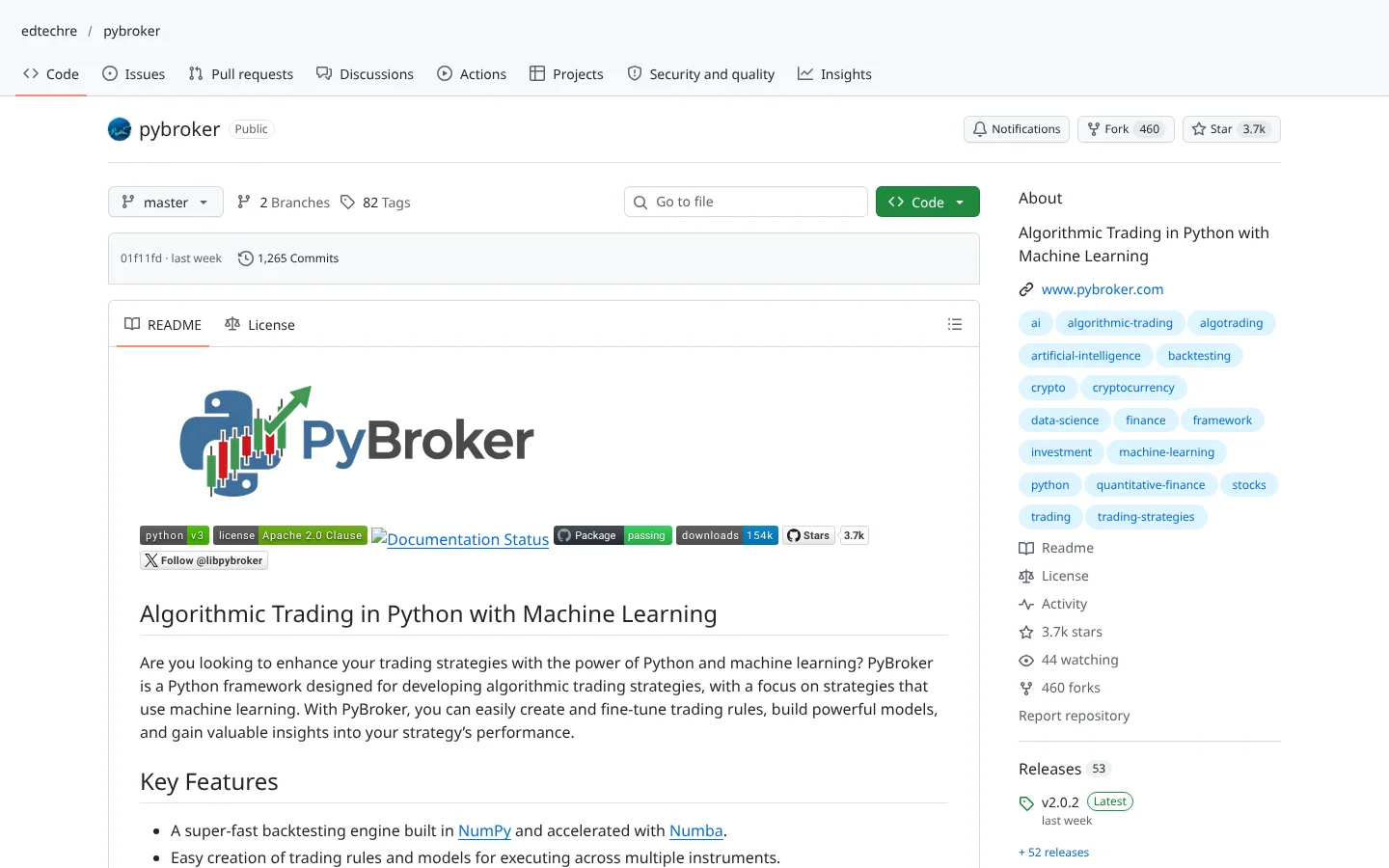
 PyBrokeredtechre/pybroker
A Python backtester built for machine learning strategies, with walk-forward analysis baked in.
★ 3.7k stars · Intermediate · updated 2026-10
Nautilus Trader is the most serious free trading engine on GitHub, and our Community Score of 92 reflects strong adoption, daily maintenance and positive sentiment from people who trade for a living. It solves the problem that quietly kills most systematic traders: the gap between the strategy you tested and the one you deployed.
It is also overkill for most readers. If you cannot comfortably write and debug Python, this engine will cost you months before it saves you a dollar. Pick it if you are an engineer building a real, multi-venue system and want to own every layer. Wait for the v2 stable release before putting meaningful money behind it.
Nautilus Trader is a free, open-source trading engine from Nautech Systems with a Rust core and Python strategies. It runs backtests and live trading with the same code across crypto, futures, FX, stocks, betting exchanges and prediction markets.
Yes. The code is open source under the LGPL-3.0 license and free to download from GitHub. Your costs come from market data, servers and broker or exchange fees.
Yes. Interactive Brokers is listed as a stable integration, alongside crypto exchanges like Binance, Bybit, Coinbase, Kraken and OKX. Expect to spend real time configuring and testing the connection.
It depends on what you value. Nautilus Trader gives more control, speed and self-hosting, while QuantConnect's LEAN ecosystem offers more convenience and bundled data. Practitioners on r/algotrading often pick Nautilus when they want to own the whole stack.
No. It is built for experienced developers, and users describe a steep learning curve. Beginners should learn backtesting basics with simpler tools first, then come back once they can write and debug Python strategies on their own.
Incoming transmission | Free weekly newsletter
FullStack Alpha has tested 200 AI stock tools. Be honest: how many of yours do the same job, and which one did you forget you signed up for?
One email a week fixes that: which tools are worth the money, what they cost right now, and how the traders on this site wire them into a routine. Five minutes to read. Zero noise.
Inside every issue
5 MIN READ
The Verdict
One AI trading tool tested and scored. What it does well, what it costs, and the catch the sales page leaves out.
Price Watch
Price changes and live promos on the tools traders actually use, monthly and annual side by side, so you stop overpaying.
Workflow Teardown
One educator's routine taken apart: the scan, the chart, the tools, and the free swap for every paid one.
Scan of the Week
Exact scanner settings you can copy, pulled from the educator's own lesson with the timestamp.
Process beats prediction. This is the email that keeps your process honest.
FullStack Alpha Network
BestAITradingTools.com
Trading workflows, the tool matchmaker and the GitHub repo directory.
 Claude