
 85Score
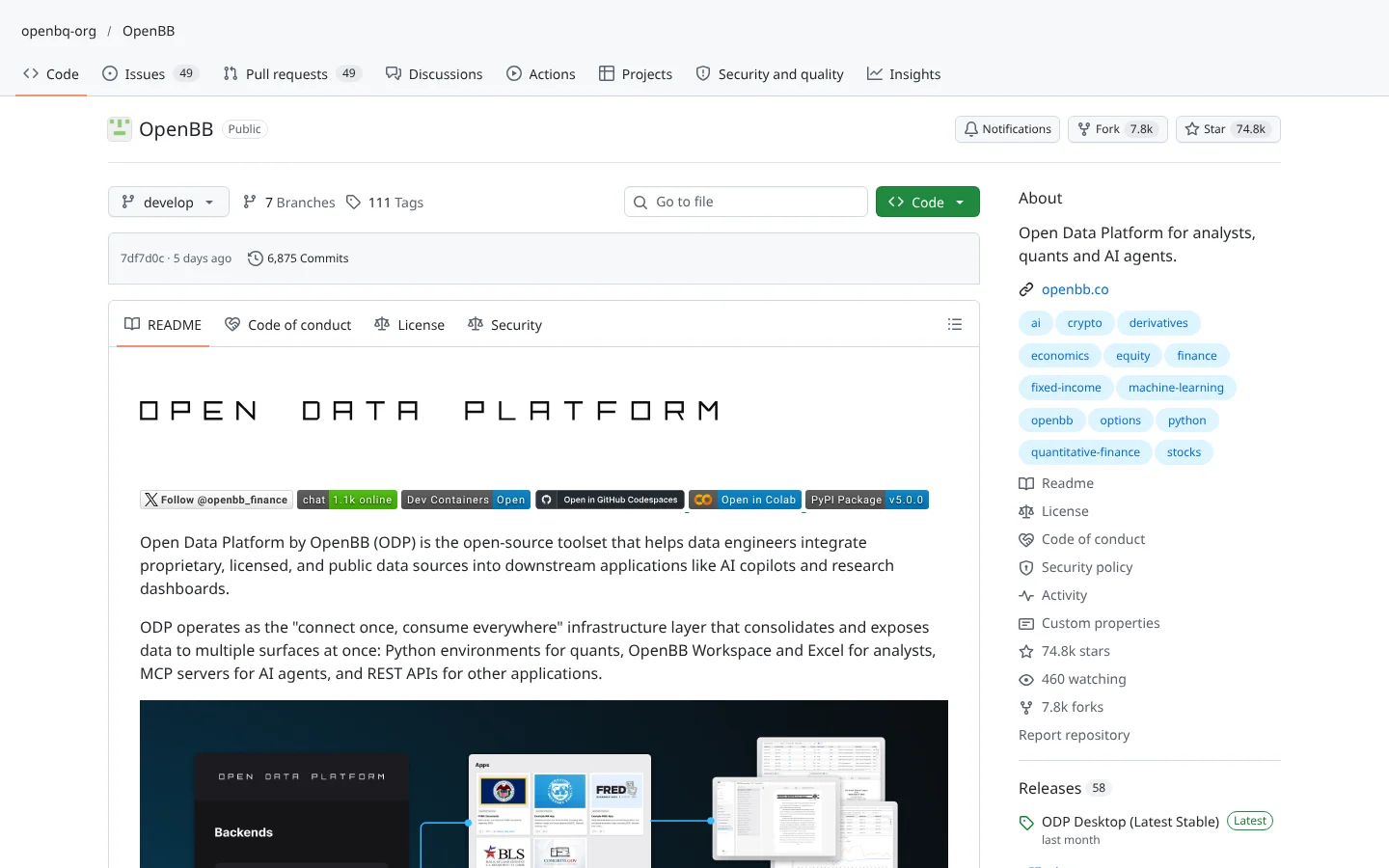
 OpenBBOpenBB-finance/OpenBB
The free, open-source answer to the Bloomberg Terminal: one Python toolkit over 100+ data providers.
★ 75k stars · Beginner · updated 2026-10

Research and Data deep dive
 CCXTccxt/ccxt
CCXT is a free, open-source code library that lets one program talk to more than 100 crypto exchanges using the same commands. It is for developers building crypto bots, dashboards or data tools who do not want to learn every exchange's quirks. The catch: the one-size-fits-all layer leaks those quirks anyway, and its market lists can quietly hide delisted coins from your historical tests.
Think of it as a universal travel adapter for crypto exchanges: one plug fits a hundred wall sockets, but some sockets still spark.
You've probably used CCXT without knowing it. It sits under most open-source crypto bots. Here's what it does in under two minutes.
CCXT is a free library that lets one program talk to more than a hundred crypto exchanges with the same commands. Think of a universal travel adapter. One plug, a hundred sockets. A few still spark.
It's popular because it deletes the most boring job in crypto automation.
Five things we like. One, one set of commands for over a hundred exchanges. Two, the fastest way to prototype across venues. Three, it's free with an MIT license. Four, it works in several programming languages. Five, a huge, active project with frequent updates.
It connects to Binance, Bybit, OKX, KuCoin, Hyperliquid and many more. Freqtrade runs on it.
Reviews are mixed but respectful. Developers love the speed. Serious traders say the shared layer leaks each exchange's quirks.
It also saves you from rewriting your bot every time you want to try a new exchange.
Two cautions. Delisted coins can quietly vanish from its market lists, which makes old backtests look better than reality. And it's a library, not a bot. You still write the strategy.
Best for developers building crypto bots or data tools. Scroll down for the scorecard and the bots built on top of it.
This is education, not financial advice. Your market edge starts with the right tool. Stay alpha.
FullStack Alpha Editorial Team
Reviewed by Jay Rocco, Chief Editor
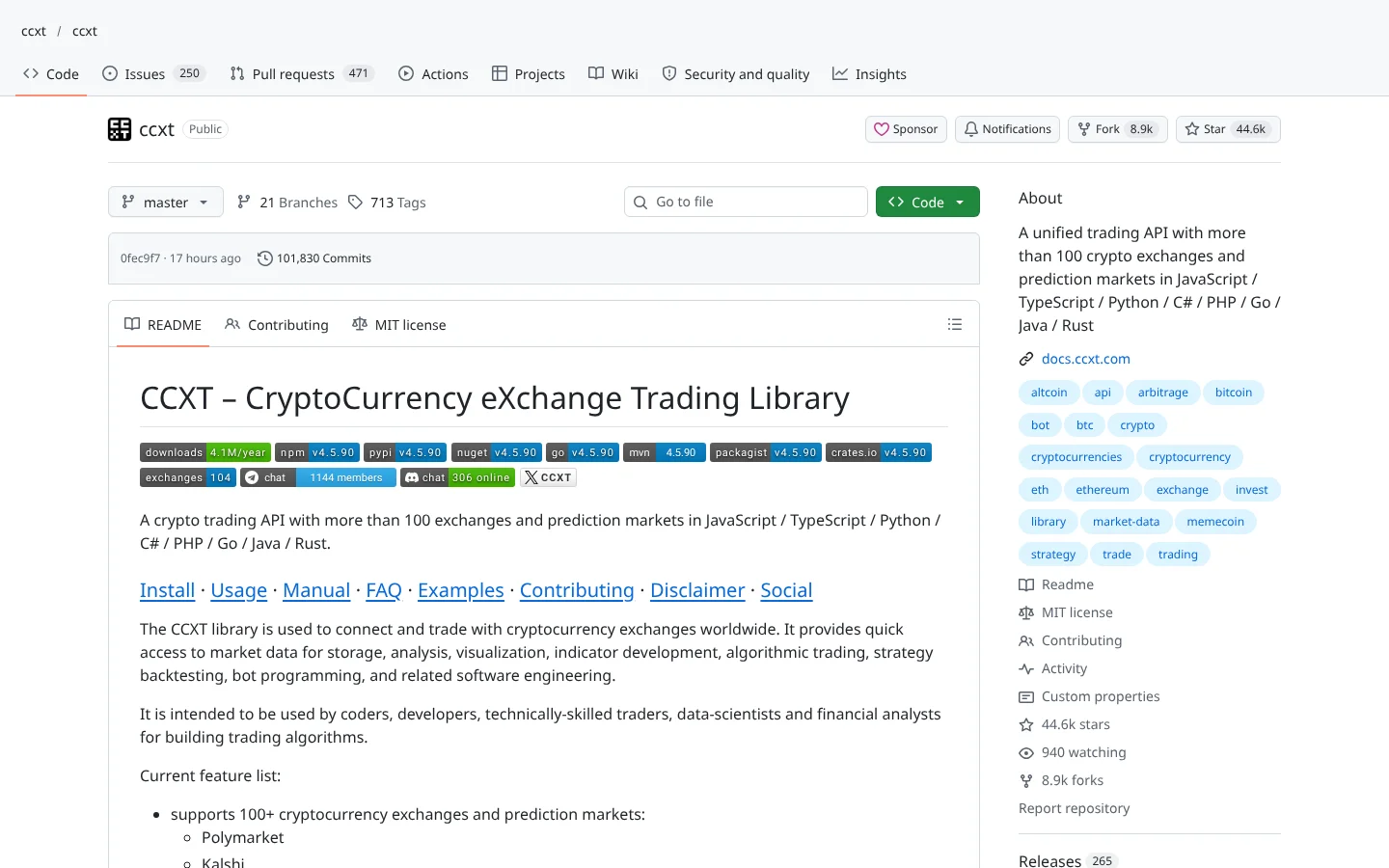
CCXT is a repo (a project's folder of code on  GitHub) with nearly 45,000 stars, and you have probably used it without knowing. It is a library, meaning building blocks programmers drop into their own software, not an app you open. Its job is translation: every exchange has its own API (the set of commands code uses to talk to it), and this library wraps them all in one shared format.
Here is why that matters. Each exchange names things differently, rounds numbers differently and throws different errors. Write fetch_ticker or create_order once, and the same line works on  Binance,
 Bybit,
 OKX,
 KuCoin,
 Bitget,
 Gate,
 Hyperliquid and dozens more. It handles public data like prices and order books, and private actions like balances and orders once you add your keys. The README lists support for JavaScript, TypeScript, Python, PHP, C#, Go, Java and Rust, and it now also covers prediction markets such as
 Polymarket and
 Kalshi.
It is plumbing. There is no strategy, no backtester and no dashboard. Think of it as the pipes behind the wall: you only notice them when they burst, and you will be the plumber on call. Popular bots, including  Freqtrade, use it to reach exchanges they do not support directly. That reach is the selling point and the weak spot, because a universal layer is only as good as its least-tested adapter.
Community Score
90 / 100
GitHub data checked 2026. Community read: mixed.
Works with
Good fit if you are
Skip it if you are
Sentiment is mixed but respectful. On r/algotradingcrypto, the consensus is that this library is the fastest way to prototype across many exchanges with one set of commands. Almost everyone starts here.
Then many leave, and the reasons are worth hearing before you write a line of code. Experienced traders call the abstraction leaky, meaning exchange quirks still break through the shared layer, and report adapter bugs on less popular exchanges. One widely read thread warns against using it for historical data at all: load_markets lists only currently active pairs, so delisted coins vanish and backtests suffer survivorship bias.
“If you just want to prototype across multiple exchanges quickly, ccxt can save time.”
 BitpanelDave, r/algotradingcrypto, 2025
What they like
What they complain about
Crypto exchange accounts with API access
Private actions like balances and orders need keys from each exchange you connect.
BinanceBybitOKXKuCoinBitgetGateHyperliquid MEXC
 Crypto.com
A supported programming language
It is code you import, available for Python, JavaScript, PHP, C#, Go, Java and Rust.
A separate historical data source for backtests
Community users warn its market lists drop delisted pairs, so complete history needs another source.
Coding skills
There is no screen to click. Everything happens in your own scripts.
Survivorship bias in history
Pulling history through load_markets can skip pairs that were delisted. A backtest without the dead coins looks better than reality ever was.
Leaky abstraction
Order types, fees, minimums and error codes differ by exchange. A command that works on one venue can behave differently on another.
Adapter bugs
With 100+ exchanges, smaller adapters get less testing. Stick to certified exchanges for real money and test every order path, including cancels and partial fills, before you trust it with size.
API key security
Your keys live on your machine. A leaked key with trading rights can be abused, so disable withdrawals and restrict by IP where possible.
Exchange risk
This software is non-custodial and never holds your money, but the exchanges do. An exchange failure, freeze or hack is your loss, not the library's. Spread risk and keep only working capital on any single venue.

Keep reading across FullStack Alpha
Not ready to run code yourself? Our hands-on AI stock tool reviews on AIStockPickerApp.com score finished products on five pillars, the AI stock tools directory at AIStockPickerApps.com sorts 200+ tools by the job they do, and AIStockTradingBots.com walks through broker APIs, bot setup and backtesting step by step. Or head back to the Trading Workflows home page to match tools to your own routine and budget.
85ScoreOpenBBOpenBB-finance/OpenBBThe free, open-source answer to the Bloomberg Terminal: one Python toolkit over 100+ data providers.
★ 75k stars · Beginner · updated 2026-10
 85Score
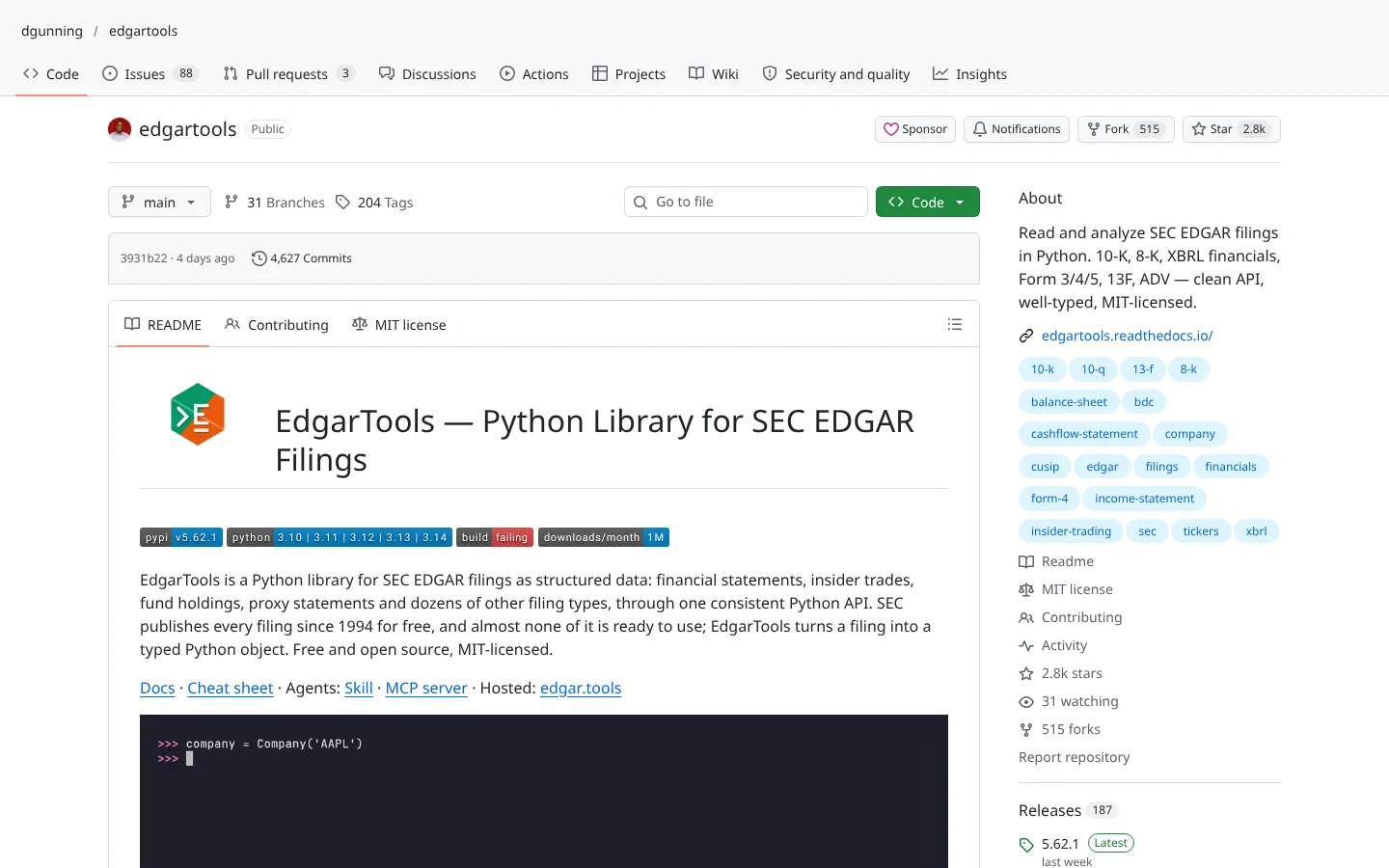
 edgartoolsdgunning/edgartools
Read SEC filings in Python without wrestling EDGAR. Includes an MCP server.
★ 2.8k stars · Beginner · updated 2026-10
 67Score
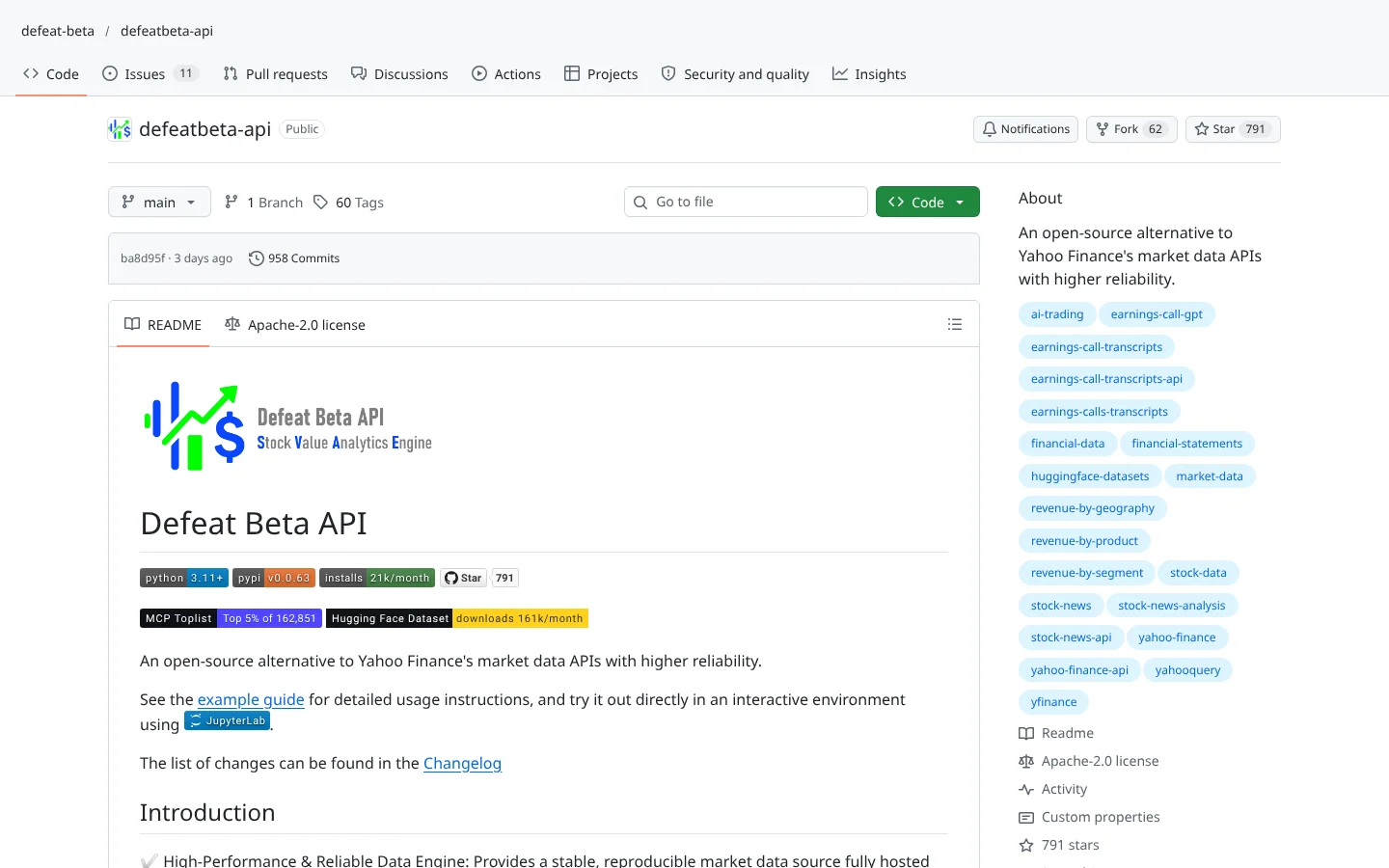
 DefeatBeta APIdefeat-beta/defeatbeta-api
An open-source alternative to Yahoo Finance data with its own MCP server.
★ 791 stars · Beginner · updated 2026-10
CCXT is infrastructure, and great infrastructure is boring. Our Community Score of 90 reflects massive adoption, daily maintenance and an MIT license, with sentiment held back by real complaints about leaky adapters and misleading history. For prototyping across exchanges, nothing else comes close.
Ask yourself a simple question first: am I testing an idea, or running money? Use CCXT as the on-ramp, not the destination. Prototype with it, but get historical data from a source that keeps delisted coins, and consider an exchange's native API once real money and speed matter. The library saves you weeks. Your testing discipline decides whether those weeks pay off.
It is used to connect code to crypto exchanges through one shared set of commands. Developers use it to pull prices and order books, check balances and place orders across more than 100 exchanges without learning each one separately.
Yes. Its README calls it free, open-source software under the MIT license with no hidden fees. It says the project is funded by rebates from exchange API broker programs, and you pay the same trading fees you would pay the exchange directly.
It is non-custodial, meaning it never holds your money and talks to exchanges directly from your machine. Safety depends on how you store API keys, so keep them in environment files and disable withdrawals.
No. It is built for crypto exchanges and now some prediction markets like Polymarket and Kalshi. For stocks, you need a broker API instead.
Be careful. Community users warn that load_markets lists only active pairs, so delisted coins drop out and backtests suffer survivorship bias. Use a dedicated historical data source for serious testing.
Incoming transmission | Free weekly newsletter
FullStack Alpha has tested 200 AI stock tools. Be honest: how many of yours do the same job, and which one did you forget you signed up for?
One email a week fixes that: which tools are worth the money, what they cost right now, and how the traders on this site wire them into a routine. Five minutes to read. Zero noise.
Inside every issue
5 MIN READ
The Verdict
One AI trading tool tested and scored. What it does well, what it costs, and the catch the sales page leaves out.
Price Watch
Price changes and live promos on the tools traders actually use, monthly and annual side by side, so you stop overpaying.
Workflow Teardown
One educator's routine taken apart: the scan, the chart, the tools, and the free swap for every paid one.
Scan of the Week
Exact scanner settings you can copy, pulled from the educator's own lesson with the timestamp.
Process beats prediction. This is the email that keeps your process honest.
FullStack Alpha Network
BestAITradingTools.com
Trading workflows, the tool matchmaker and the GitHub repo directory.
 Claude
 ChatGPT