
 96Score
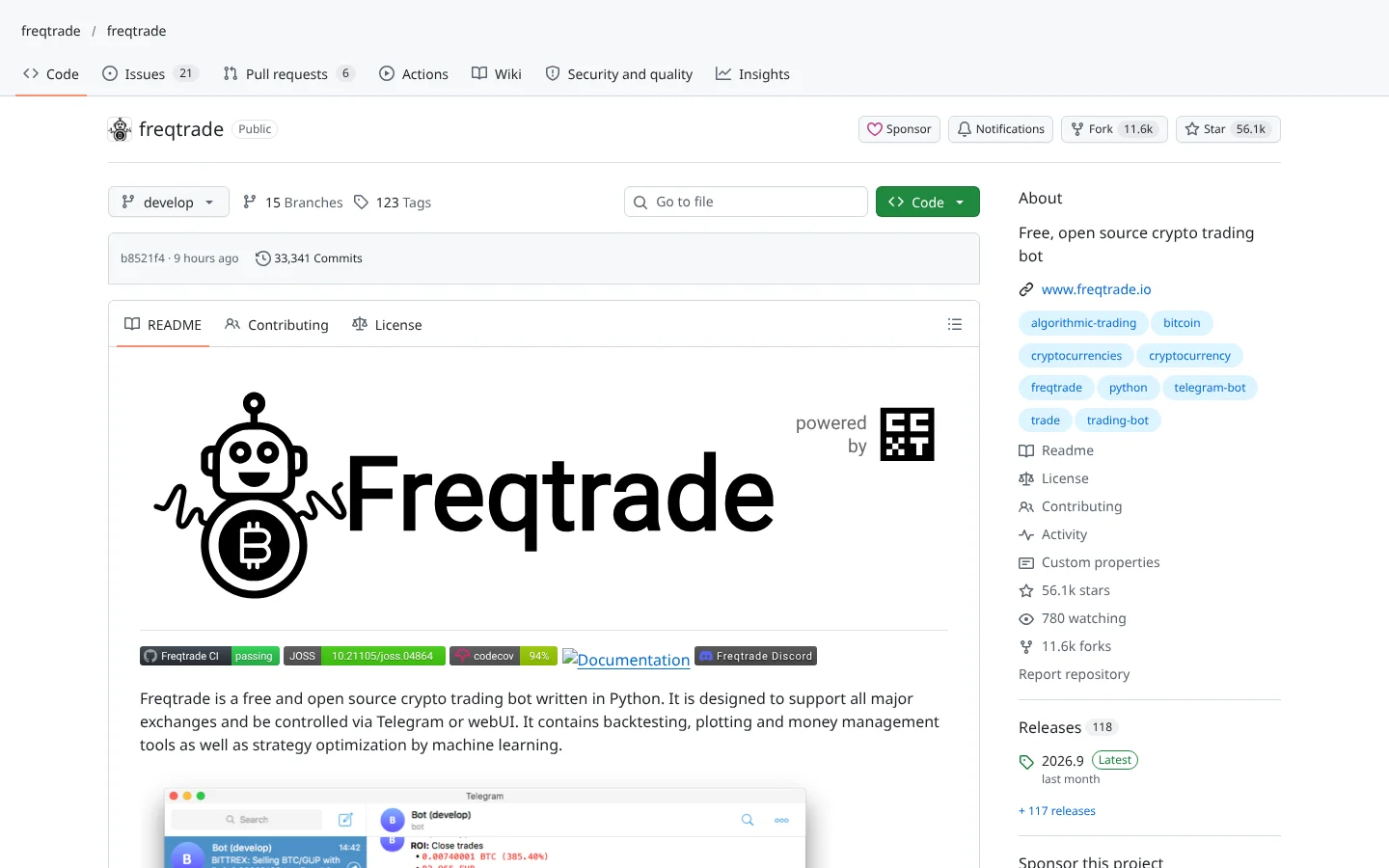
 Freqtradefreqtrade/freqtrade
The most widely used open-source crypto bot, with FreqAI for models that retrain on rolling data.
★ 56k stars · Intermediate · updated 2026-10

Trading Bots deep dive
 Hummingbothummingbot/hummingbot
Hummingbot is a free, open-source framework for running crypto market-making and arbitrage bots on centralized and decentralized exchanges. It is for technical traders who want to provide liquidity or exploit price gaps with professional-style tools. The catch: users report it is hard to get running, profits often came from exchange reward programs rather than trading, and the community feels quieter than the star count suggests.
Think of it as opening a currency exchange booth at the airport: you earn the small gap between buy and sell prices, but one bad swing in the rate can wipe out a week of spreads.
Wall Street firms make money on the gap between buy and sell prices. Hummingbot hands you their playbook for free. Here's the catch nobody puts in the README.
Hummingbot is a free framework for crypto market making and arbitrage. Think of a currency exchange booth at the airport. You earn the small spread, but one bad swing can wipe out a week of it.
It's popular because it made a pro strategy available to anyone.
Five things we like. One, a serious market-making engine. Two, it connects to dozens of exchanges, including decentralized ones. Three, paper trading with no API keys. Four, training through its Botcamp and competitions. Five, an add-on lets Claude help run it.
It works with Binance, Coinbase, Kraken, OKX, Hyperliquid, Uniswap and more.
Reviews are mixed. People respect the engine, but say it's hard to get running, and that past profits often came from exchange reward programs, not trading.
Start with paper trading and small spreads, and watch how often you get stuck holding coins you didn't want.
Two cautions. Inventory risk: if the market trends, you can pile up losing positions. And custom strategies are harder to backtest than you'd hope.
Best for technical crypto traders who understand spreads. Scroll down for setup steps and alternatives.
This is education, not financial advice. Your market edge starts with the right tool. Stay alpha.
FullStack Alpha Editorial Team
Reviewed by Jay Rocco, Chief Editor
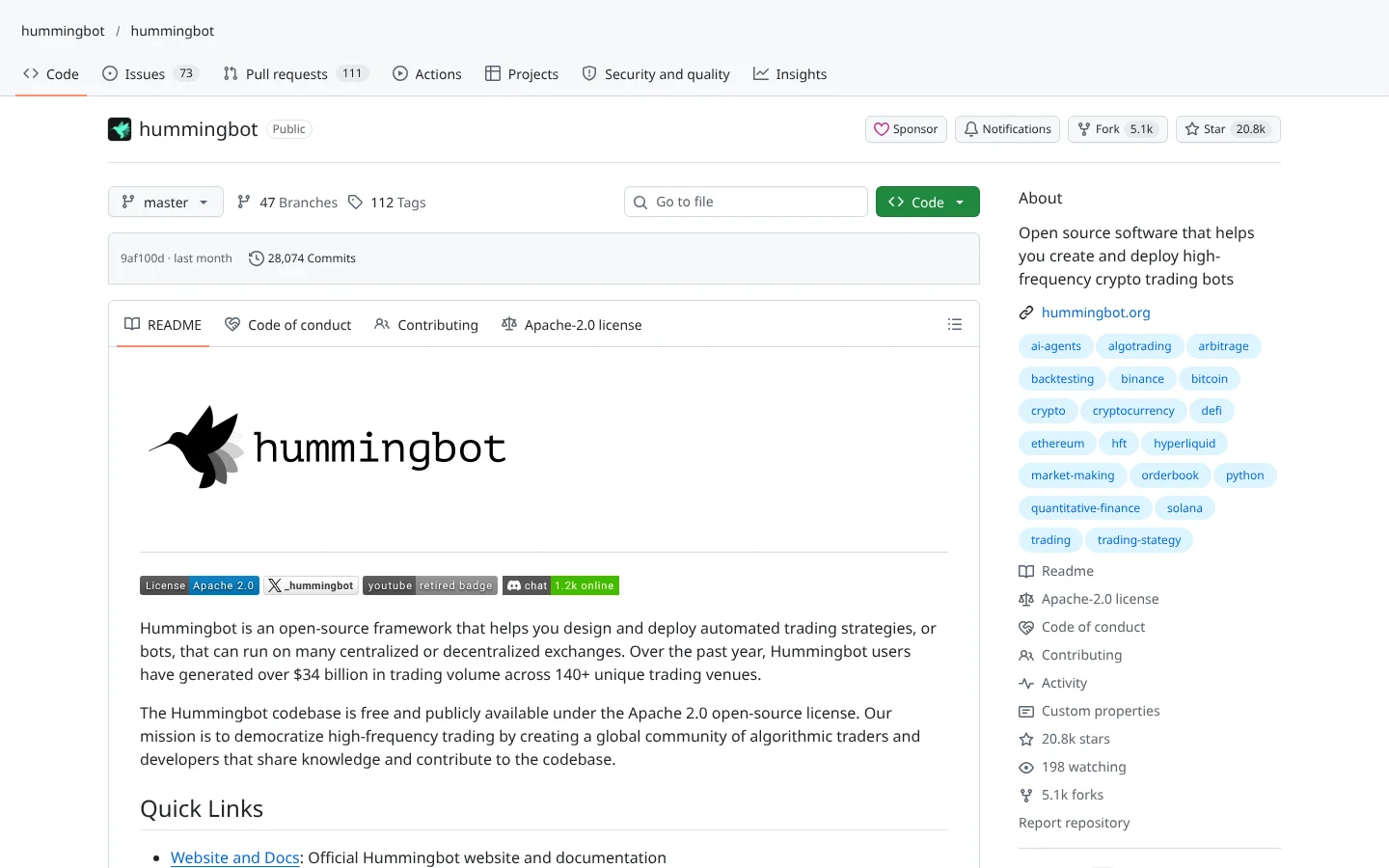
This is a repo (a project's folder of code on  GitHub) with more than 20,000 stars and an Apache 2.0 license. Its stated mission is to bring high-frequency trading tools to everyone, and the README reports more than 34 billion dollars of trading volume across 140 or more venues in the past year. It specializes in two strategies most retail bots ignore: market making and arbitrage. Those are the strategies professional trading firms run all day, which tells you both why they work and who you are competing against.
Market making means placing both a buy and a sell order around the current price and earning the small gap, called the spread, when both fill. Arbitrage means buying where something is cheaper and selling where it is pricier at the same time. The framework offers single-file Python scripts, reusable V2 controllers, and building blocks called executors for grid, DCA, TWAP and arbitrage orders. A paper trading connector simulates trades against live Binance prices with no API keys needed.
Its reach is wide, which is the real reason people pick it over a hand-rolled script. Centralized exchange connectors include Binance,  Coinbase,
 Kraken,
 OKX,
 Bybit,
 KuCoin,
 Gate.io,
 Bitget,
 Gemini and more. On-chain order books include
 Hyperliquid,
 dYdX and
 Injective, and a middleware layer called Gateway reaches decentralized exchanges such as
 Uniswap,
 Jupiter,
 Raydium and
 PancakeSwap. A separate official MCP server lets AI assistants like Claude or
 Gemini CLI check balances, view markets and deploy bots through the Hummingbot API.
Community Score
87 / 100
GitHub data checked 2026. Community read: mixed.
Works with
Good fit if you are
Skip it if you are
Sentiment is mixed. People respect it as a strong open-source market-making framework, and the team behind it runs training through  Botcamp and hosts trading competitions. Few free tools give retail traders this kind of plumbing.
The day-to-day reviews are rougher. In the project's subreddit, users say it is hard to get running, report no working backtest for their custom V2 strategies, and suggest that much of the profit people saw came from liquidity-mining rewards (exchanges paying bonuses for providing liquidity) rather than the trading itself. Some describe the subreddit as inactive. None of that means the code is bad. It means the gap between downloading the software and running a profitable desk is wider than the marketing implies.
“I can't even get it to run properly.”
 Unlikely-Passage-653, r/Hummingbot, 2026
What they like
What they complain about
 Docker Compose, then run make setup, make deploy and make link-cli from the cloned repo. The source install path needs
 Anaconda or Miniconda instead.
 Binance prices with no keys and no money.
 Claude manage bots, run the project's API server, then the official MCP server through Docker or uv. Put the API credentials in its .env file, never in chat.
Exchange accounts with API access
Centralized exchange connectors use API keys; on-chain venues use wallet keys.
BinanceCoinbaseKrakenOKXBybitKuCoinGate.ioBitgetHyperliquiddYdXDocker or Conda
Docker is the simplest install; the source install uses an Anaconda or Miniconda environment.
DockerAnacondaAn always-on server
Market-making bots must run around the clock to keep orders updated as prices move.
A crypto wallet for DEX trading (optional)
Decentralized exchanges reached through Gateway need wallet keys and funds on that blockchain.
UniswapJupiterRaydiumPancakeSwapAn AI assistant (optional)
The official MCP server supports Claude and Gemini CLI for bot management through the project's API.
ClaudeGemini CLIInventory risk
Market makers end up holding whatever the crowd is selling. In a sharp drop, your bot keeps buying, and spread income cannot cover the loss.
Reward-driven profits
Users say much historical profit came from liquidity-mining rewards. When an exchange ends a program, the edge can disappear overnight.
Hard setup
Users report struggling to get the bot running at all. Budget real time for Docker, configs and connector errors.
Limited backtesting for custom work
The README says V2 controllers can be backtested, but users report gaps for custom V2 strategies. Expect paper trading to carry more of the testing load.
Key and wallet security
Bots hold live keys and sometimes wallet keys. A compromised server can mean drained funds, so lock it down and disable withdrawals.

Keep reading across FullStack Alpha
Not ready to run code yourself? Our hands-on AI stock tool reviews on AIStockPickerApp.com score finished products on five pillars, the AI stock tools directory at AIStockPickerApps.com sorts 200+ tools by the job they do, and AIStockTradingBots.com walks through broker APIs, bot setup and backtesting step by step. Or head back to the Trading Workflows home page to match tools to your own routine and budget.
96ScoreFreqtradefreqtrade/freqtradeThe most widely used open-source crypto bot, with FreqAI for models that retrain on rolling data.
★ 56k stars · Intermediate · updated 2026-10
 80Score
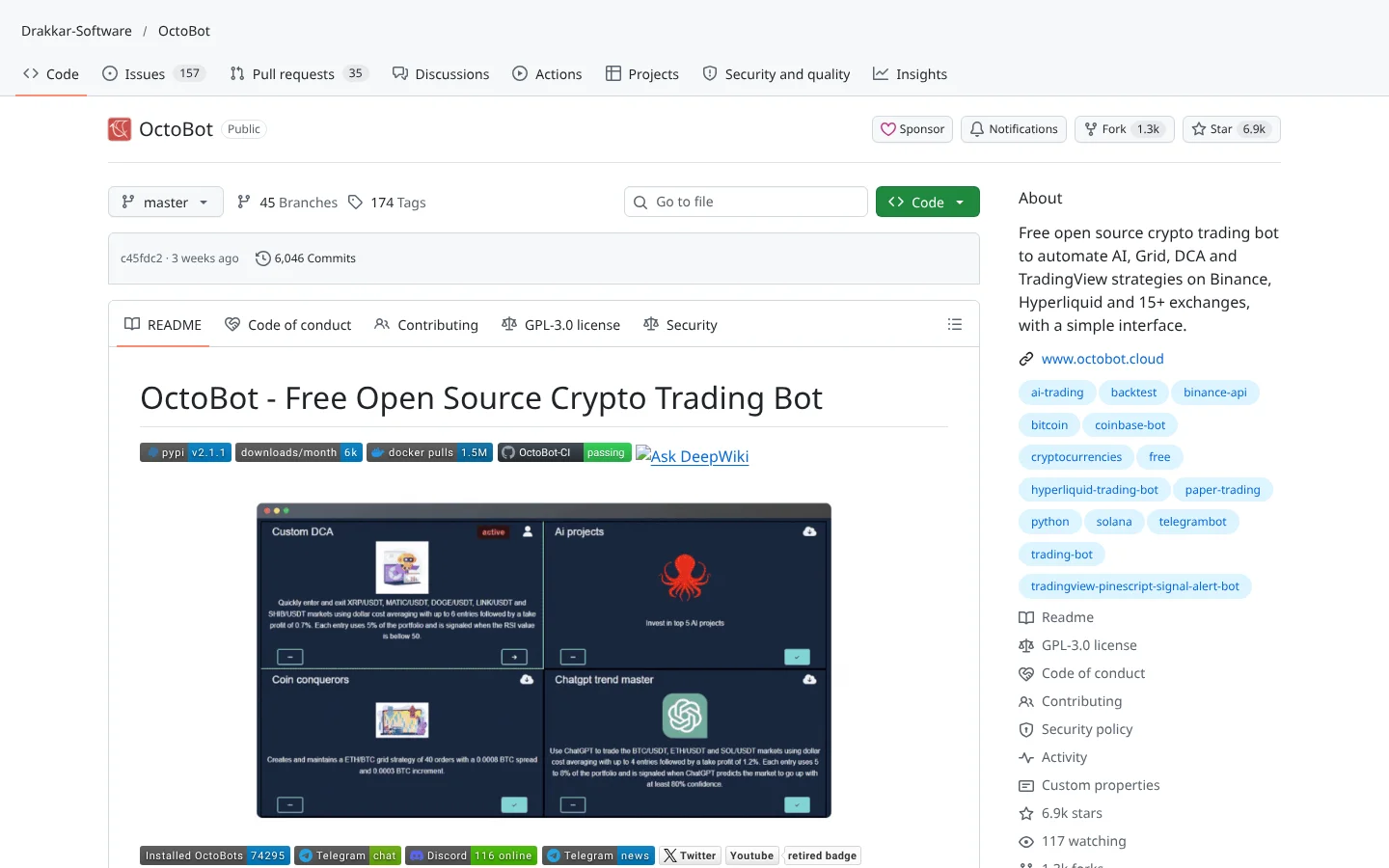
 OctoBotDrakkar-Software/OctoBot
A modular crypto bot with a web interface, aimed at people who would rather click than code.
★ 6.9k stars · Beginner · updated 2026-10
 80Score
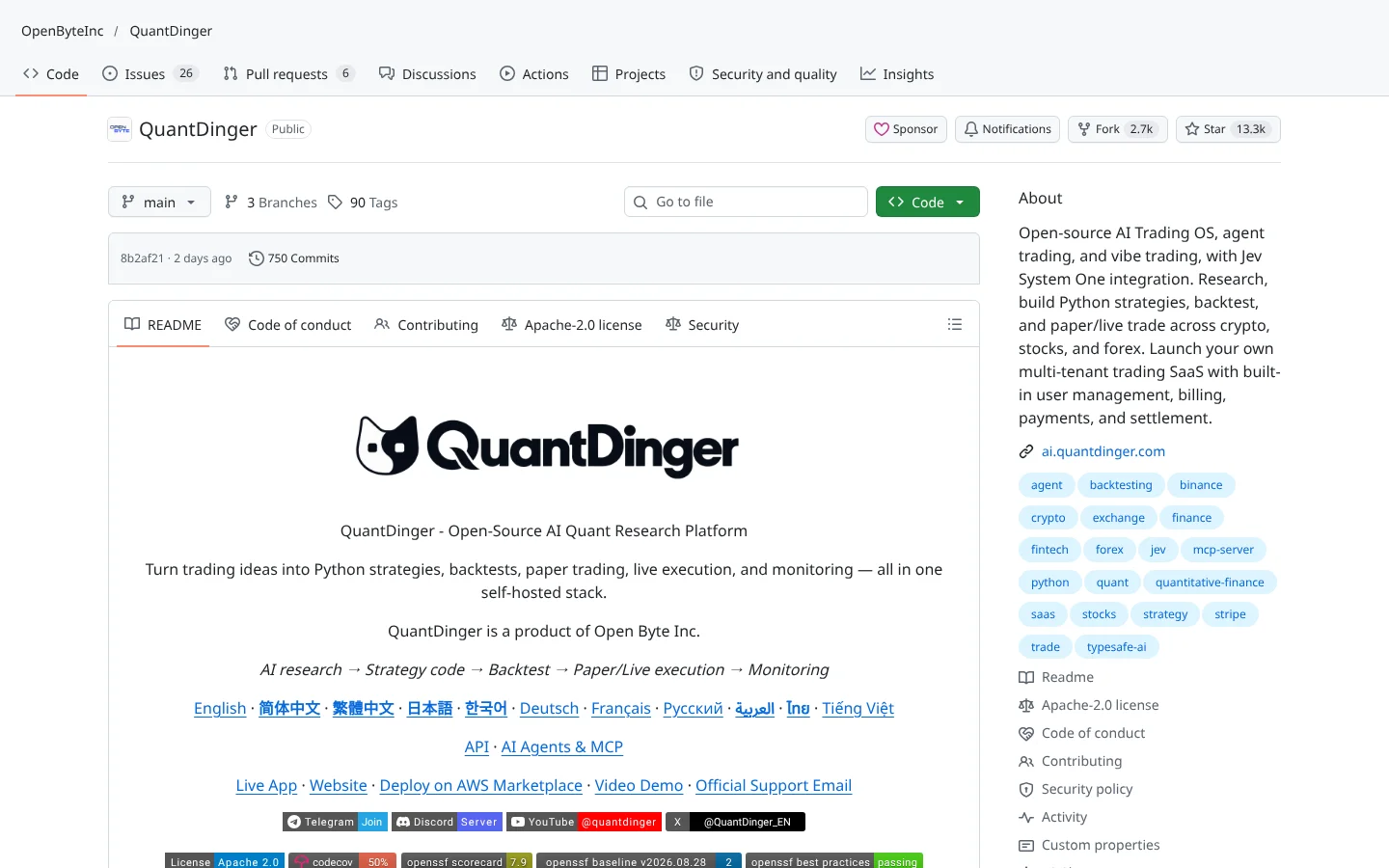
 QuantDingerOpenByteInc/QuantDinger
A self-hosted AI trading operating system covering research, backtests and paper or live trading.
★ 13k stars · Intermediate · updated 2026-10
Hummingbot is the most complete free market-making framework on GitHub, and our Community Score of 87 credits strong adoption, active maintenance and a permissive license. The connector list and the new AI tooling are impressive for open-source software.
But market making is a professional's game, played on razor-thin spreads against firms with faster machines. If users cannot get Hummingbot running and profits leaned on reward programs, that tells you where the edge actually was. Paper trade for weeks, measure honestly, and only scale if trading itself, not bonuses, pays the bills. Pick it if you are technical and curious about how liquidity really works. Skip it if you wanted passive income.
Yes. It is open source under the Apache 2.0 license and free to download from GitHub. Your costs are exchange fees, a server and any blockchain gas fees on decentralized exchanges.
It can be, but there is no promise. Reddit users report that much of the profit people saw came from liquidity-mining rewards, and market making carries real inventory risk. Paper trade first and measure results without rewards.
Yes. An official MCP server lets Claude and Gemini CLI check balances, view markets and deploy bots through the project's API. The team also offers Condor, an AI harness controlled through  Telegram or a web dashboard.
Yes. The README shows a paper trading connector that simulates trades on live Binance prices with no API keys. It is the right first step before any real money.
The GitHub repo hosts the code, issues and docs links, and r/Hummingbot hosts user discussion. Some users describe the subreddit as quiet, so the official docs site at hummingbot.org is often the faster route.
Incoming transmission | Free weekly newsletter
FullStack Alpha has tested 200 AI stock tools. Be honest: how many of yours do the same job, and which one did you forget you signed up for?
One email a week fixes that: which tools are worth the money, what they cost right now, and how the traders on this site wire them into a routine. Five minutes to read. Zero noise.
Inside every issue
5 MIN READ
The Verdict
One AI trading tool tested and scored. What it does well, what it costs, and the catch the sales page leaves out.
Price Watch
Price changes and live promos on the tools traders actually use, monthly and annual side by side, so you stop overpaying.
Workflow Teardown
One educator's routine taken apart: the scan, the chart, the tools, and the free swap for every paid one.
Scan of the Week
Exact scanner settings you can copy, pulled from the educator's own lesson with the timestamp.
Process beats prediction. This is the email that keeps your process honest.
FullStack Alpha Network
BestAITradingTools.com
Trading workflows, the tool matchmaker and the GitHub repo directory.