 Charles Schwab
Quick Answer
Ross Cameron's small account day trading strategy is a real, teachable momentum method... and the $105,951.28 result is an extreme outlier that almost nobody watching will reproduce. Both things are true at once, which is why the video deserves a closer read than either the fans or the haters give it. The hook: he turned $2,000 into six figures in 46 trading days with 113 trades, a claimed 70% win rate, and average winners and losers both sitting around $2,000... meaning the edge came from accuracy and scaling, not from some magic 5-to-1 payoff.
What Does Ross Cameron - Warrior Trading Actually Claim?
Cameron claims he grew a $2,000 account into $105,951.28 over 46 trading days using the same momentum strategy he's traded since funding his first account in 2001. The video, published September 16, 2026, runs about 59 minutes and has passed half a million views.
The numbers he puts on screen:
| Claim | Figure |
|---|---|
| Starting capital | $2,000 |
| Ending balance | $105,951.28 |
| Trading days | 46 |
| Total trades | 113 |
| Winners / losers | 80 / 33 |
| Claimed win rate | ~70% |
| Average win / average loss | roughly $2,000 each |
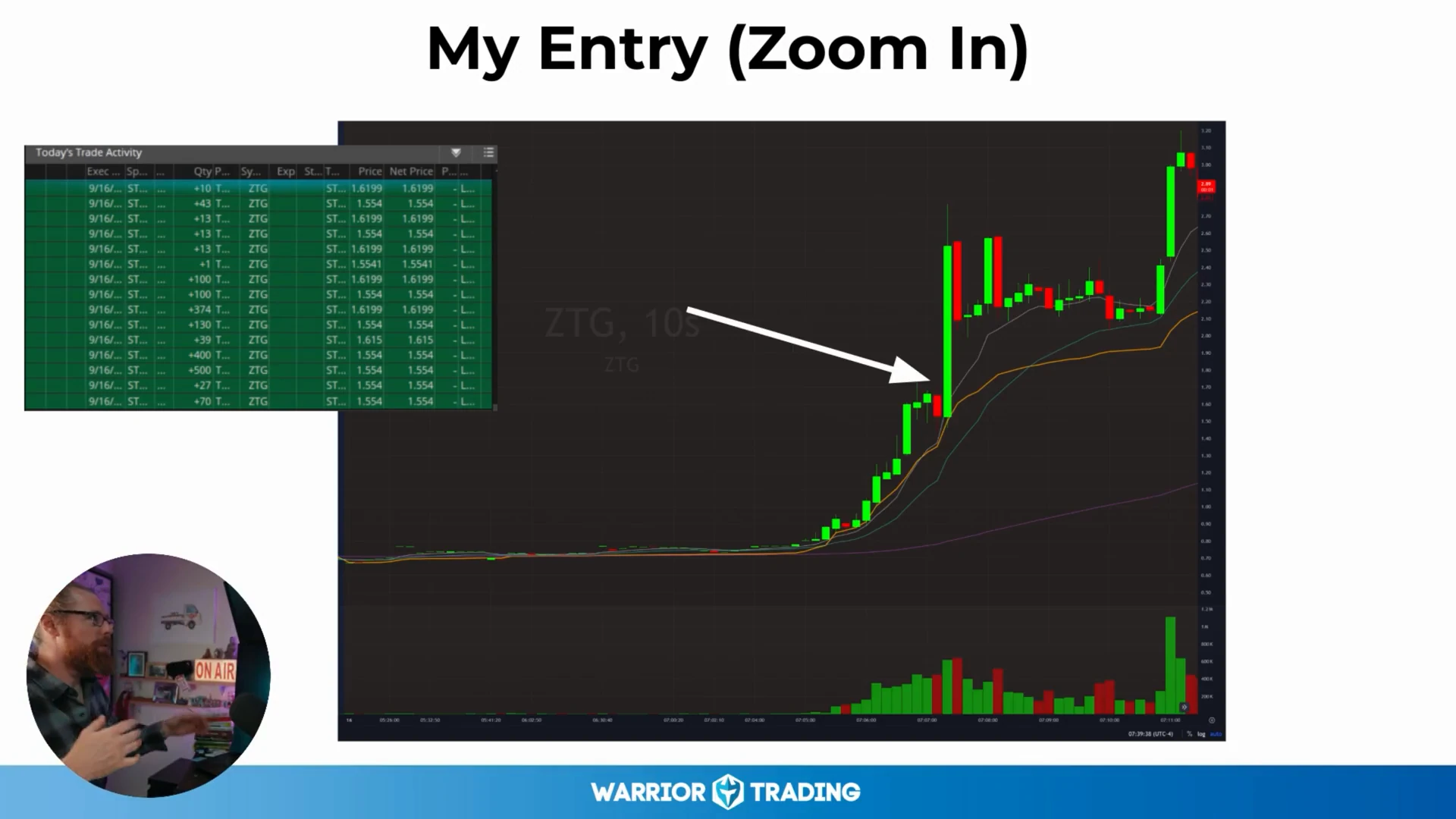
Run the arithmetic yourself: $105,951.28 divided by $2,000 is 52.98. That's roughly a 5,298% gain before commissions, data fees, slippage and short-term capital gains tax. No audit, no third-party verification, no broker statement released publicly. What you get is a trade log and chart shown on screen around (37:23), plus a performance-by-relative-volume chart at (18:00).
To his credit, he front-loads the disclaimer instead of burying it. Within the first minute he asks viewers to make a promise: "I do not want you to put real money on the line until you first proven you can follow these steps consistently" (0:15). He closes the same way, reminding viewers his "results are not typical" (59:07).
He also sells education. Warrior Trading lists Warrior Starter at $797 and Warrior Pro at $2,997, and ran an Open House promo through December 1, 2026 at a $10 entry price. That's context, not an accusation... the demonstration is also a funnel, and you should read it knowing that.
Watch the original: How I Turned $2,000 into $105,951.28 in 46 Days
How Does Ross Cameron's Small Account Day Trading Strategy Work?
The strategy is momentum trading in low-float small caps: find stocks already moving hard on unusual volume with a news catalyst, wait for a pullback and a confirmation candle, enter with a tight stop, and take profit into strength. Everything else is bookkeeping around those four moves.
Here's the whole method, broken down the way he teaches it.
The math: risk vs reward and the accuracy you need to break even
Start with the only equation that matters. Around (3:11) he asks a question most traders never sit with: if you risk $2,000 to make $2,000, how often do you have to be right just to break even?
Fifty percent. Dead even. Every trade below that line is bleeding.
Flip the ratio and it gets ugly fast. Risk $2 to make $1 and you need to be right 67% of the time just to stay flat (4:59). That's the trap most small accounts fall into without realizing it... they take tiny profits and hold big losers, quietly inverting their profit loss ratio until no win rate can save them.
| Risk-to-reward | Break-even win rate |
|---|---|
| Risk $2 to make $1 | 67% |
| Risk $1 to make $1 | 50% |
| Risk $1 to make $2 | 33% |
| Risk $1 to make $3 | 25% |
The interesting wrinkle in his challenge: he wasn't running a fat 3-to-1. Average win and average loss were both near $2,000. A roughly 1-to-1 profit loss ratio with a 70% win rate still compounds hard... but it leaves zero margin for the win rate to slip. Drop to 50% and the whole thing flatlines.
Your profit loss ratio sets the bar. Your accuracy decides whether you clear it.
Why high accuracy starts a positive feedback loop
Cameron argues accuracy isn't just about profit, it's about psychology. And he's right in a way most educators skip.
The destructive loop he describes around (8:32): you buy near the top of a move, refuse to take the small loss, hold through the pullback, then capitulate at the bottom. Bought the top, sold the bottom. Do that enough and you've got shaky self-confidence, a worse profit loss ratio, and a track record that makes you hesitate on the setups that actually work.
Then you hesitate, miss the good one, and chase the bad one. Revenge trading follows. So does overtrading.
The reverse loop runs at (9:40). Raise accuracy and you automatically delete your worst outlier losses... because the trades that turn into disasters are almost always the low-quality ones you took out of boredom. Fewer disasters means a healthier profit loss ratio, which means more confidence, which means you actually pull the trigger on the clean setup when it shows up.
Accuracy is a risk management tool disguised as a performance metric.
Stock selection, in the order he gives it
By (24:20) he's consolidated everything into five filters. A stock has to clear all five before it even lands on the watchlist.
- Up at least 10% on the day. This is a demand signal (15:43). Not up 2% drifting sideways... up double digits, with buyers paying up.
- At least 5x relative volume. Relative volume compares today's volume to the stock's 50-day average. Five times means it's trading five times heavier than normal.
- A news catalyst. Earnings, FDA news, a contract, a guidance raise. Something that explains why anyone cares today.
- Priced between $2 and $20. Cheap enough that a small account can take a real share size, liquid enough to get filled.
- Float under 20 million shares. Float is the number of shares actually available to trade. Small float plus heavy volume equals violent moves.
One example he walks through at (28:42) was up 150% before he considered a single entry, with volume running thousands of times its 50-day average. That's the profile. Not "a stock that looks like it might go."
If you want the scanning side of this handled without staring at five tabs, the day trading tools we've tested and ranked covers the scanners that actually surface these in time.
Why 5x relative volume matters
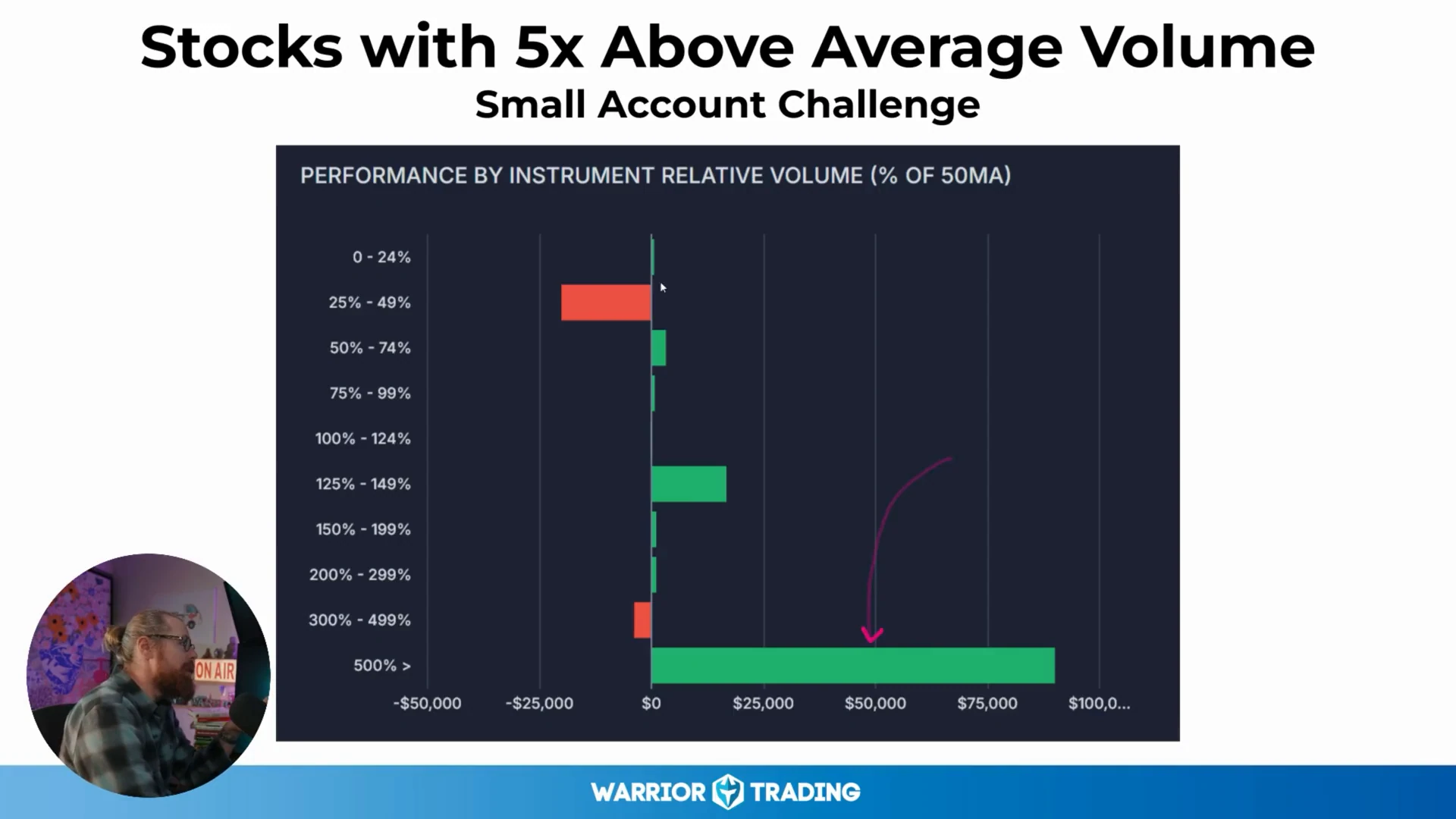
Of the five filters, he's hardest on this one. Around (17:30) he says almost all of his profit has come from stocks hitting five times relative volume or better, with the remainder scraped from names with slightly less. He shows the breakdown on a performance-by-relative-volume chart at (18:00)... worth pausing the video on, because it's the single clearest piece of evidence in the hour.
Why does volume matter more than the percentage gain? Because volume is participation. A stock up 12% on normal volume is one buyer with a market order and a thin book. A stock up 12% on 5x volume has institutional money, retail money, and short sellers all colliding in the same place. That collision is what creates the fast, clean moves a small account needs.
Low volume moves are a mirage. You'll get filled on the way in and stuck on the way out.
Edge case: a stock can clear 5x relative volume on a halt resumption with almost no float available. Those move so fast your stop is theoretical. Skip them until you've got real screen time.
Entries: wait for confirmation instead of anticipating the news
The most useful 30 seconds in the video sits around (19:22). His rule: don't guess at what the catalyst will do, wait for the price action to confirm it.
Gapping up more than 2% in pre-market or after hours is where nearly all of his profit has come from over the last decade. But the gap is the alert, not the entry.
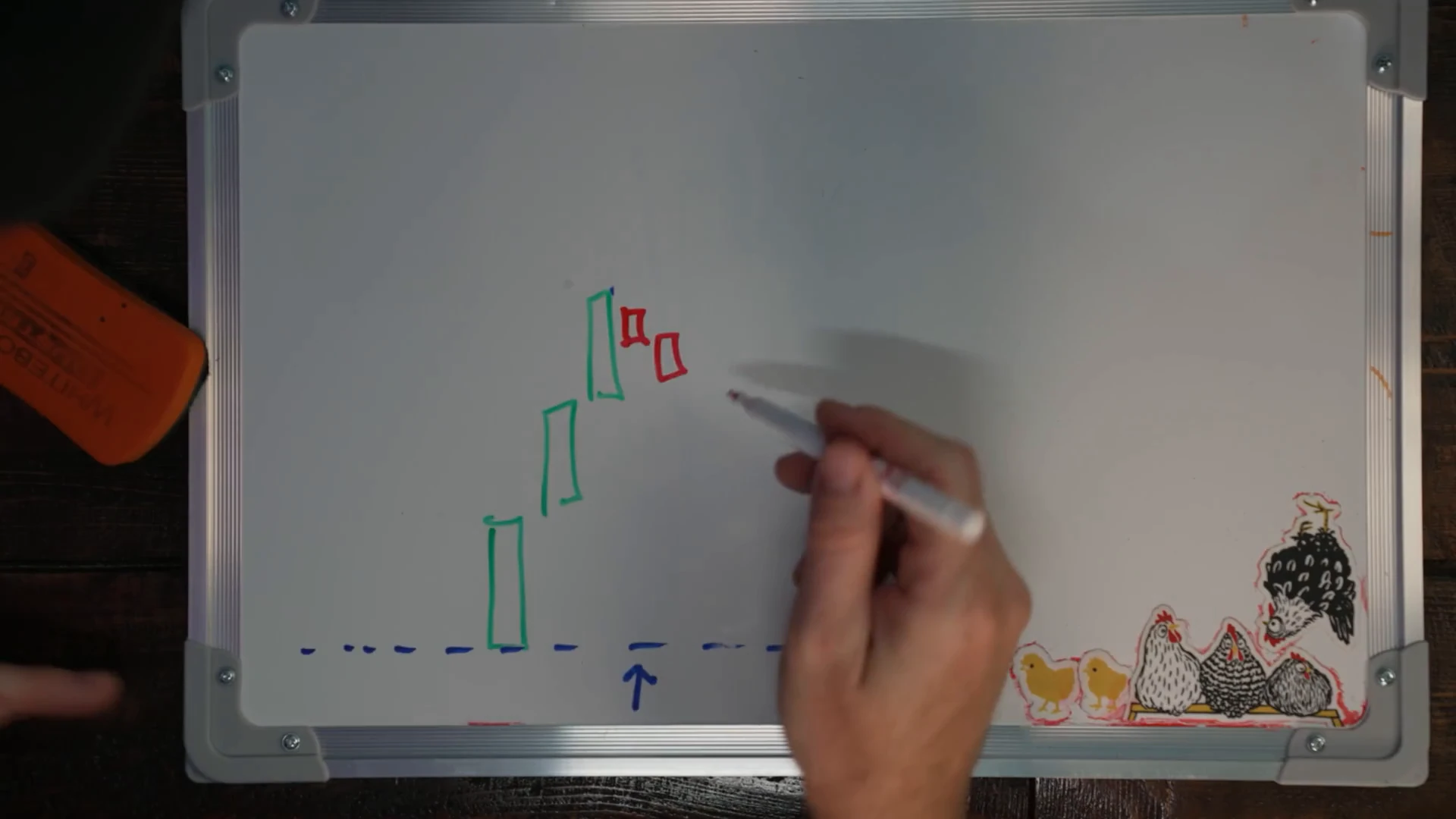
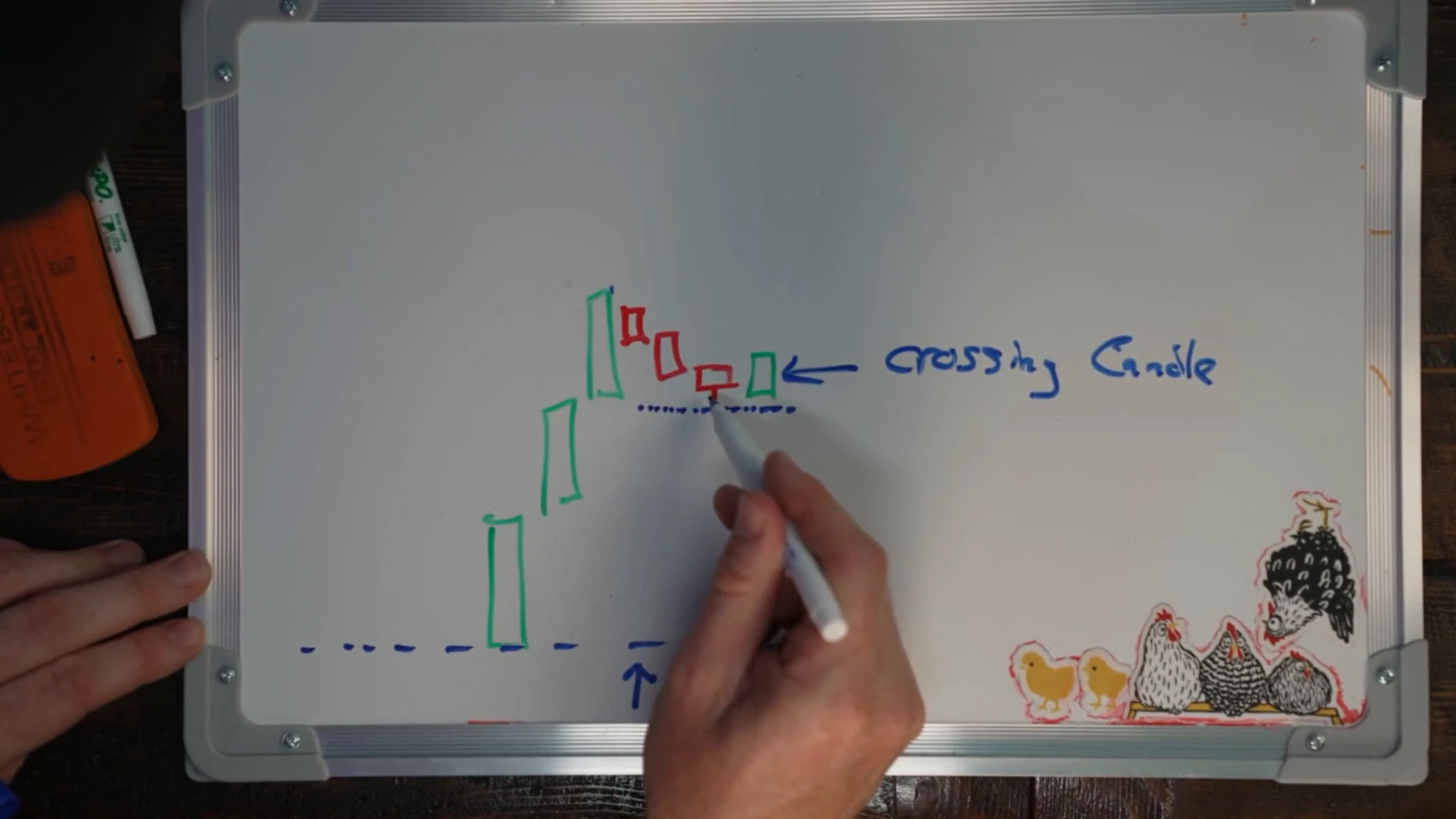
He breaks the entry down at the whiteboard. At (32:15) he draws green candles coming off a base... that tight consolidation where price stops dropping and starts coiling. Then at (34:33) he draws the crossing candle: the one that trades through the high of the previous candle and tells you buyers just took control again.
That crossing candle is the trigger. Your stop goes under the low of the base. Your risk is now defined in cents, not hope.
Why this matters for risk-reward: at (31:45) he points out that entering too high on an extended move means needing to be right 70% of the time just to survive the setup. Not sustainable for a beginner. At (33:32) he shows the same trade from a worse entry... to get 2-to-1 from there, the stock would have to go up another 100%. Possible on a wild day. Not a plan.
The entry isn't where the stock looks exciting. It's where your stop is close.
His own fill is shown in the trade log and chart at (37:23) if you want to see the sequence end-to-end.
Short squeezes: why shorts are forced to cover
At (23:04) he explains the mechanic that makes low float momentum stocks so violent. Short sellers borrow shares and sell them, betting on a drop. When price rips instead, their loss grows with every tick. Push past their max pain and they have no choice: they buy shares back to close the position.
Buying to cover is still buying. It adds fuel to the exact move that's hurting them.
Which is why, as he points out, a stock can run with no real fundamental story at all. The squeeze is the story. For a small float name with 5x volume, that feedback loop can produce 50% to 100% intraday moves on nothing but forced buying.
This cuts both ways. When the covering finishes, the bid vanishes. That's when you get the dead cat bounce that traps every late buyer, and the people who chased the top become exit liquidity.
Knowing when to walk away each day
He flags this early, at (1:16), as one of the weak points in his own challenge... stock selection and exits were fine, but knowing when to stop was the recurring problem.
The fix is boring and it works:
- Set a daily max loss before the open. One number. When you hit it, the platform closes.
- Set a daily goal and respect it. Giving back a green day is its own category of pain.
- Trade the first 60 to 90 minutes. That's when relative volume is real. After 11am the tape gets choppy and setups degrade.
- Cap your trade count. Most small account damage comes from trades 6 through 12, not trades 1 through 5.
The market is open six and a half hours. Your edge is open for about ninety minutes.
His list of mistakes
Around (41:35) he puts his own errors on the whiteboard, which is the part of the video that earns the most credibility. The recurring themes:
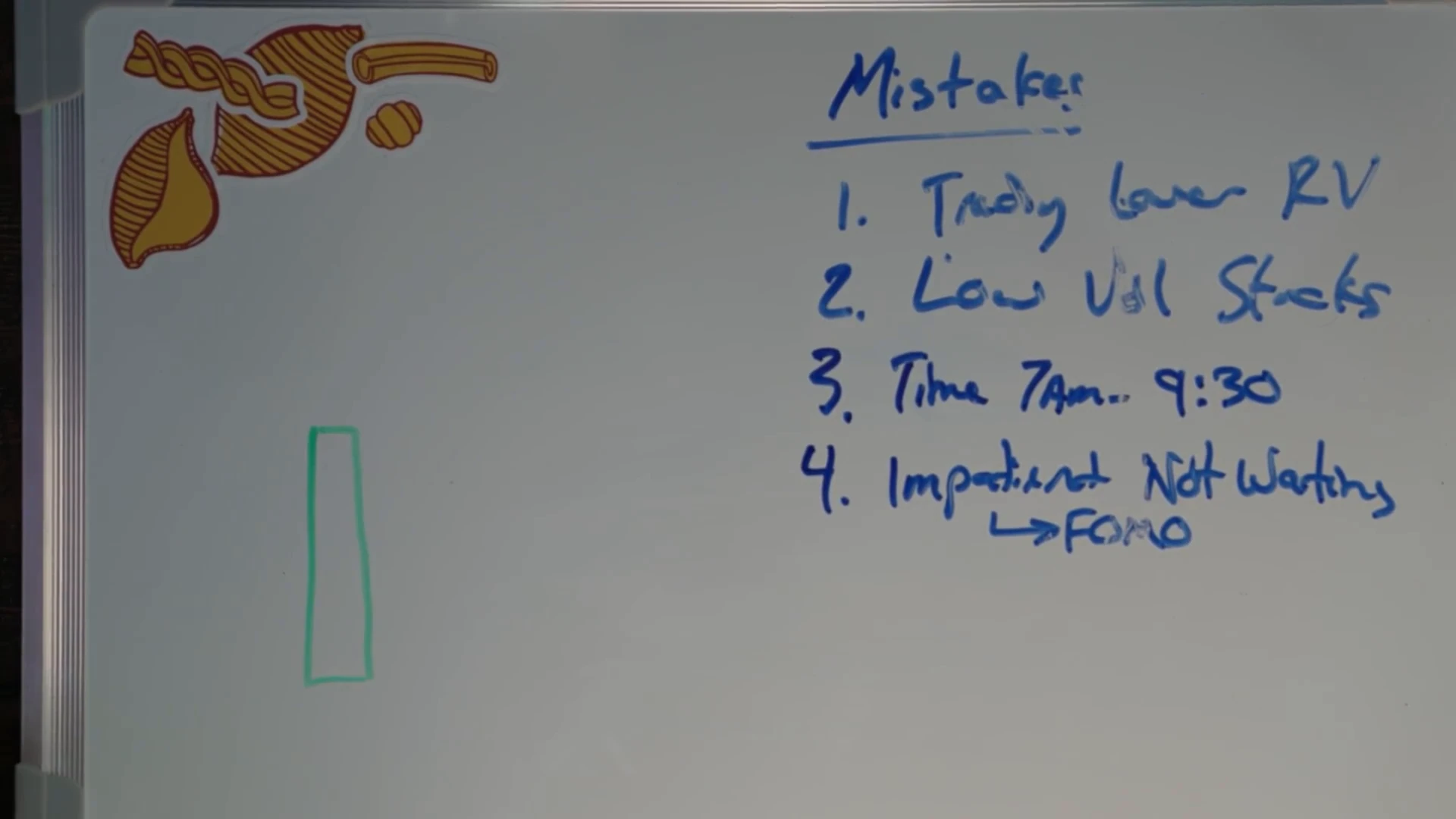
- Entering extended, before a pullback and a base formed
- Sizing too large on a lower-conviction setup
- Trading past the daily max loss instead of walking
- Taking a second-tier stock because the A-grade one didn't appear
- Holding a loser past the stop hoping for the bounce
Notice what's missing: none of these are "I picked the wrong stock." They're all execution and discipline. That matches what most honest trading journals show. If you don't keep one yet, start with a trading journal template and log the mistake category, not just the P&L.
Play stupid games with your max loss, win stupid prizes.
Use the scorecard below to grade a setup against his five filters and pressure-test your own break-even win rate.
⭐ Top 5 Features We Love
Five parts of this small account day trading strategy hold up under scrutiny, independent of whether anyone matches his P&L.
1. The break-even math is taught before the setup. Most trading content opens with a chart. He opens with a question about accuracy (3:11) and doesn't show a single entry until the arithmetic is settled. That ordering is correct, and it's rare.
2. Relative volume is treated as a hard gate, not a nice-to-have. The performance-by-relative-volume chart at (18:00) is the closest thing to evidence in the video. He's not asserting that 5x matters... he's showing where the money actually came from. That's a falsifiable claim, which is more than most educators offer.
3. The entry is defined by stop distance, not excitement. The crossing-candle teaching at (34:33), combined with the warning about extended entries at (31:45), gives a beginner an actual decision rule: if your stop is far away, the trade is already gone. That single filter prevents most chase trades.
4. He shows his own mistakes. The whiteboard list at (41:35) names sizing errors, trading past max loss, and settling for second-tier stocks. A pitch video wouldn't include that section.
5. The disclaimer is in the first 60 seconds and the last 60. "I've paid my dues" (0:50) is the honest framing of a 25-year track record. He explicitly tells viewers to paper trade it first. Compare that to the average YouTube thumbnail with a six-figure number on it.
Worth noting: the structure here (defined filters, defined trigger, defined stop) is exactly what makes a strategy testable. If you want to see whether a rules-based approach survives contact with real data, our breakdown of how to find a trading edge before risking a dollar walks through the testing process.
⚠️ Things to Look Out For
The strategy is sound. The result is not a template. Five things to be clear-eyed about before you try this.
The 5,298% return is an outlier, and the structure makes it one. A $2,000 account that grows to $105,951.28 in 46 days is compounding at a rate that requires both near-perfect execution and a cooperative market. Cameron has 25 years of screen time. He's running this as a demonstration, not as a typical quarter. He says so himself.
No independent audit exists. You're looking at a screen recording of a trade log, not a verified statement. That's not an accusation of fraud... it's a statement about what the evidence can support. Self-reported results from anyone, including people with excellent reputations, sit in a different category than audited ones.
The costs are invisible in the headline. 113 trades on low-float small caps means commissions, locate fees if you short, data subscriptions, and slippage on fast-moving names. Short-term gains are taxed as ordinary income, which in a high bracket can take a third or more of the profit. The net number is not $105,951.28.
The PDT rule changed, but the risk didn't. FINRA replaced the old pattern-day-trader framework with intraday margin requirements effective June 4, 2026, with brokers allowed to transition through October 20, 2027. The $25,000 minimum is no longer universal once your broker has migrated. What stayed: $2,000 remains the minimum equity for leveraged margin trading, brokers can set stricter rules, and FINRA still flags frequent margin trading as high risk. The gate opened. The cliff is still there. You can read FINRA's own summary at finra.org.
It's also a funnel. The video promotes Small Account Study Guides and points toward Warrior Trading's courses, which list at $797 and $2,997. That's a legitimate business model, and the free content genuinely teaches something. Just know you're watching the top of a sales process while you take notes.
Who this is not for: anyone who can't watch a screen from 9:30 to 11:00 ET, anyone trading money they need within 12 months, anyone who hasn't logged 100 simulated trades, and anyone who gets emotional after two losses. Low float momentum is the most punishing category in retail trading. Play stupid games with it and the prizes are predictable.
How Do You Size a Small Account Day Trading Strategy on $2,000?
Start with the loss, not the gain. A small account day trading strategy survives on position sizing, because one oversized loser can erase two weeks of careful wins.
Here's the math on a $2,000 account using a 1% risk rule. This is an example, not Cameron's exact numbers:
- Risk per trade: 1% of $2,000 = $20
- Entry $5.00, stop $4.90: 10 cents of risk per share
- Shares: $20 divided by $0.10 = 200 shares
- Daily stop: three losers, or $60, and you're done for the day
Twenty dollars feels tiny. That's the point. A small account day trading strategy is a compounding machine only if the account is still alive in month three.
Cameron's story shows the upside of a hot streak with growing size. The part most viewers miss is that size only grew after the cushion did. Copy that order of operations, not the headline number, and your small account day trading strategy has a chance.
Flex or Cap? Our Verdict
Scored on four questions.
| Question | Grade | Why |
|---|---|---|
| Receipts shown? | Partial | Trade log, chart and volume performance data shown on screen (18:00, 37:23). No audited broker statement. |
| What can be verified? | Low | Trade count, win rate and balance are self-reported. The strategy mechanics are verifiable and consistent with his published approach. |
| Risk disclosed? | Strong | Disclaimers at 0:15 and 59:07, plus a whiteboard list of his own mistakes at 41:35. |
| Can a regular retail trader repeat it? | The method, yes. The result, almost certainly not. |
Verdict: Flex on the strategy, Need More Receipts on the number.
The teaching is real. The five filters, the break-even math, the confirmation entry, the max-loss rule... all of that is a legitimate small account day trading strategy that a disciplined person can learn and test. Nothing in it is mystical.
The $105,951.28 is a different conversation. Self-reported, unaudited, achieved by someone with a quarter century of experience during a specific stretch of volatile small-cap action. Treat the figure as a marketing artifact and the method as the actual product, and you'll get value out of the hour.
Judge a strategy by its rules, not by the biggest number its author ever posted.
What You Should Know Before You Try It
Six practical moves before you risk a dollar on this small account day trading strategy.
1. Paper trade it for 60 sessions minimum. Not 10. Sixty. Cameron's own request in the first minute is that you prove you can follow the steps consistently and profitably in a simulator first. Track win rate, average win, average loss. If your profit loss ratio is upside down in a simulator, it'll be worse with real money and real adrenaline.
2. Size from your stop, not your gut. Pick a max risk per trade... 1% of account equity is the common starting point. On a $2,000 account that's $20. If your stop is 10 cents below entry, that's 200 shares. The stop distance decides the size. Every time.
3. Price in the full cost stack. Commissions, short locate fees, platform and Level 2 data, and slippage on 5x-volume names that move before your order fills. On small accounts, costs can eat a double-digit percentage of gross profit. Model it before you assume an edge.
4. Know your broker's margin rules post-June 2026. The intraday margin framework replaced PDT, but implementation varies by broker through October 2027. Call them. Ask exactly what their intraday equity requirement is and what happens if you breach it mid-session. The $2,000 margin minimum still applies.
5. Set the daily max loss in the platform, not in your head. Two consecutive red trades is the moment discipline dies. Automate the stop on your day, not just on your trade.
6. Verify, don't trust. Check FINRA and Investor.gov for the rules. Check a tool's actual output before you subscribe. If you're weighing software, our breakdown of what you pay for versus what you get with AI trading software covers where the money actually goes. And if you need a platform that can keep up with 5x relative volume scans, start with the best stock apps for day trading.
Keep reading on FullStack Alpha: our Charles Schwab review, how traders automate rules like these, day trading tools compared side by side, and more Flex or Cap breakdowns.
Frequently Asked Questions
What are some good day trading strategies for beginners?
The simplest starting point is a single momentum setup with a defined trigger and a defined stop, traded only in the first 90 minutes. Cameron's version requires the stock to be up 10%, running 5x relative volume, with a news catalyst, priced $2 to $20, and a float under 20 million shares. One setup, traded 100 times in a simulator, teaches more than five setups traded once each.
Why do 95% of traders lose?
Most losses come from execution, not stock picking. Traders invert their profit loss ratio by cutting winners early and holding losers, then compound it with overtrading and revenge trading after a red session. Cameron's own mistake list at (41:35) is all discipline errors, not selection errors. Costs and taxes finish off whatever edge survives.
Can you day trade with small amounts of money?
Yes, and the rules got friendlier in 2026. FINRA replaced the pattern-day-trader framework with intraday margin requirements effective June 4, 2026, so the universal $25,000 minimum no longer applies once your broker migrates. The $2,000 minimum equity for leveraged margin trading remains, brokers can require more, and FINRA still classifies frequent margin trading as high risk.
How to grow your small trading account?
Through accuracy and position sizing, not bigger bets. Fix your break-even win rate first: if your average win equals your average loss, you need better than 50% accuracy to make anything. Then size every trade off your stop distance at a fixed percentage of equity, and let the account size dictate your share count rather than the other way around.
Can I make $100 a day daytrading?
It's arithmetically possible and behaviorally difficult. On a $5,000 account, $100 is a 2% daily gain, which is far above what most professionals target consistently. Daily profit targets also encourage forcing trades on days with no clean setup. A weekly or monthly target with a hard daily max loss is a more survivable framework.
Can I use AI in trading?
Yes, mostly for scanning and screening rather than decision-making. AI tools are genuinely useful for surfacing stocks hitting relative volume and float criteria faster than you can manually. They're far less reliable at predicting direction. We've put the main options head to head in our review of 10 AI trading tools we tested.
Is Warrior Trading genuine?
Warrior Trading is an established, operating trading education company with public pricing, a long-running YouTube channel, and visible risk disclaimers. Its courses listed at $797 and $2,997 as of late 2026. Being genuine as a business doesn't mean the advertised results are typical, and Cameron states plainly that they aren't. Evaluate the education on its teaching quality, not on his personal P&L.
What's the best small account day trading strategy for beginners?
One setup, small risk, and a hard daily stop. Cameron's momentum approach (high relative volume, a news catalyst, low float) is a common small account day trading strategy, but the sizing rules matter more than the setup for a beginner.
The Takeaway
The number on the thumbnail is the least useful thing in that video. The useful parts are a break-even equation, five stock selection filters, a confirmation entry, and a daily max loss... four things you can write on an index card and test in a simulator tonight for free.
Do this week: open a simulator, write Cameron's five filters at the top of a page, and run one scan each morning at 9:25 ET. Log every stock that clears all five. Don't trade them. Just watch what happens to them by 11:00. After 20 sessions you'll know more about this small account day trading strategy than any course can tell you... because the data will be yours.
Then paper trade it for 60 sessions. Then, maybe, size small with real money.
Fewer tabs, fewer alerts, one process you actually follow. Your market edge starts with the right tool. Stay alpha.
One strategy examined here. 200+ AI stock tools are catalogued in the FullStack Alpha directory, filterable by category, price and what they actually do.
Browse the directory → aistockpickerapps.com