
 90Score
 Qlibmicrosoft/qlib
Microsoft Research's quant platform: data pipeline, factor library and model training in one place.
★ 50k stars · Advanced · updated 2026-10
Quant and ML deep dive
 FinRLAI4Finance-Foundation/FinRL
FinRL is a free, MIT-licensed framework from the  AI4Finance Foundation for training deep reinforcement learning agents to trade stocks, crypto and more on historical data. It fits students and researchers who want to learn how AI trading agents work. The catch: users who tested it report poor results, and the project itself points new users to a successor called FinRL-X.
Think of it as a flight simulator for AI traders: great for learning how the controls work, but nobody should confuse a high score in the simulator with flying a real plane.
Seventeen thousand stars. Dozens of research papers. And the traders who actually ran it say the results are poor. Let's talk about FinRL.
FinRL comes from the AI4Finance Foundation. It trains AI agents by trial and error, the same kind of learning that taught computers to beat humans at Go. Think of a flight simulator for AI traders. Great for learning the controls. A high score isn't flying a real plane.
Five things we like.
One, ready-made market environments, so you skip the plumbing.
Two, five training methods with names like PPO and SAC, all wired up through Stable Baselines3.
Three, a full tutorial using Dow 30 stocks from Yahoo Finance.
Four, connectors to fifteen data sources, including Alpaca and Binance.
Five, a free MIT license and a long research trail.
Now the honest part. On r/algotrading, users report weak results and heavy overfitting. Markets change their rules. Games don't. And the README now sends new users to a successor called FinRL-X.
Best for students and researchers learning how AI trading agents work, not for running money. Scroll down for the scorecard and better alternatives.
This is education, not financial advice. Your market edge starts with the right tool. Stay alpha.
FullStack Alpha Editorial Team
Reviewed by Jay Rocco, Chief Editor
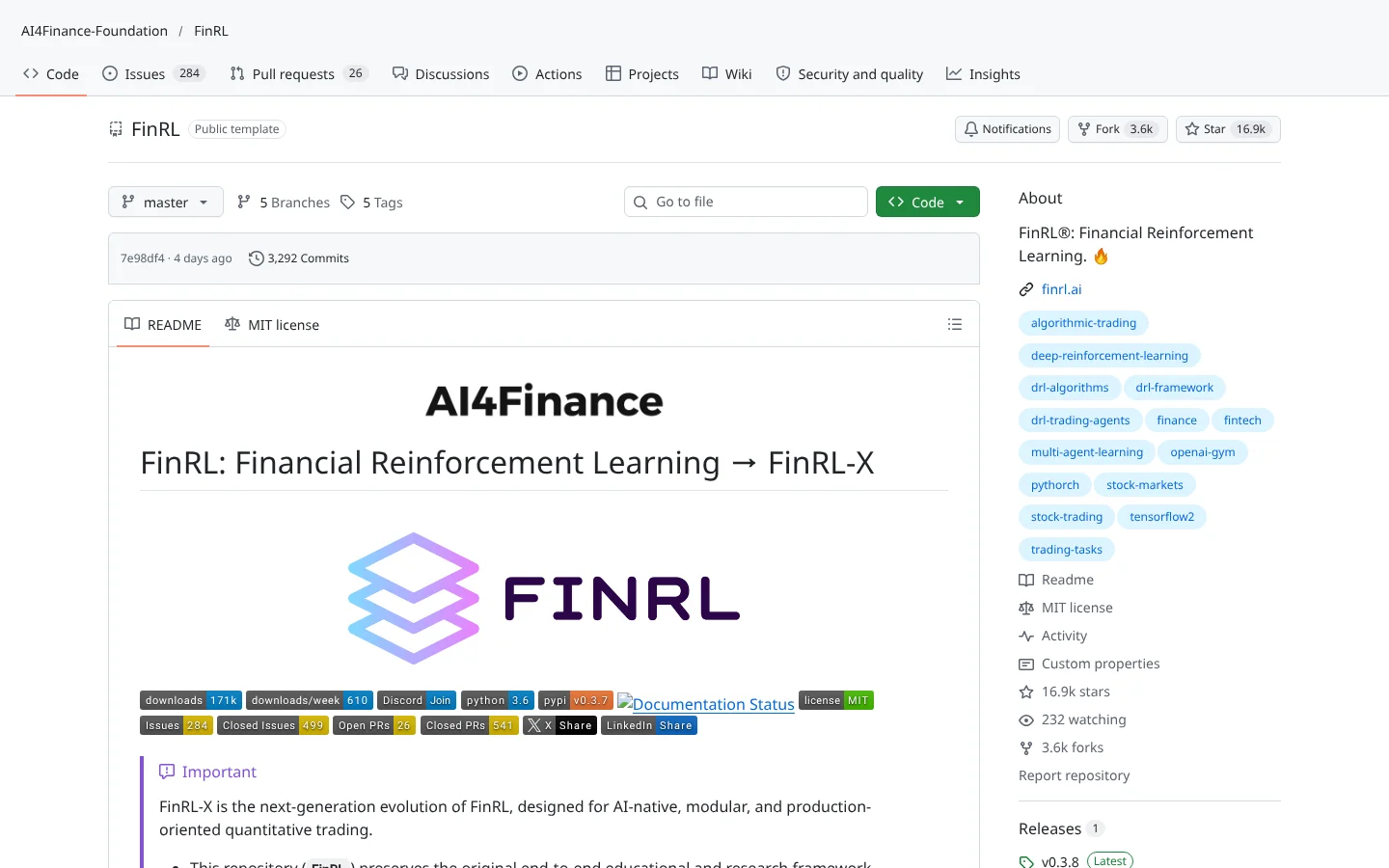
This is a repo (a project's folder of code on GitHub) from the AI4Finance Foundation, and it bills itself as the first open-source framework for financial reinforcement learning. Reinforcement learning is a type of AI that learns by trial and error: it takes actions, gets rewarded or punished, and slowly adjusts. It is how AI learned to beat humans at Go and video games.
The framework applies that idea to markets in three layers. Market environments act like a game board built from historical prices. AI agents, trained with algorithms called PPO, A2C, DDPG, SAC and TD3, play that game by deciding what to buy and sell. Applications on top cover stock trading, portfolio allocation, crypto and high-frequency trading.
The main tutorial walks through the full loop. It downloads Dow 30 stock data from  Yahoo Finance, adds indicators like MACD and RSI plus the VIX volatility index, trains five agents with
 Stable Baselines3, then compares them against a classic Mean Variance portfolio and the
 Dow Jones index. Data connectors reach 15 sources, including Alpaca,
 Binance,
 EODHD,
 WRDS and several Chinese and Taiwanese providers.
Here is the part many reviews skip. The README now promotes FinRL-X, also called FinRL-Trading, as the successor for production and new users. This repo preserves the original framework. The comparison table lists only basic Alpaca support for live trading here, versus multi-account integration and risk controls in FinRL-X.
Why does that matter to a regular trader? Because a framework built for papers optimizes for a clean experiment, not for the messy stuff that decides real results: slippage, fees, data errors, regime changes and a human who panics on a red day. The tutorial chart can look great while ignoring most of what makes trading hard.
Community Score
78 / 100
GitHub data checked 2026. Community read: negative.
Works with
Good fit if you are
Skip it if you are
The reputation splits cleanly. As an academic introduction to reinforcement learning environments for finance, people find it useful. As a way to make money, the verdict from r/algotrading, r/Trading and  Hacker News is negative: weak demonstrated alphas (returns beyond the market), heavy data hunger and a strong tendency to overfit.
That matches what experienced quants say about reinforcement learning in markets generally. Games have fixed rules. Markets change their rules every time enough people find an edge. A model that learned to win 2014 to 2025 may simply have learned 2014 to 2025.
“I did some experimentation with that notebook and the results are poor.”
 DauntingPrawn, r/algotrading, 2022
What they like
What they complain about
 GitHub address from the README, then move into the new folder.
 Alpaca, store the key and secret in a .env file or environment variables, never in a notebook you might share.
A computer with Python and decent memory
Training five agents on years of data takes time and RAM. A GPU helps for larger experiments.
Historical market data
Agents learn from price history. The tutorial uses free Yahoo Finance data.
Machine learning basics
You will tune algorithms like PPO and SAC and judge results critically.
A broker account with API (optional)
Only for the basic live trading hook in the original framework.
Poor results in practice
Users who ran the notebooks report poor results, and the community view is that demonstrated alphas are weak. Do not expect tutorial agents to work live.
Overfitting is the default
Reinforcement learning needs enormous data and markets provide relatively little. Agents easily memorize history rather than learn durable patterns.
Superseded for production
The README directs production and new users to FinRL-X. Live trading here is basic Alpaca support only.
Academic purpose
The project says the code is shared for academic purposes and nothing in it is financial advice or a recommendation to trade real money.
Steep learning curve
Notebooks, RL algorithms and many dependencies make this an advanced tool. Beginners may spend weeks on setup before learning anything about markets.

Keep reading across FullStack Alpha
Not ready to run code yourself? Our hands-on AI stock tool reviews on AIStockPickerApp.com score finished products on five pillars, the AI stock tools directory at AIStockPickerApps.com sorts 200+ tools by the job they do, and AIStockTradingBots.com walks through broker APIs, bot setup and backtesting step by step. Or head back to the Trading Workflows home page to match tools to your own routine and budget.
90ScoreQlibmicrosoft/qlibMicrosoft Research's quant platform: data pipeline, factor library and model training in one place.
★ 50k stars · Advanced · updated 2026-10
 87Score
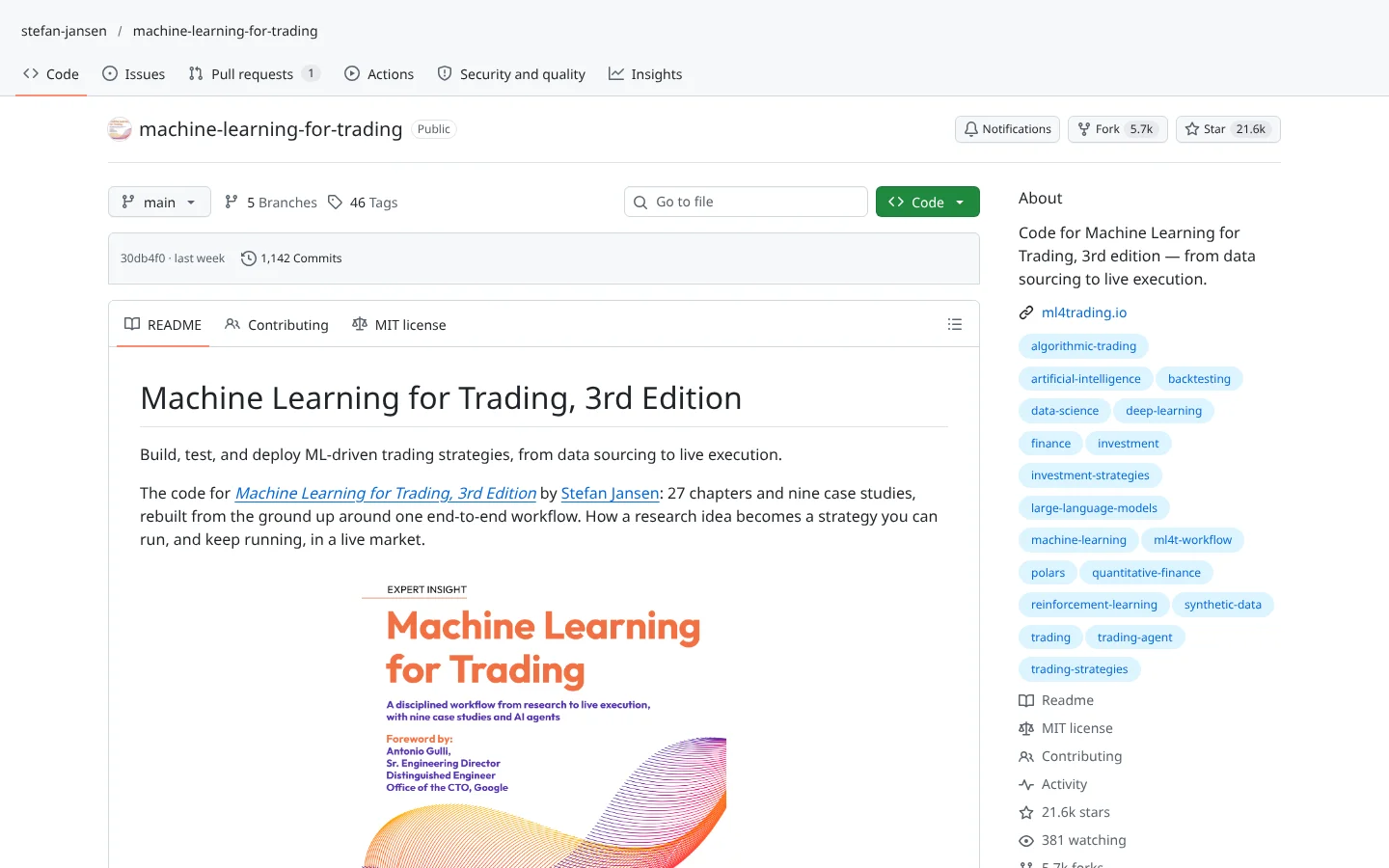
 Machine Learning for Tradingstefan-jansen/machine-learning-for-trading
The companion code to Stefan Jansen's book. Hundreds of notebooks from features to live strategies.
★ 22k stars · Intermediate · updated 2026-10
 60Score
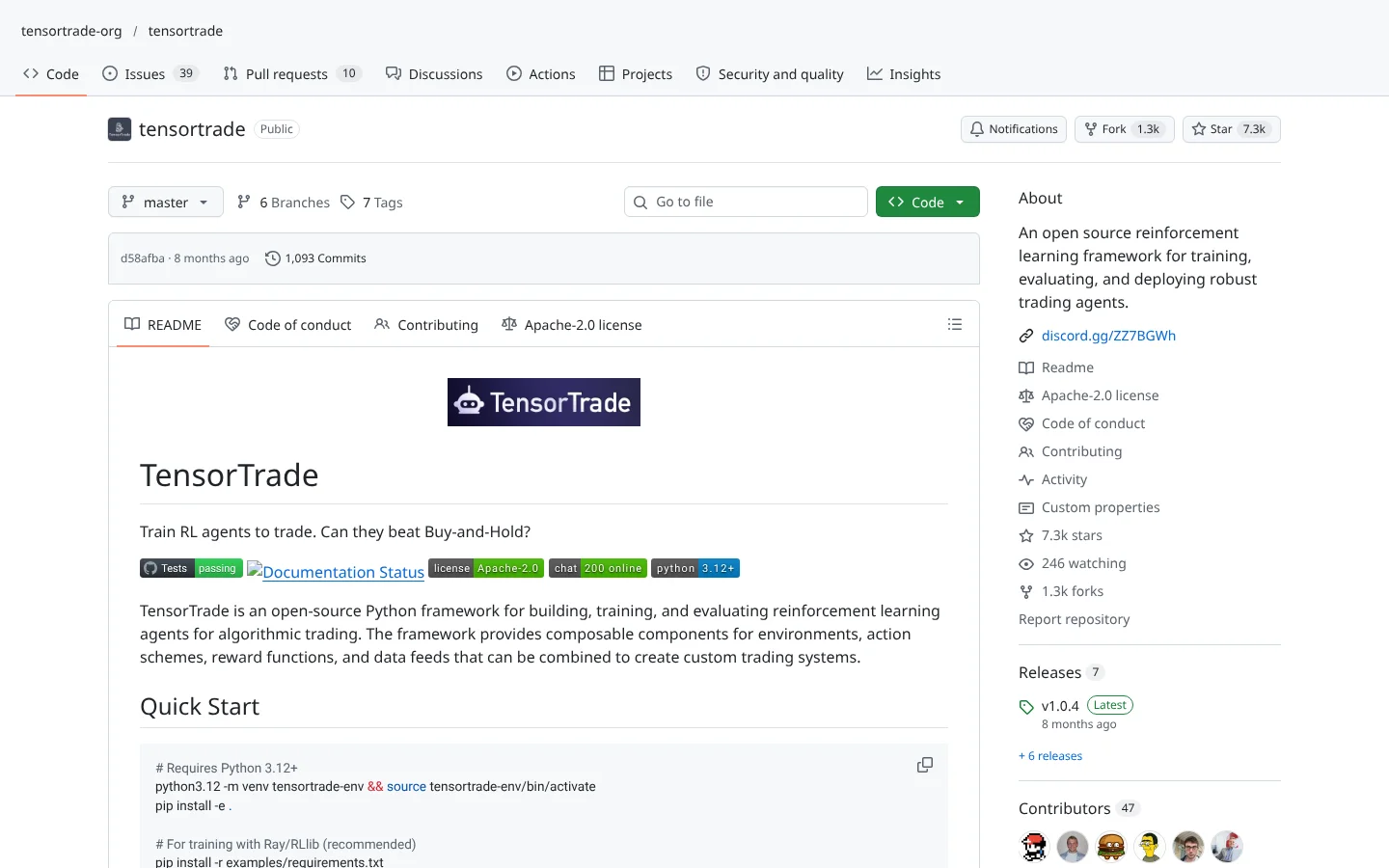
 TensorTradetensortrade-org/tensortrade
A reinforcement learning framework for building and training trading agents.
★ 7.3k stars · Advanced · updated 2026-02
This framework earned its stars as a teaching tool. It made deep reinforcement learning for markets accessible, packaged real data sources, and gave a generation of students a working loop from data to trained agent to backtest. As a classroom, it is excellent.
As a trading system, the evidence says no. Users report poor results, the community flags overfitting, and the project itself points new users to FinRL-X. Use FinRL to learn how AI trading agents think and fail, then build your actual system on simpler, testable rules.
A practical rule for anyone tempted by the tutorial chart: if an agent cannot explain why it bought, you cannot explain why it will keep working. Simple rules you understand, tested honestly and sized small, beat a black box that happened to win on one stretch of history.
It is an open-source framework from the AI4Finance Foundation for financial reinforcement learning. It provides market environments, trading agents and tutorials for training AI to trade on historical data.
Yes. The code is MIT licensed. The FinRL name and logo are trademarks of FinRL LLC, which the license does not cover.
There is no public evidence it does. Users who tested the notebooks report poor results, and the project describes itself as academic, not financial advice.
The original framework lives at AI4Finance-Foundation/FinRL on GitHub. Its README promotes FinRL-X, also called FinRL-Trading, as the successor for production use and new users.
It is a companion project that supplies many of the market environments the original agents train in. It is part of the same AI4Finance ecosystem.
Incoming transmission | Free weekly newsletter
FullStack Alpha has tested 200 AI stock tools. Be honest: how many of yours do the same job, and which one did you forget you signed up for?
One email a week fixes that: which tools are worth the money, what they cost right now, and how the traders on this site wire them into a routine. Five minutes to read. Zero noise.
Inside every issue
5 MIN READ
The Verdict
One AI trading tool tested and scored. What it does well, what it costs, and the catch the sales page leaves out.
Price Watch
Price changes and live promos on the tools traders actually use, monthly and annual side by side, so you stop overpaying.
Workflow Teardown
One educator's routine taken apart: the scan, the chart, the tools, and the free swap for every paid one.
Scan of the Week
Exact scanner settings you can copy, pulled from the educator's own lesson with the timestamp.
Process beats prediction. This is the email that keeps your process honest.
FullStack Alpha Network
BestAITradingTools.com
Trading workflows, the tool matchmaker and the GitHub repo directory.