
 87Score
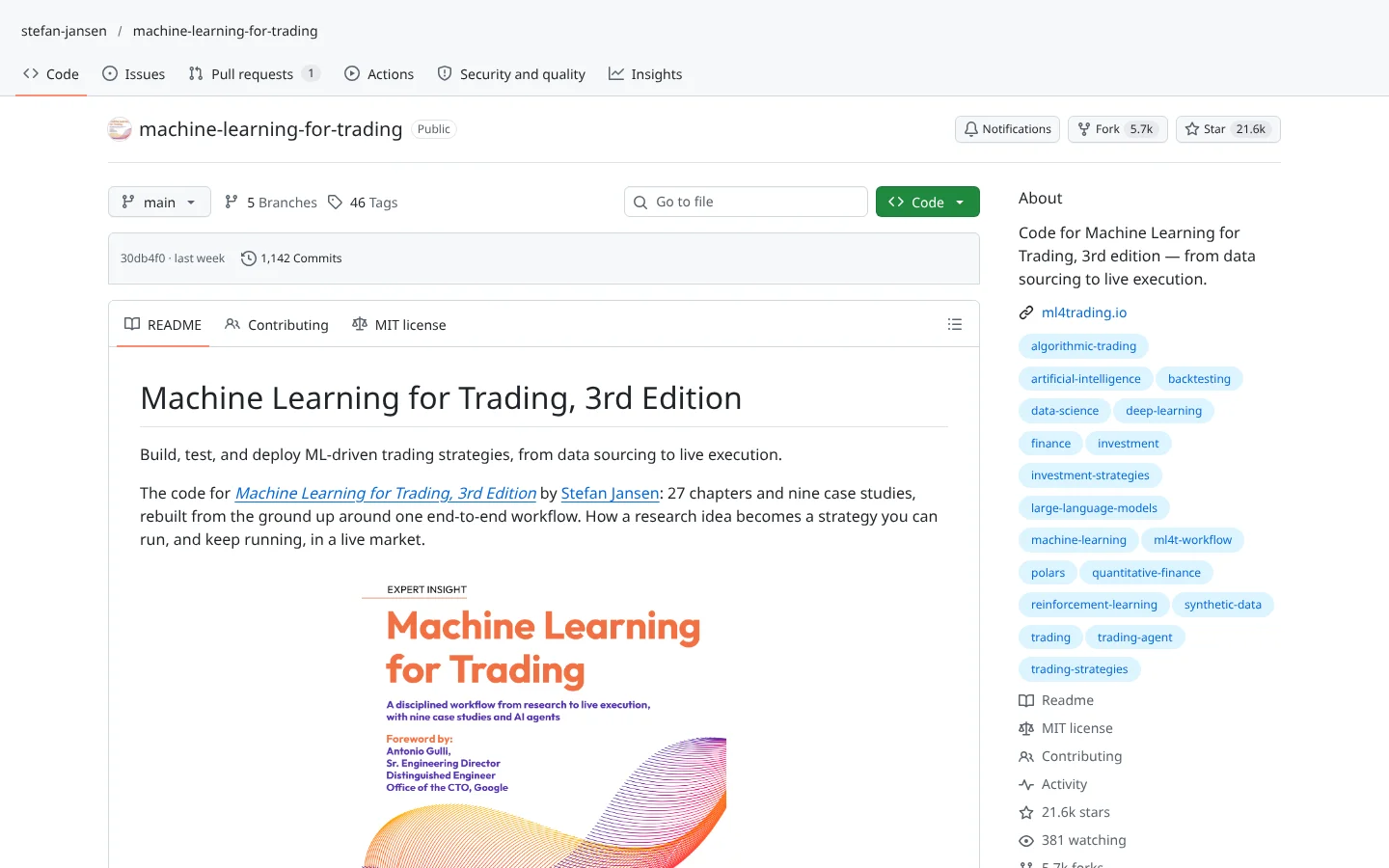
 Machine Learning for Tradingstefan-jansen/machine-learning-for-trading
The companion code to Stefan Jansen's book. Hundreds of notebooks from features to live strategies.
★ 22k stars · Intermediate · updated 2026-10

Quant and ML deep dive
 Qlibmicrosoft/qlib
Qlib is  Microsoft Research's free, open-source platform for building and testing machine learning stock models, from raw data to backtest in one pipeline. It suits quant-curious Python users and researchers who want a serious lab without building one. The catch: its official dataset is currently disabled, the built-in data comes from
 Yahoo Finance, and one
 Reddit quant says he spotted future data leaking into model code.
Think of it as a fully stocked university chemistry lab: every instrument is there, but nobody tells you what to mix, and a dirty beaker can ruin the whole experiment.
Microsoft built a quant research lab and gave it away. Nearly fifty thousand people starred it. Here's why most of them should handle it with gloves.
Qlib is a free platform for building machine learning stock models, from raw data to a tested portfolio. Think of a fully stocked chemistry lab. Every instrument is there. Nobody tells you what to mix.
It's popular because it's complete, and Microsoft Research is behind it.
Five things we like. One, one pipeline from data to backtest. Two, a big library of ready-made models. Three, ready-made signals, called factors, to start from. Four, it pairs with Microsoft's RD-Agent for AI-assisted research. Five, a friendly MIT license.
It works with Python, Docker and Yahoo Finance data, and you hand signals to a broker yourself.
Reviews are mixed. People respect the pipeline. One Reddit quant says he spotted future data leaking into model code. That's one claim, but worth checking.
The real lesson Qlib teaches is process: data, signal, test, then repeat until the idea survives.
Two cautions. The official dataset is currently disabled, so your data is on you. And there's no execution layer. It researches. It doesn't trade.
Best for quant-curious Python users who know some machine learning. Scroll down for setup steps and simpler alternatives.
This is education, not financial advice. Your market edge starts with the right tool. Stay alpha.
FullStack Alpha Editorial Team
Reviewed by Jay Rocco, Chief Editor
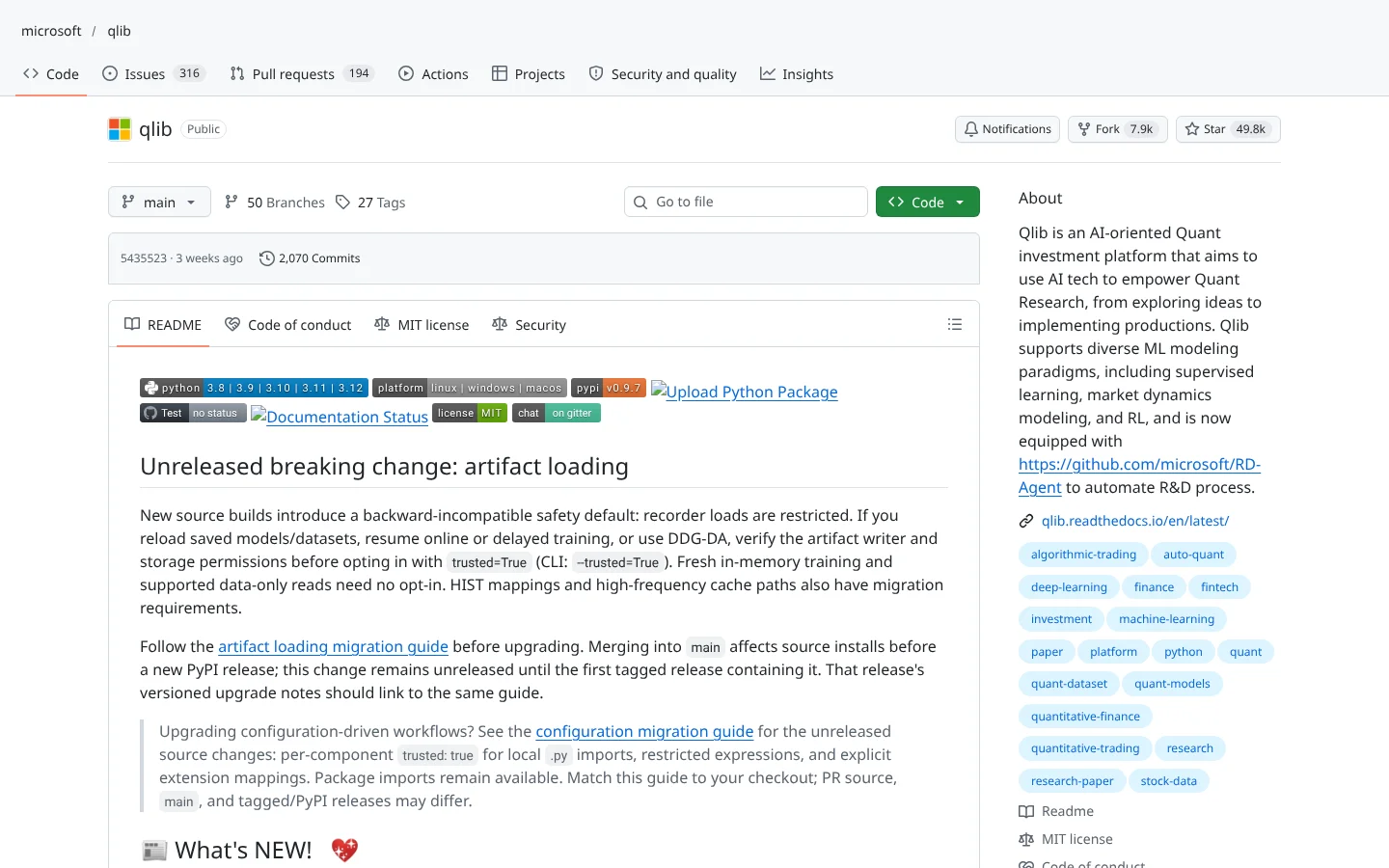
This is a repo (a project's folder of code on  GitHub) from Microsoft Research with nearly 50,000 stars. It is a research platform, not a trading bot. It covers the full machine learning pipeline: loading price data, turning it into signals called factors, training models, and running a backtest (replaying a strategy on old prices to see what would have happened).
The model shelf is deep. It ships ready-made versions of LightGBM, XGBoost, CatBoost, LSTM, GRU, Transformer and more than a dozen research models, plus factor sets called Alpha158 and Alpha360. One command, qrun, runs a whole experiment from a config file: build the dataset, train, backtest and score. It also includes reinforcement learning for order execution and a sister project, RD-Agent, that uses large language models to mine new factors automatically.
What it does not do is trade. Think of the output as a ranked list of stocks with predicted returns, not a set of orders. There is no broker connection in the README, and the data story is shaky right now. The README says the official dataset is temporarily disabled and points to a community source instead, and warns that the Yahoo Finance data it collects might not be perfect. Microsoft is telling you to bring your own clean data, and you should listen. A pipeline this powerful amplifies whatever you feed it, good or bad.
Community Score
90 / 100
GitHub data checked 2026. Community read: mixed.
Works with
Good fit if you are
Skip it if you are
Community sentiment is mixed, and there is less of it than the star count suggests. Supporters on r/quant and r/ai_trading see it as a solid foundation for a research pipeline, especially paired with RD-Agent and locally run language models for automated factor research.
Skeptics push hard. Some see the performance claims in its research as outlandish, and one r/quant commenter says he could see data leaks in the model code, meaning future information may slip into tests. That is the cardinal sin of quant research, because it makes a mediocre model look brilliant.
“Also I can see data leaks in the models code.”
Epsilon_ride, r/quant, 2025What they like
What they complain about
 Homebrew.
 Docker image is also available.
Clean historical stock data
The built-in Yahoo Finance data may be imperfect and the official dataset is disabled, so serious work needs your own data.
A Python environment
Everything runs in Python 3.8 to 3.12; Conda or Docker keeps dependencies sane.
DockerA decent computer
Training neural network models on years of stock data takes memory and time. Some workflow scripts run only on Linux for now.
A separate broker for execution (optional)
The platform stops at research. Turning a signal into trades means another tool and a broker account.
Optional AI model access for RD-Agent
RD-Agent uses large language models to propose factors; you supply the model, local or hosted.
Look-ahead data leaks
A community member reports seeing data leaks in model code. If future data slips in, backtests lie. Audit every feature date before believing a result.
Unreliable default data
The README itself warns Yahoo-sourced data might not be perfect, and the official dataset is disabled for now. Bad data quietly poisons every model downstream.
Research results that do not survive
Academic benchmark scores often ignore costs, slippage and capacity. A model that wins on paper can lose real money once trading costs show up. Add realistic fees and slippage to every test.
Maintenance friction
The README flags breaking changes around loading saved models and pandas 2.0 issues in some examples. Expect to fix things yourself.
No execution layer
Nothing here places trades. Every handoff to a live system is a new place for bugs.

Keep reading across FullStack Alpha
Not ready to run code yourself? Our hands-on AI stock tool reviews on AIStockPickerApp.com score finished products on five pillars, the AI stock tools directory at AIStockPickerApps.com sorts 200+ tools by the job they do, and AIStockTradingBots.com walks through broker APIs, bot setup and backtesting step by step. Or head back to the Trading Workflows home page to match tools to your own routine and budget.
87ScoreMachine Learning for Tradingstefan-jansen/machine-learning-for-tradingThe companion code to Stefan Jansen's book. Hundreds of notebooks from features to live strategies.
★ 22k stars · Intermediate · updated 2026-10
 78Score
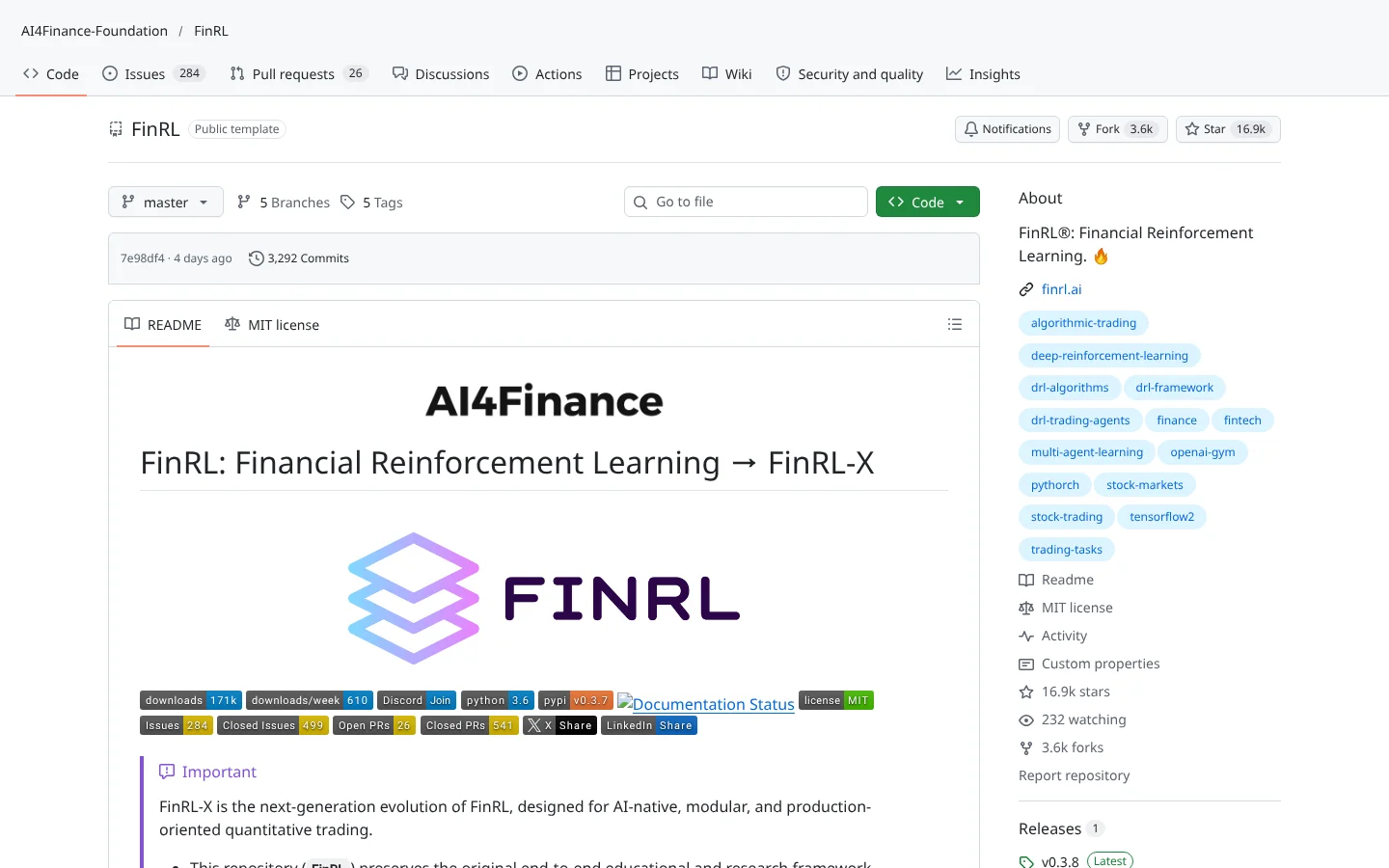
 FinRLAI4Finance-Foundation/FinRL
Deep reinforcement learning for trading, with ready-made market environments.
★ 17k stars · Advanced · updated 2026-10
 60Score
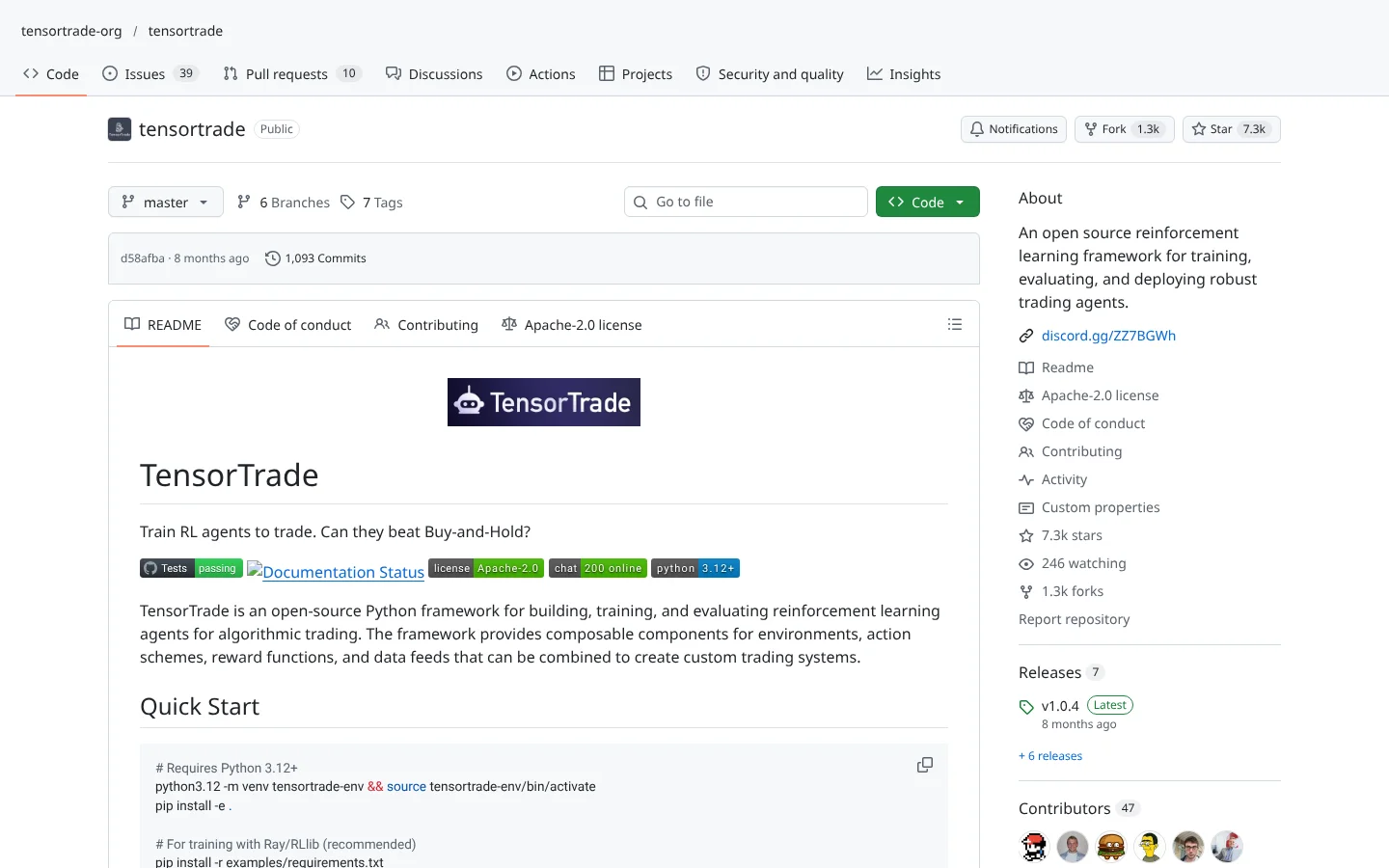
 TensorTradetensortrade-org/tensortrade
A reinforcement learning framework for building and training trading agents.
★ 7.3k stars · Advanced · updated 2026-02
Microsoft Qlib earns its Community Score of 90 on adoption, maintenance and a clean MIT license, but the sentiment score is mixed for good reason. As a free classroom for how quants build stock models, it is hard to beat. You get dozens of models, standard factor sets and a one-command experiment runner.
As a source of money-making signals, treat it with suspicion. The data is your problem, leak claims deserve a careful audit, and nothing here touches a broker. Pick Qlib if you want to learn and research. Skip it if you want a system that trades on Monday.
Qlib is an open-source, AI-oriented quant investment platform from Microsoft Research. It handles data processing, model training and backtesting for stock prediction research in one Python pipeline.
Yes. It is free under the MIT license and installs with pip install pyqlib. Your costs are computing power and any paid data you choose to use.
No. The README describes research, training and backtesting, with no broker connection. You would need a separate execution tool and broker to act on its signals.
Built-in data is collected from Yahoo Finance and the README warns it might not be perfect. The official dataset is temporarily disabled, with a community dataset suggested in the meantime.
The core is built around machine learning models like LightGBM, LSTM and Transformers. Its sister project RD-Agent adds large language model agents that propose and test new factors automatically.
Incoming transmission | Free weekly newsletter
FullStack Alpha has tested 200 AI stock tools. Be honest: how many of yours do the same job, and which one did you forget you signed up for?
One email a week fixes that: which tools are worth the money, what they cost right now, and how the traders on this site wire them into a routine. Five minutes to read. Zero noise.
Inside every issue
5 MIN READ
The Verdict
One AI trading tool tested and scored. What it does well, what it costs, and the catch the sales page leaves out.
Price Watch
Price changes and live promos on the tools traders actually use, monthly and annual side by side, so you stop overpaying.
Workflow Teardown
One educator's routine taken apart: the scan, the chart, the tools, and the free swap for every paid one.
Scan of the Week
Exact scanner settings you can copy, pulled from the educator's own lesson with the timestamp.
Process beats prediction. This is the email that keeps your process honest.
FullStack Alpha Network
BestAITradingTools.com
Trading workflows, the tool matchmaker and the GitHub repo directory.