
 90Score
 Qlibmicrosoft/qlib
Microsoft Research's quant platform: data pipeline, factor library and model training in one place.
★ 50k stars · Advanced · updated 2026-10
Quant and ML deep dive
 TradeMasterTradeMaster-NTU/TradeMaster
TradeMaster is a free, open-source research platform from  Nanyang Technological University (NTU) for building and testing reinforcement learning trading strategies on historical stock and crypto data. It is built for students, researchers, and quants who want standard datasets and benchmarks. The catch: it is a lab, not a trading bot, and the code has seen no updates since June 2025.
Think of it as a university flight simulator for trading algorithms: excellent for training and grading pilots, but nobody is flying real passengers out of it.
FullStack Alpha Editorial Team
Reviewed by Jay Rocco, Chief Editor
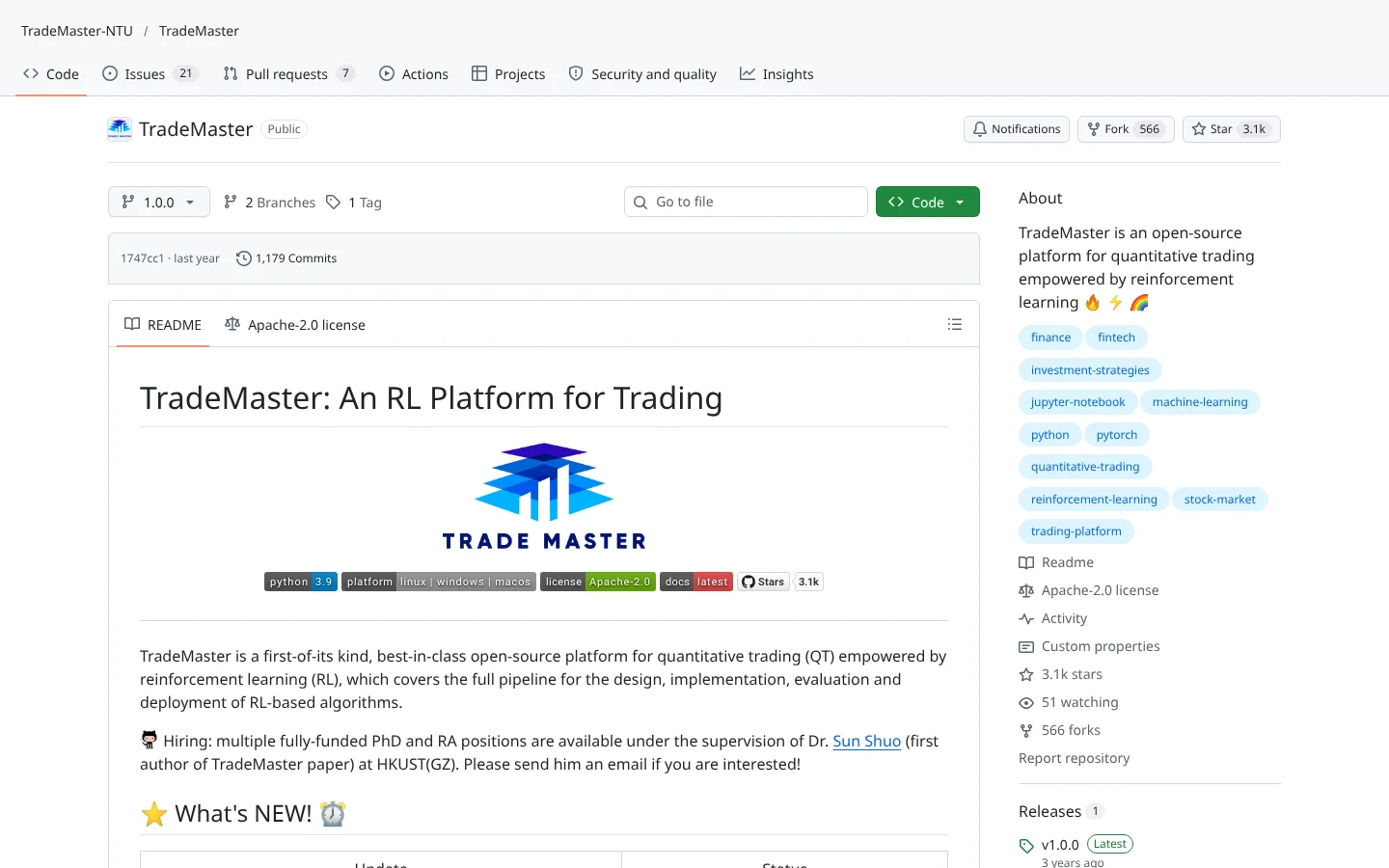
TradeMaster is a GitHub repo (a project's folder of code on GitHub) built by NTU's AMI research group in Singapore. Its goal is to cover the full research pipeline for reinforcement learning in trading: get market data, clean it, drop it into a simulated market, train an AI agent, and grade the result. Reinforcement learning is a type of AI that learns by trial and error, collecting a reward when it does well and a penalty when it does badly.
The README lists six modules: multi-market data, a preprocessing pipeline, market simulators, over 13 trading algorithms, an evaluation toolkit, and interfaces for users from different fields. The algorithms include classics like PPO, A2C, DQN, SAC, and DDPG, plus research models such as DeepScalper, DeepTrader, SARL, and EIIE. The evaluation side, called PRUDEX-Compass, grades strategies on 6 axes and 17 measures, not just raw profit.
Datasets cover the S&P 500 and Dow 30 for US stocks, China's SSE 50, Hong Kong's HS30, daily crypto prices, a Bitcoin order book sample, and some futures data. Most of it is daily bars ending around 2021 or 2022, downloadable from Google Drive or Baidu Cloud. The project's paper was published at  NeurIPS 2023, one of the top AI research conferences.
Here is the market truth. A strategy that wins inside a simulator built on 2021 data has proven it can win inside a simulator built on 2021 data. That is useful for learning and for comparing methods fairly. It is not evidence you will make money next Tuesday. TradeMaster is honest about being a research platform, and you should read it that way too.
So how should a trader use TradeMaster? As a sparring partner for ideas, not a vending machine for signals. Pick one algorithm, run it on one dataset, then deliberately break it: change the date range, add trading costs, test a market it never saw. If the edge vanishes the moment you poke it, TradeMaster just saved you real money, which is the most valuable thing a research tool can do.
Community Score
52 / 100
GitHub data checked 2026. Community read: not enough independent discussion yet.
Works with
Good fit if you are
Skip it if you are
We found no Reddit or Hacker News threads discussing TradeMaster worth citing. That is surprising for a repo with over 3,000 GitHub stars and more than 500 forks (forks are copies people make to build on). The audience appears to be academic, which means discussion happens in papers and classrooms rather than trading forums.
So the stars measure research interest, not trader adoption. Nobody is posting "my TradeMaster bot made money" threads, and that is probably healthy. The bigger concern is maintenance: the score's maintenance component is near the floor because commits stopped in mid-2025.
For a reader weighing TradeMaster, that means one thing: judge it on the README, the tutorials, and the NeurIPS paper, not on social proof. Those are solid. The open question is who will fix it when it breaks.
What they like
What they complain about
 Docker guide. Docker is the safer pick for beginners because it bundles the right versions together.
 GitHub and install from the included requirements file. Expect some dependency errors and budget time to fix them.
 Google Drive or
 Baidu Cloud links in the README.
A capable computer or cloud notebook
Training reinforcement learning agents is compute-heavy. A GPU helps for larger runs, and Colab is an option for the tutorials.
 Google Colab
Python 3.9 environment or Docker
The code targets Python 3.9 and relies on PyTorch and Ray for its algorithms.
Docker PyTorch
The provided historical datasets
TradeMaster runs on downloaded historical data rather than a live market feed.
Google DriveBaidu CloudStale codebase
No pushes since June 2025 and no tagged release since 2023. Dependencies age, bugs stay unfixed, and questions may go unanswered.
Research, not trading
The README does not describe a broker connection or live trading. Anyone selling TradeMaster as a plug-and-play money bot is selling something else.
Old data, simulated markets
Most datasets end around 2021 or 2022. A model trained there has never seen recent market regimes, and simulators skip the friction of real fills.
Steep learning curve
You need comfort with Python, machine learning, and environment setup. This is graduate-level tooling, not a beginner app.
Unclear support path
With commits stopped, GitHub issues may sit unanswered. If you build a thesis or a product on TradeMaster, plan to own and patch your fork.
Keep reading across FullStack Alpha
Not ready to run code yourself? Our hands-on AI stock tool reviews on AIStockPickerApp.com score finished products on five pillars, the AI stock tools directory at AIStockPickerApps.com sorts 200+ tools by the job they do, and AIStockTradingBots.com walks through broker APIs, bot setup and backtesting step by step. Or head back to the Trading Workflows home page to match tools to your own routine and budget.
90ScoreQlibmicrosoft/qlibMicrosoft Research's quant platform: data pipeline, factor library and model training in one place.
★ 50k stars · Advanced · updated 2026-10
 87Score
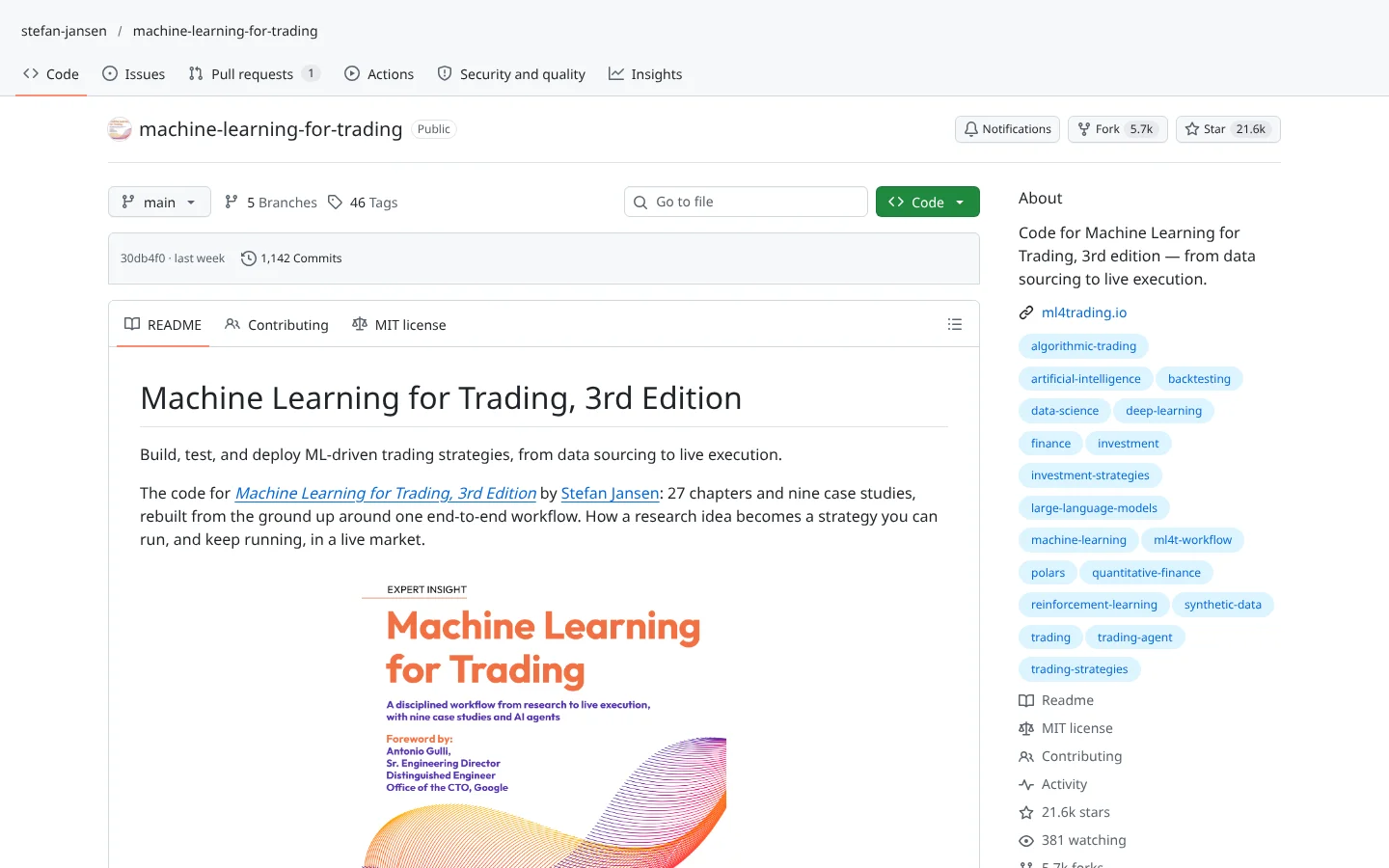
 Machine Learning for Tradingstefan-jansen/machine-learning-for-trading
The companion code to Stefan Jansen's book. Hundreds of notebooks from features to live strategies.
★ 22k stars · Intermediate · updated 2026-10
 78Score
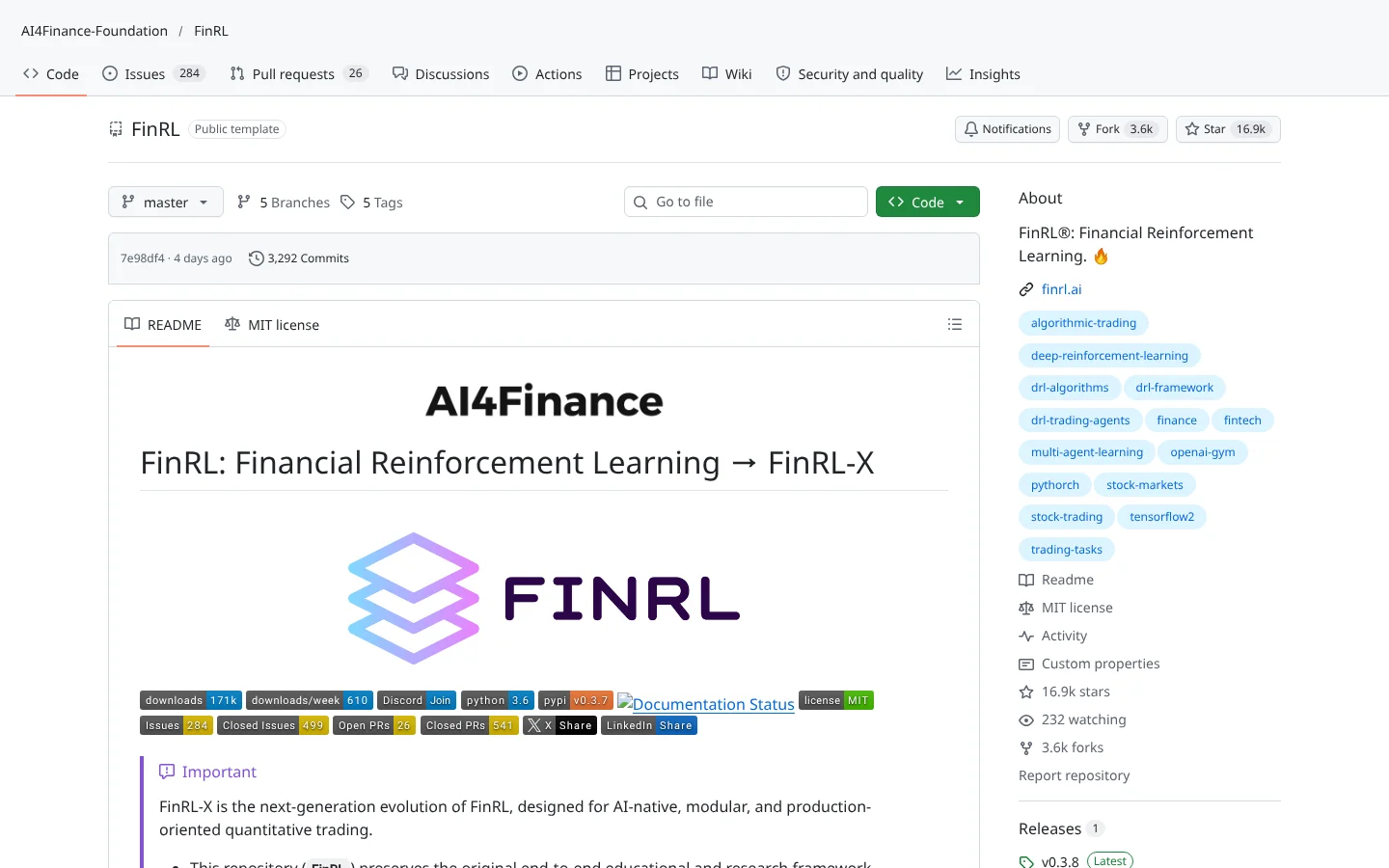
 FinRLAI4Finance-Foundation/FinRL
Deep reinforcement learning for trading, with ready-made market environments.
★ 17k stars · Advanced · updated 2026-10
TradeMaster is a serious piece of academic work. If you want to understand how reinforcement learning behaves on financial data, its algorithm library, datasets, and evaluation toolkit give you a better starting point than most hobby repos. Its 3,000-plus stars reflect that.
Compare that with the hype end of the AI trading market, where screenshots of curves that only go up do the selling. TradeMaster grades a strategy on stability, risk, and robustness across 17 measures, which is closer to how a professional desk thinks. That mindset is worth borrowing even if you never run a line of its code.
For traders, the verdict is narrower. TradeMaster will teach you; it will not trade for you, and the code has gone quiet. Use it as a classroom, fork it if you are a researcher, and keep your expectations anchored in process. A great backtest is a hypothesis, not a paycheck.
TradeMaster is an open-source reinforcement learning platform for quantitative trading from NTU's AMI group. It bundles datasets, market simulators, over 13 algorithms, and an evaluation toolkit for research and education.
Yes. TradeMaster is released under the Apache-2.0 license, so you can use and modify it at no cost. Your real costs are compute time and your own hours.
The README does not describe any live broker connection. TradeMaster is built around historical datasets and simulators, so treat it as a research and backtesting tool.
Not actively. The last code push was in June 2025 and the last tagged release was v1.0.0 in March 2023. Expect to fix dependency issues yourself.
Yes, for research. It includes US, China, and Hong Kong stock index datasets, daily crypto prices, a Bitcoin order book sample, and some futures data.
Incoming transmission | Free weekly newsletter
FullStack Alpha has tested 200 AI stock tools. Be honest: how many of yours do the same job, and which one did you forget you signed up for?
One email a week fixes that: which tools are worth the money, what they cost right now, and how the traders on this site wire them into a routine. Five minutes to read. Zero noise.
Inside every issue
5 MIN READ
The Verdict
One AI trading tool tested and scored. What it does well, what it costs, and the catch the sales page leaves out.
Price Watch
Price changes and live promos on the tools traders actually use, monthly and annual side by side, so you stop overpaying.
Workflow Teardown
One educator's routine taken apart: the scan, the chart, the tools, and the free swap for every paid one.
Scan of the Week
Exact scanner settings you can copy, pulled from the educator's own lesson with the timestamp.
Process beats prediction. This is the email that keeps your process honest.
FullStack Alpha Network
BestAITradingTools.com
Trading workflows, the tool matchmaker and the GitHub repo directory.