Quick Answer
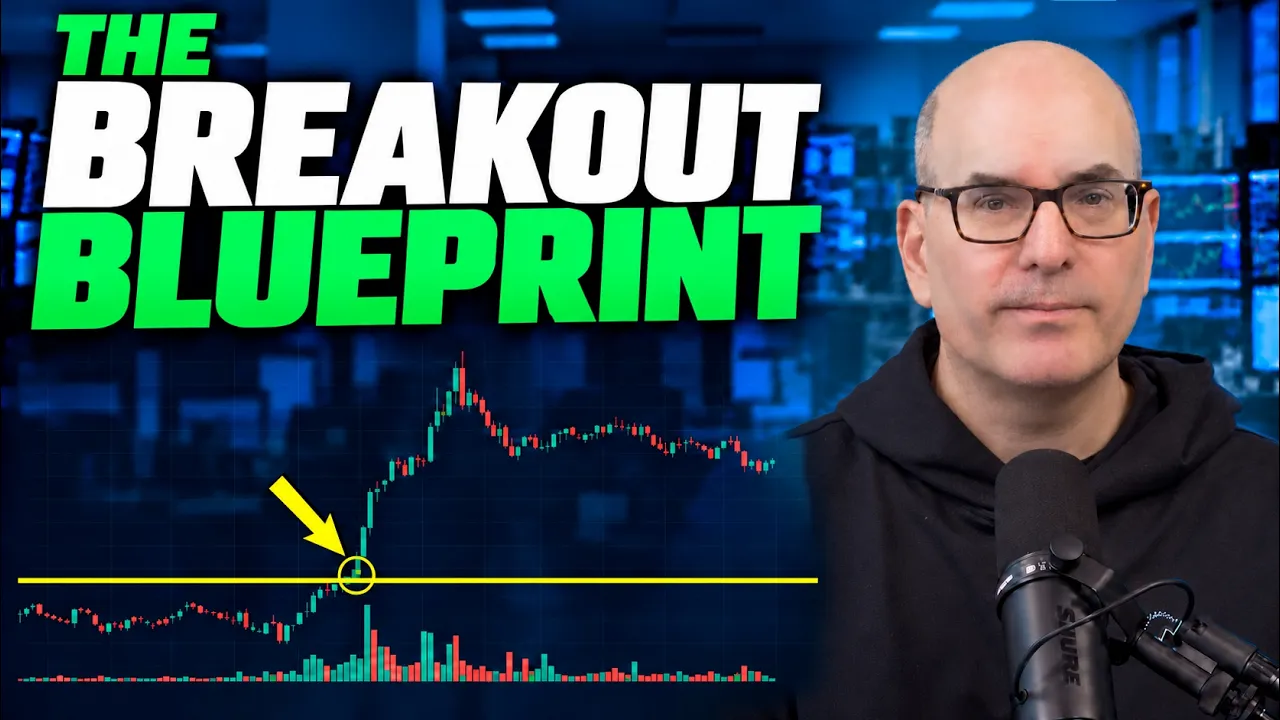
The swing trading rules in this Chart Fanatics episode are a real, coherent filter system, not a get-rich pitch, so the verdict leans Flex with one big asterisk: the receipts are hand-picked winners, not a tracked record. Guest Connor Bates, a 25-year-old asset manager running roughly $50 million, walks through six screening criteria and five entry setups across a 97-minute interview. What he never shows is a win rate, a drawdown number, or an audited equity curve.
Here's the uncomfortable part. The six rules are the easy bit. Any trader can memorize "base, linearity, liquidity, ATR, narrative, catalyst" in under a minute. Almost nobody can sit on their hands while a stock they love fails the checklist. As Bates puts it early on, people let their opinions get ahead of the market (0:12). That's the real strategy, and it's the part no screener sells you.
What Does Chart Fanatics Actually Claim?
The claim is specific: a handful of correctly sized trades per year, each risking a small slice of the account, can carry an entire year. Not a win rate. Not a monthly return. A hit-rate-agnostic, asymmetry-first argument.
The episode (watch it here) was uploaded October 18, 2026 and had roughly 77,300 views and 772 likes by mid-November. Chart Fanatics introduces Bates as a professional asset manager handling about $50 million at 25. The numbers he puts on screen:
| Claim shown | Timestamp | What backs it |
|---|---|---|
| 60-70% move off a moving average level | 0:20, 54:49 | Annotated daily chart |
| Risk of 5-6% on the position, under 1% of AUM | 61:32 | Verbal, no statement shown |
| Base breakout to near-100% in under a month | 37:37 | Chart with stop marked at the lows |
| Minimum average true range around 5% | 7:51 | His scan criteria, verbal |
| A 7-year breakout with 30% short interest | 70:17 | Chart plus float discussion |
His framing on the risk side is the most quotable line in the episode: at worst he loses "5 6% you know, less than 1% of the AUM" versus "multiple multiples on my risk" (61:32). That's a clean statement of asymmetry. It's also unverifiable from the outside.
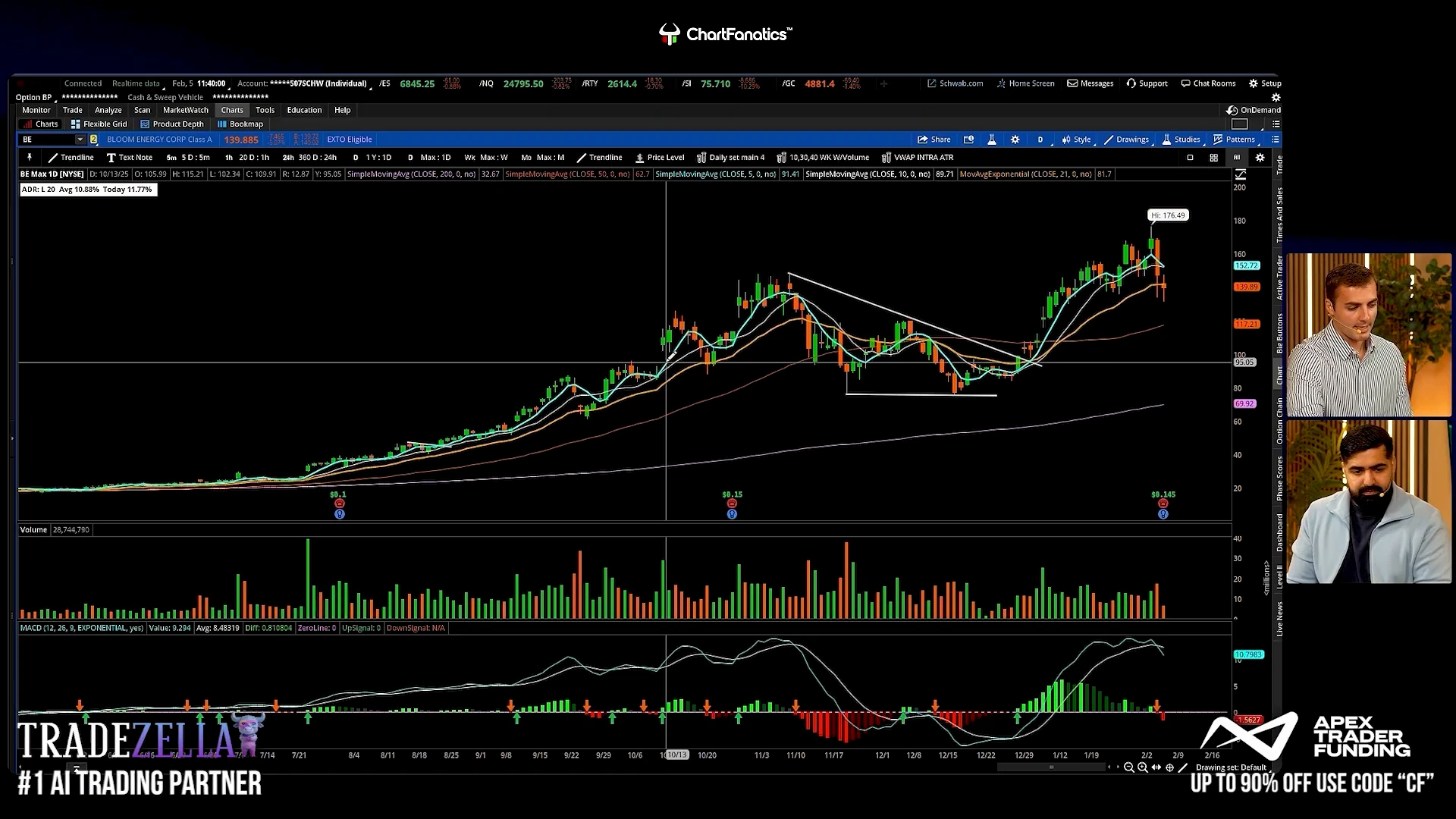
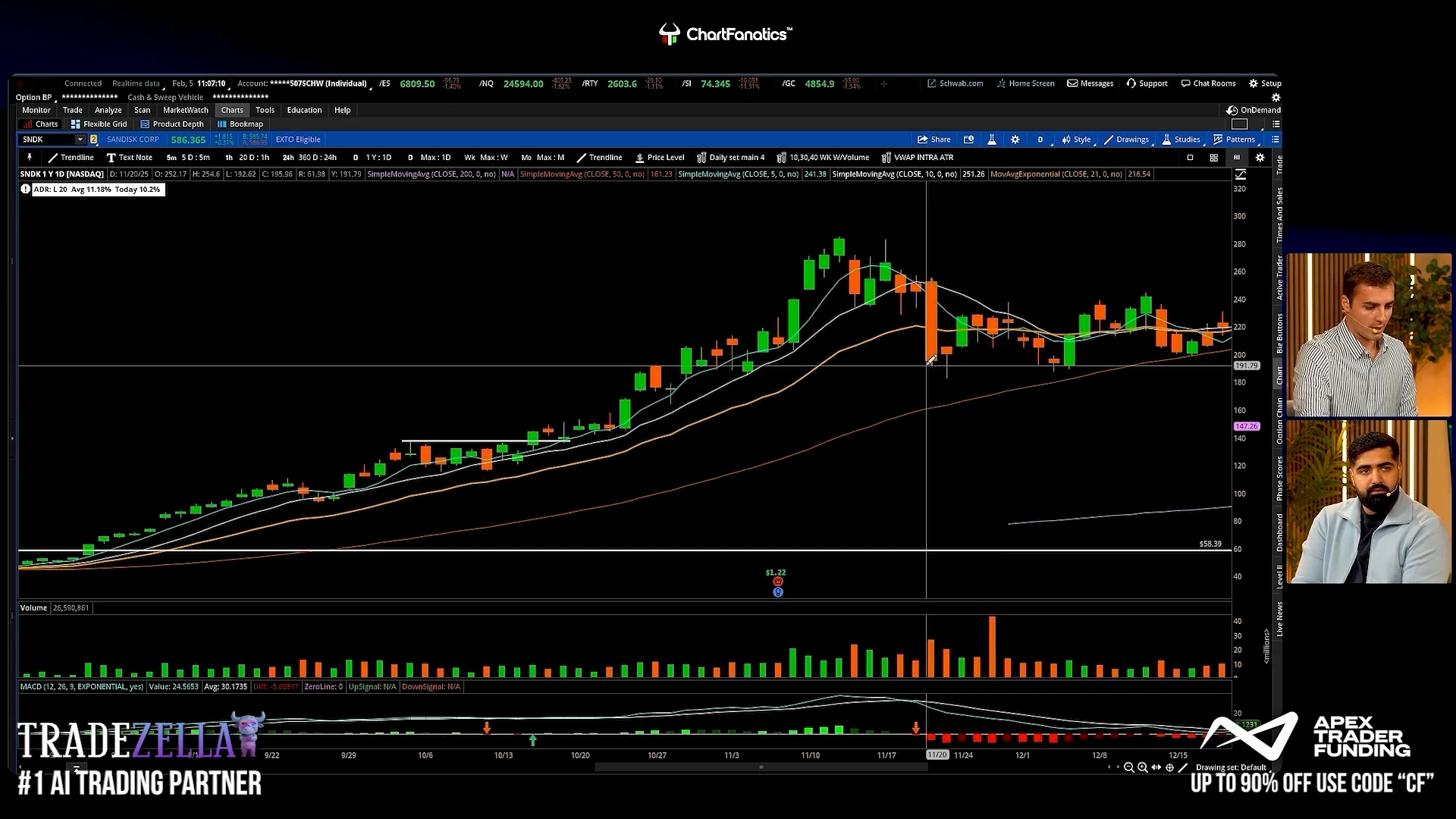
Named examples across the episode include SanDisk, Rocket Lab, Planet Labs and Bloom Energy, with moves illustrated in the 70% to 100%+ range. These are case studies chosen after the fact. They tell you what the setup looks like when it works. They tell you nothing about how often it doesn't.
Market truth: a chart review is a teaching tool, not a track record. Treat it that way and the episode is genuinely useful.
What Are the 6 Swing Trading Rules for Big Moves?
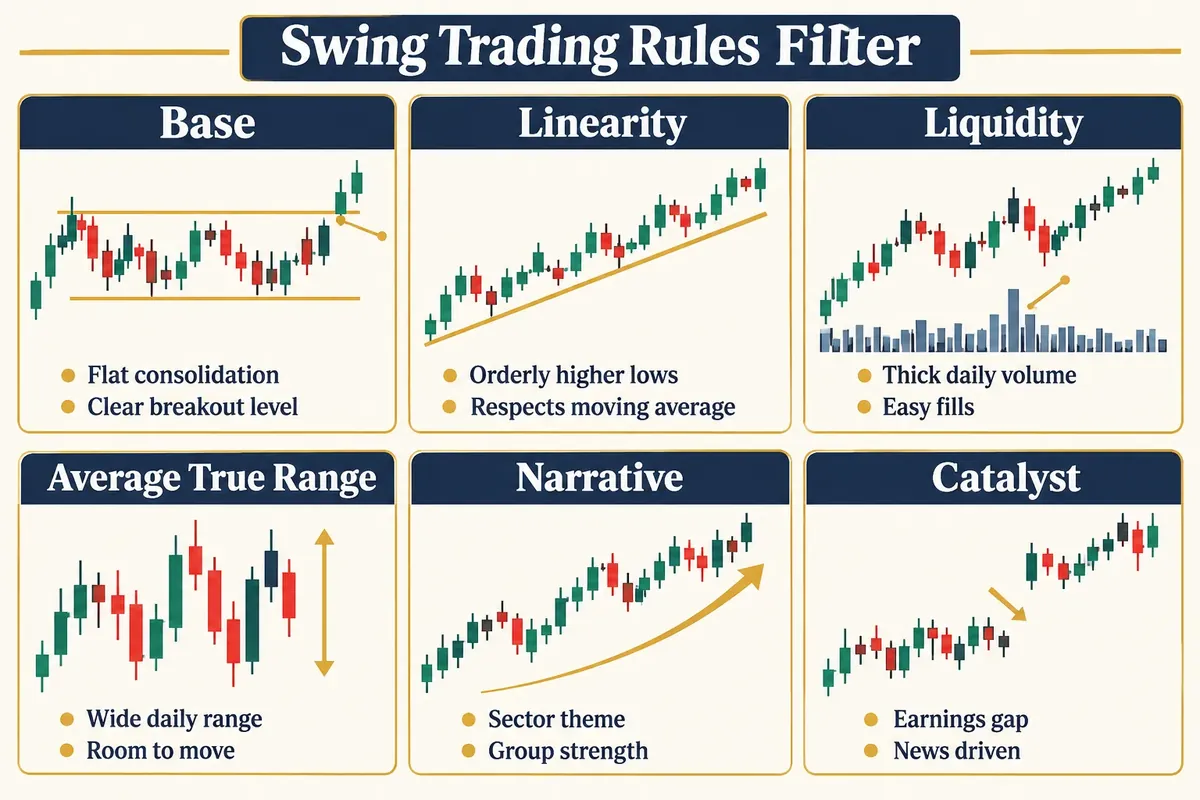
The six rules are candidate filters, not a six-step buy trigger. You run them to build a watchlist of stocks capable of a large repricing, then you wait for one of five separate entry setups. Mixing those two layers up is the most common mistake viewers make.
The trade that started it: a 60% to 70% move with a stop under 1% of the account
The trade Bates opens with had a space-sector catalyst, including an executive order, plus a textbook structure: a big advance, a pullback into a moving average, a clear rejection level, then a reclaim (54:49). He sized it so the whole idea cost under 1% of assets under management if wrong. The stock ran about 70%.
That ratio is the entire argument. Risk a defined, boring amount. Pursue an undefined, large amount. You don't need to be right often for the math to work, but you do need the discipline to take the small loss every single time the setup fails. Most traders take the small wins and the big losses, which is the same math running backwards.
The six rules, in the order the episode gives them
- Base. The stock is emerging from a long consolidation or flat base. A base is just a stretch of sideways price action where buyers and sellers are balanced. Its value is that it hands you a clean, obvious breakout level and a clean place for a stop. Bates doesn't give a minimum base length, which is a gap worth noting.
- Linearity. Price moves in an orderly trend, higher highs and higher lows, respecting its moving averages, instead of lurching vertically and collapsing. Linear stocks are manageable. Erratic ones stop you out on noise.
- Liquidity. Enough daily dollar volume that you can get in and out without moving the price. Independent analysis of the episode puts an indicative threshold near $80 million in average daily dollar volume. Treat that as a guideline, not gospel, and scale it to your account size.
- Average true range. Average true range measures how far a stock typically travels in a day. Bates wants it high. "I don't want to buy Coca-Cola, it moves a percent a day" (6:49). His scan floor is "typically at least 5%" of price (7:51).
- Narrative, story or group. The stock belongs to a theme the market is actively paying up for: space, AI infrastructure, nuclear, whatever's live this quarter. Sector narrative is what pulls in buyers who've never read a chart.
- Catalyst. Something new and knowable: earnings, a contract, a policy change. Catalysts are what turn a pretty base into an actual repricing.
Rules 1 through 3 keep you safe. Rules 4 through 6 are what make the move big. Drop any of the first three and you're gambling. Drop any of the last three and you're bored.
High tight flags and stair steps
A high tight flag is a stock that doubles in weeks, then pauses in a shallow consolidation with a pullback no deeper than about 20% (17:47). The stair step is the gentler cousin: advance, mini base, advance again, each one offering a fresh entry with a fresh stop.
Why the 20% depth matters: a shallow pullback after a huge move means holders aren't selling. A 40% unwind means they are. Same chart shape, opposite message.
Pullbacks: undercut and reclaim, not falling knives
Bates is explicit that he isn't buying collapses. The pattern he wants is an orderly pullback into a moving average, often an undercut and reclaim, where the stock dips below the average, shakes out the weak holders, then closes back above it (19:50). The reclaim is the entry. A close back below the 50-day is the exit.
The decision rule is simple. Buy the reclaim, not the decline. If it breaks back under the average, you're wrong and it's a small loss. Choose this entry over a breakout if you want a tighter stop; choose the breakout if you want confirmation instead.
Volume confirmation after a tight day
Tight range days, where the stock barely moves, signal that selling has dried up. What you want next is a breakout day on expanding volume (24:29). Volume without tightness is noise. Tightness without volume is a stock nobody cares about yet.
Add a catalyst to that volume day and, in his words, even better. That's three of the six rules stacking on one bar.
Where big moves start: earnings gaps
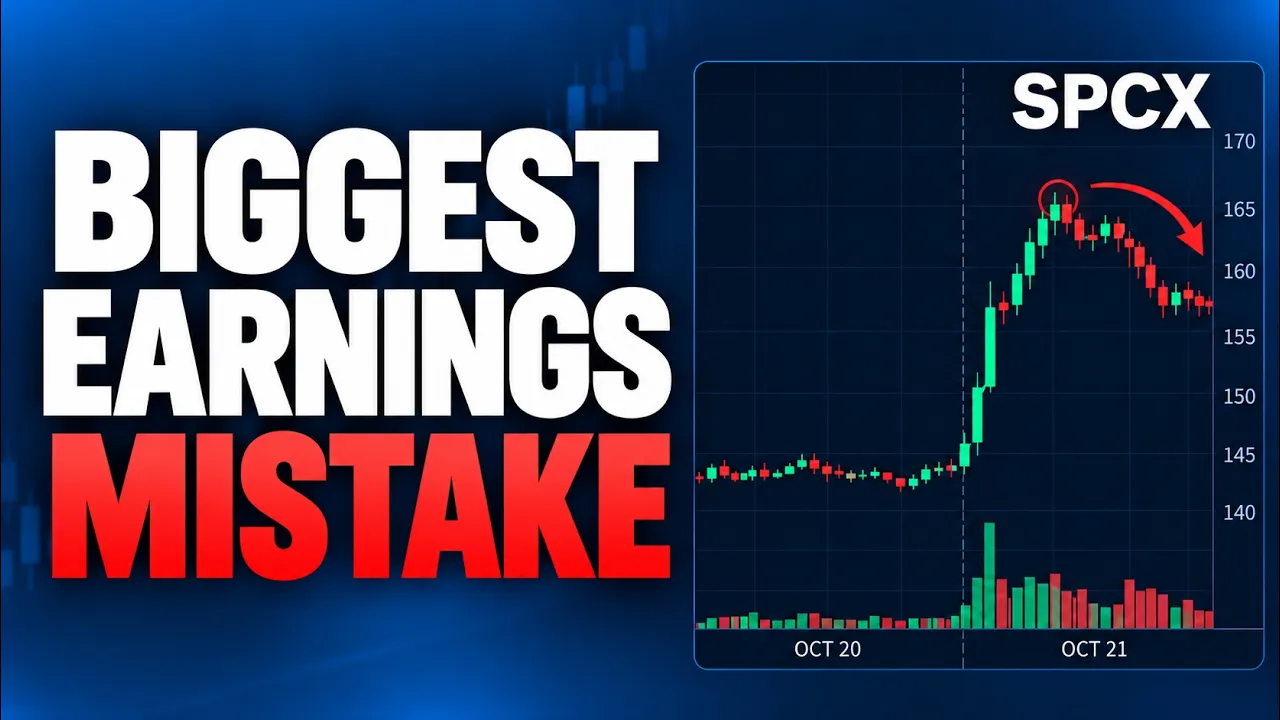
Bates argues most substantial moves begin with an earnings gap, because earnings are the rare catalyst that reprices a company with information nobody had the day before (26:01). The first gap, he says, is where the best opportunity sits, because the story is still early and under-owned.
The edge case: gaps cut both ways. An earnings gap is also where a tight stop gets jumped straight over at the open. Buying the gap means accepting that your risk is not fully defined until the market opens the next morning.
Base breakout example with a stop at the lows
One of the clearest teaching charts in the episode shows a base breakout with the stop placed at the base lows, producing close to a triple-digit gain in under a month (37:37). He also notes he watched a later pullback in the same name and didn't take it. That admission matters more than the winner. Skipping a setup you half-like is a rule too.
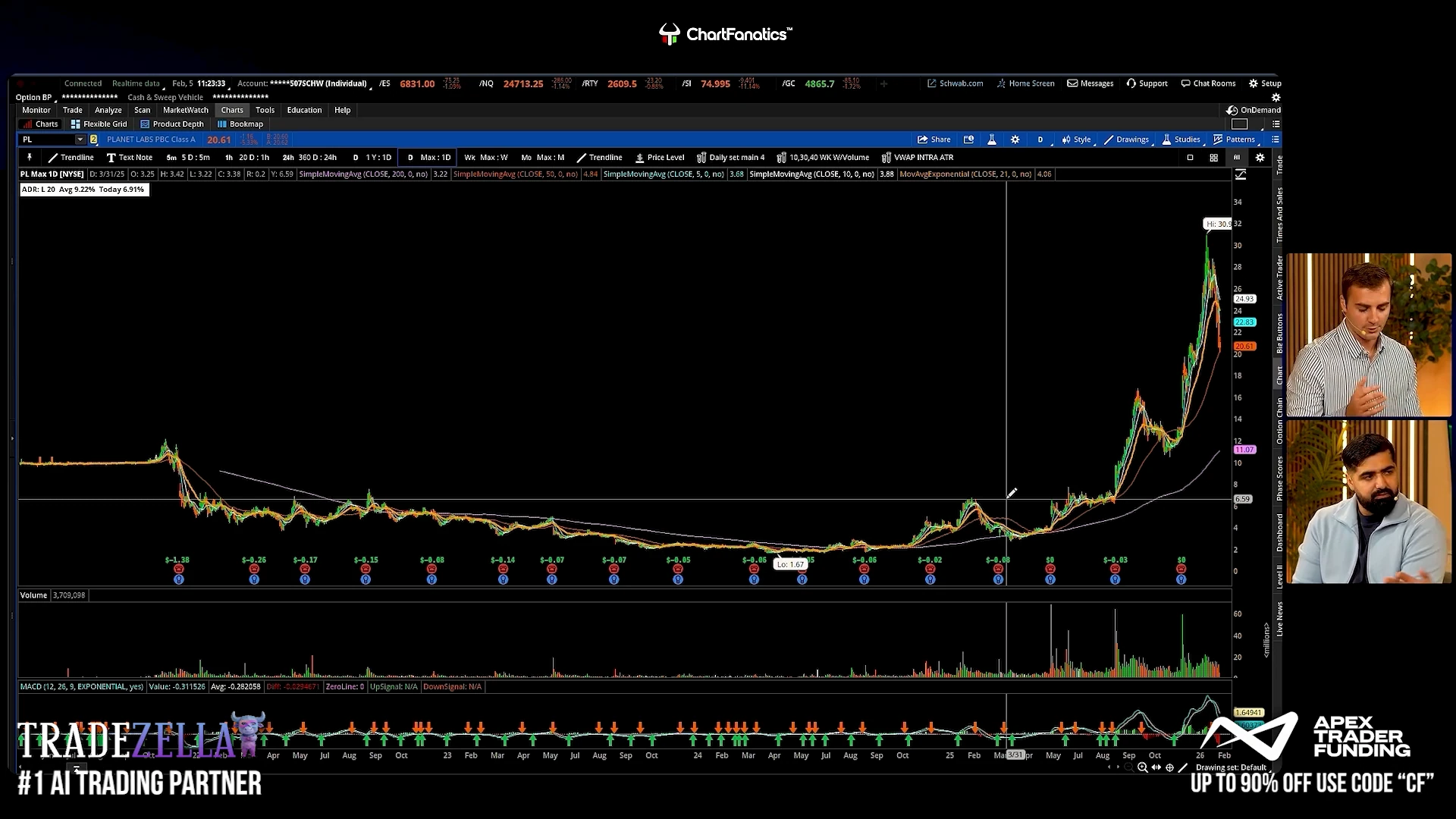
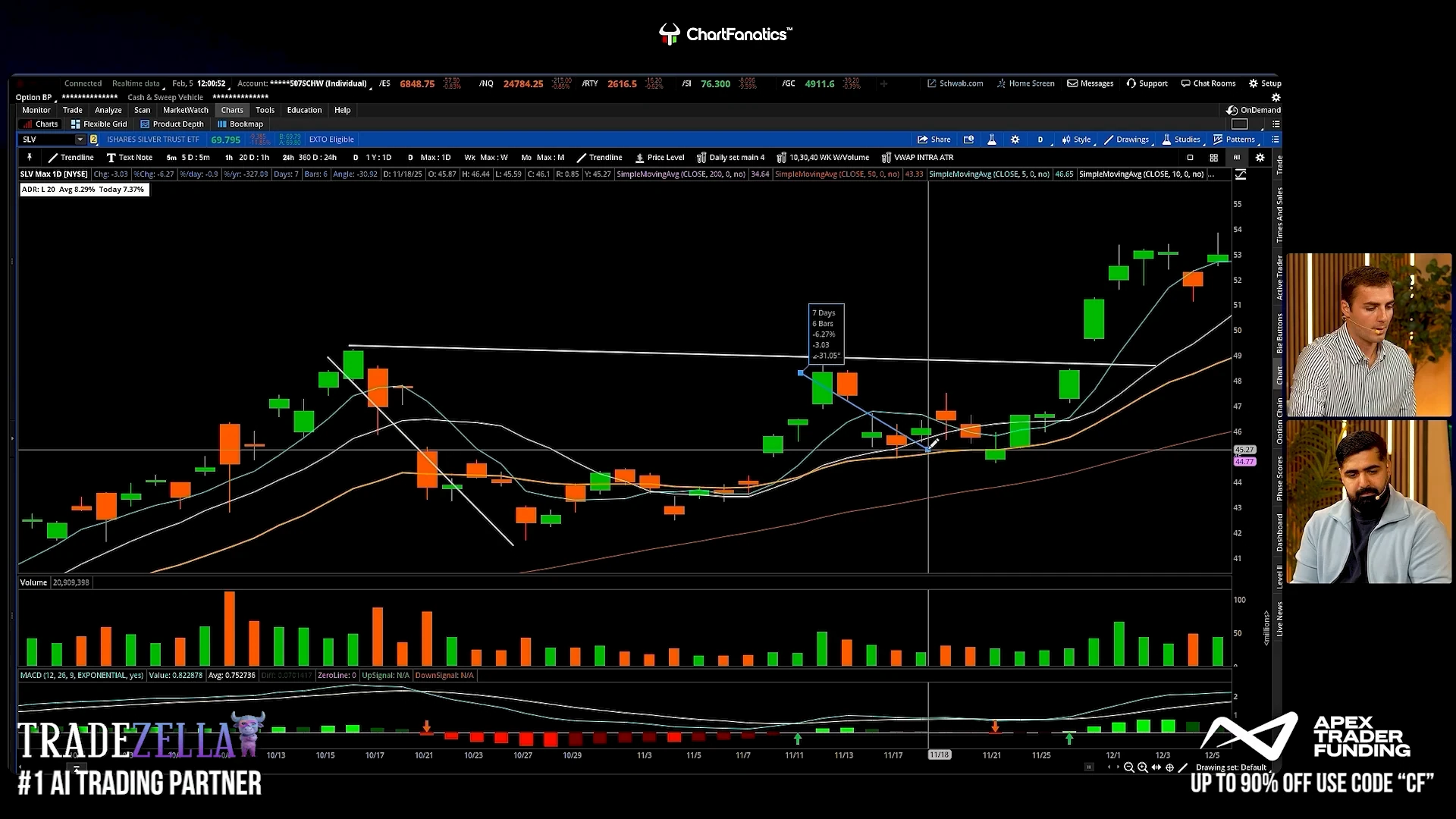
Structures like this are easier to find with a tool than with eyeballs, which is why a decent stock screener built for swing trading earns its keep here. The screener finds candidates. The rules decide.
Run your own candidates through the checklist below before you put money behind anything.
⭐ Top 5 Features We Love
The best thing about these swing trading rules is that each one is checkable before the trade, not rationalized after it. Five specifics that hold up.
1. Risk is defined before entry, every time. Stop at the base lows. Stop below the 50-day. The loss is decided before the position exists (37:37, 19:50). That single habit separates traders who survive from traders who post screenshots for six months and then vanish.
2. The ATR filter is honest about what it costs. Most educators hand-wave volatility. Bates says the quiet part out loud: a stock that moves 1% a day can't produce a 70% swing in weeks (6:49). He wants average true range near 5% of price and accepts the wider stops that come with it.
3. Narrative is treated as a real variable. Price doesn't move because a chart is pretty. It moves because capital rotates into a sector narrative. Grouping rule 5 with the technical rules is more honest than pure chart purism.
4. He shows the trades he skipped. Noting that he watched a pullback and passed (37:37) is a small moment that does a lot of credibility work. Fake gurus only show entries.
5. The framework is small enough to actually run. Six filters, five setups. You can write it on an index card. That matters more than people think, because a system you can't recall under pressure is a system you won't follow. If you're still assembling yours, start with how to find a trading edge before you risk a dollar.
⚠️ Things to Look Out For
Here's where the asterisks live. These swing trading rules are sound in structure and thin on evidence, and the gap between those two things is where retail accounts get hurt.
No track record is shown. Zero win rate, zero drawdown, zero audited equity curve. Four named winners across 97 minutes. That's survivorship bias by construction. Nothing in the episode tells you how many SanDisk-shaped setups failed to produce SanDisk-shaped results.
Position sizing math doesn't transfer cleanly. Risking under 1% of a $50 million book is a different experience from risking 1% of $5,000. The percentage is the same. The psychology, the commission drag and the minimum position size are not.
High ATR cuts both ways. A stock with a 5%+ average true range will trigger a tight stop on an ordinary Tuesday. It will also gap through your stop on bad news. More volatility means more opportunity and more slippage, and the episode spends far more time on the first than the second.
The current tape is unkind to breakouts. On November 15, 2026 the VIX hit 24.05, up as much as 25% intraday, while AI and tech names sold off. Breakout systems produce more failed breakouts and more stop-outs when volatility is high and breadth is poor. A strategy built on 2024-2025 leadership charts does not automatically work in a choppy tape.
Earnings gaps are the riskiest entry in the set. You cannot define risk through an overnight gap. Period.
Who this isn't for: anyone who can't check charts daily, anyone who needs income this quarter, anyone with a pure retirement account, and anyone who's going to average down when the stop hits. If reading those lines made you flinch, this isn't your system yet.
How Do You Turn These Swing Trading Rules Into a Weekly Routine?
Split the work by day so the rules get used, not just admired. Bates runs about $50 million, so his process has staff behind it. Yours probably has a weekend and a laptop. That's enough if the swing trading rules are scheduled.
- Sunday: Run the six-rule screen. Keep the names that pass every rule, not most of them.
- Monday: Mark entry levels and stops on the daily chart for the top five. Set alerts.
- Tuesday to Thursday: Act only on alerts. Check volume confirmation before any entry.
- Friday: Review open trades. Move stops only on the daily close.
The schedule matters more than it looks. Swing trading rules fail when traders check charts all day and start acting on noise. One screen, one set of alerts and one weekly review keeps you inside the system. Keep a one-line note on each trade explaining which of the swing trading rules it passed.
Flex or Cap? Our Verdict
The verdict on these swing trading rules: Flex, with receipts pending. Scored across four questions.
| Question | Grade | Why |
|---|---|---|
| Receipts shown | Partial | Annotated charts with timestamps, no statements or audited record |
| What can be verified | Mixed | Chart structures are checkable; the $50M AUM and 70% claims are not |
| Risk disclosed | Yes | Stop placement and sizing discussed repeatedly and specifically |
| Repeatable by retail | Mostly | Rules are free to run; the discipline is the hard part |
The framework itself is legitimate and old. Bases, volume confirmation, moving-average reclaims and leading-group selection have been in trading literature for decades. Bates isn't inventing anything, and he doesn't pretend to be. That's a point in his favour.
What keeps this out of straight-Flex territory is the absence of any failure data. Four winners is a highlight reel, not a sample. If a tracked record with win rate and drawdown ever drops, revisit the grade.
Call: Flex on the method. Need more receipts on the results.
What You Should Know Before You Try It
Before risking real money on these swing trading rules, handle these six things in order.
- Paper trade it first for 30 sessions. Run the six-rule checklist on live candidates without capital. Log every setup, including the ones you skip. If you can't follow the rules with fake money, you definitely can't with real money.
- Fix your position size by risk, not by conviction. Decide your maximum loss per trade as a percentage of the account, then let the distance to your stop determine share count. With 5%+ ATR names, that means smaller positions than you'd expect. A trading journal template makes this boring and automatic, which is the point.
- Know the real costs. Commissions may be zero, but spreads on thinner names, slippage on gaps and data subscriptions are not. Swing trades held under a year are taxed as short-term capital gains at ordinary income rates in the US. Check current IRS guidance, not a YouTube comment.
- Understand the new margin rules. FINRA replaced the old Pattern Day Trader framework with an intraday margin standard effective June 4, 2026, with brokers permitted to implement through October 20, 2027. The blanket $25,000 PDT minimum in its old form is gone, but your broker can still impose stricter requirements. Confirm your specific firm's policy before you plan around it.
- Verify the structures yourself. Pull up SanDisk, Rocket Lab, Planet Labs and Bloom Energy on a daily chart and find the bases, the gaps and the reclaims. Then find five names where the same pattern failed. That second exercise teaches more than the first.
- Pick two tools and stop shopping. Scanner overload is its own form of procrastination. Our ranked list of 2026 AI trading tools and the swing trading tools directory exist so you spend an afternoon deciding instead of a year.
The uncomfortable summary: the six rules take ten minutes to learn and years to obey. Discipline beats prediction.
Keep reading on FullStack Alpha: our AI stock tool reviews, how traders automate swing trading rules like these, swing trading tools compared side by side, and more Flex or Cap breakdowns.
Frequently Asked Questions
How much money is needed for swing trading?
There's no legal minimum for swing trading a cash account, and many US brokers have no account minimum at all. Margin accounts generally require $2,000. Practically, small accounts struggle with high-ATR stocks because a single share can be expensive and proper position sizing becomes awkward. Fractional shares help.
What is the 3-5-7 rule in stock trading?
The 3-5-7 rule is a risk-management guideline, not an official regulation: risk no more than 3% of your account on a single trade, no more than 5% on a single theme or correlated group, and keep total portfolio risk under 7% at any time. It's a cap on how much damage one bad week can do.
Can I make $100 a day daytrading?
It's arithmetically possible and statistically unlikely for most people. Research consistently finds a large majority of active day traders lose money over time. A $100 daily target on a small account requires return rates that force oversized positions, which is how accounts get wiped out. Target process consistency first; dollar goals invite revenge trading.
What is the 3-6-9 rule in trading?
The 3-6-9 rule isn't a standard trading rule with one accepted definition. It's used loosely for time-based reviews, checking a position or a strategy at 3, 6 and 9 day or month intervals. Treat any version you see as one educator's framework, not an industry standard.
What is the 11am rule in trading?
The 11am rule is a common intraday observation: if a stock hasn't reversed its opening direction by around 11:00 a.m. Eastern, the trend established in the morning session often holds into the afternoon. It's a heuristic drawn from typical volume patterns, not a guarantee, and it fails regularly on news days.
What is the most successful day trading pattern?
No single pattern has a verified highest success rate across all markets and conditions. The breakout from tight consolidation on expanding volume is among the most widely used by momentum traders, partly because it offers a clearly defined stop. Pattern choice matters far less than position sizing and exit discipline.
What is Chart Fanatics?
Chart Fanatics is a YouTube channel that publishes long-form interviews with traders and asset managers, walking through their chart setups and process. The episode discussed here features Connor Bates, a 25-year-old asset manager, in a roughly 97-minute session uploaded October 18, 2026.
What are the most important swing trading rules for beginners?
Keep risk per trade small, buy strength rather than falling knives, and wait for volume to confirm the move. The swing trading rules in this episode add a screen for tight setups and earnings gaps, but risk control comes first.
Where to Go From Here
Do one thing this week: take the six-rule checklist above, run it against every name on your current watchlist, and delete the ones that fail three or more. Most watchlists shrink by half. That's not a loss, it's the first real filter you've applied in months.
Then paper trade the undercut-and-reclaim entry for 30 sessions before a dollar moves. If you need help choosing what to run the scans on, our day trading and swing tool reviews cut the shortlist down for you.
Fewer tabs, fewer alerts, one checklist you actually follow. Your market edge starts with the right tool. Stay alpha.
One video examined in depth here. There are 200+ AI stock tools catalogued in the FullStack Alpha directory, filterable by category, price and what they actually do.
Browse the directory → aistockpickerapps.com