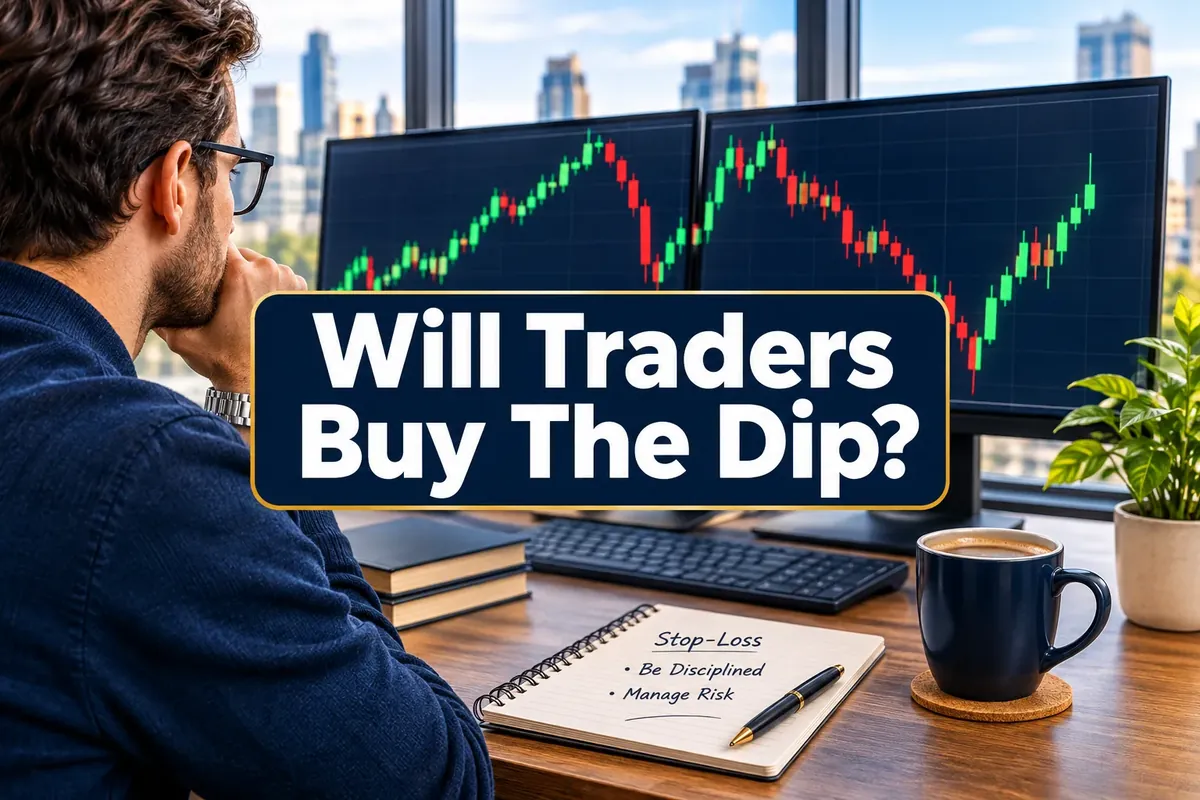
Quick Answer
The buy the dip strategy still works, but only with a trend, a catalyst and a stop loss behind it. Ross Cameron's November 6, 2026 video "Will Traders Buy The Dip?" is mostly a flex with receipts attached: he shows two $50-ish losses on screen, admits he gave back roughly $16,000 to $17,000 of a $25,000 two-day run, and never pretends the tape was easy. That honesty is the useful part. The part most viewers will skip is that his results are formally disclosed as not typical.
Here's the hook, though. While retail traders were debating whether to catch the knife, Nvidia fell as much as 35% from its record peak and erased about $2 trillion in market value in November 2026, and retail bought a net $111 million in the first 30 minutes of one session. Somebody is buying. The question is whether they have a process or a prayer.
Verdict in one line: it's a modest flex, not cap, because the losses are shown in the same breath as the wins and the buy the dip strategy on display is a timed intraday pullback entry, not blind averaging down.
What makes it credible isn't the profit number. It's the structure. Cameron describes cutting a trade for a $50 loss when it didn't move immediately, then another for $55 after a rejection. A trader inventing a highlight reel doesn't lead with two small stop-outs on a dull November Friday.
What makes it incomplete: the big dollar figures ($16,000 Tuesday, just under $10,000 Wednesday, minus a $16,000 to $17,000 giveback) are stated, not shown as statements inside the video. Warrior Trading does publish third-party-reviewed records elsewhere. Inside this particular 16 minutes, you're taking the number on faith.
The takeaway: judge a trading video by whether the losses are as detailed as the wins. This one passes that test.
What Happened, According to Ross Cameron - Warrior Trading
Cameron walks through a quiet pre-market session, two small losing trades, and a bearish-to-neutral outlook on the broader market after a heavy red day in the S&P 500. The video opens with him framing the plan plainly: break down the leading gainers, review his pre-market trades, give an outlook (0:00).
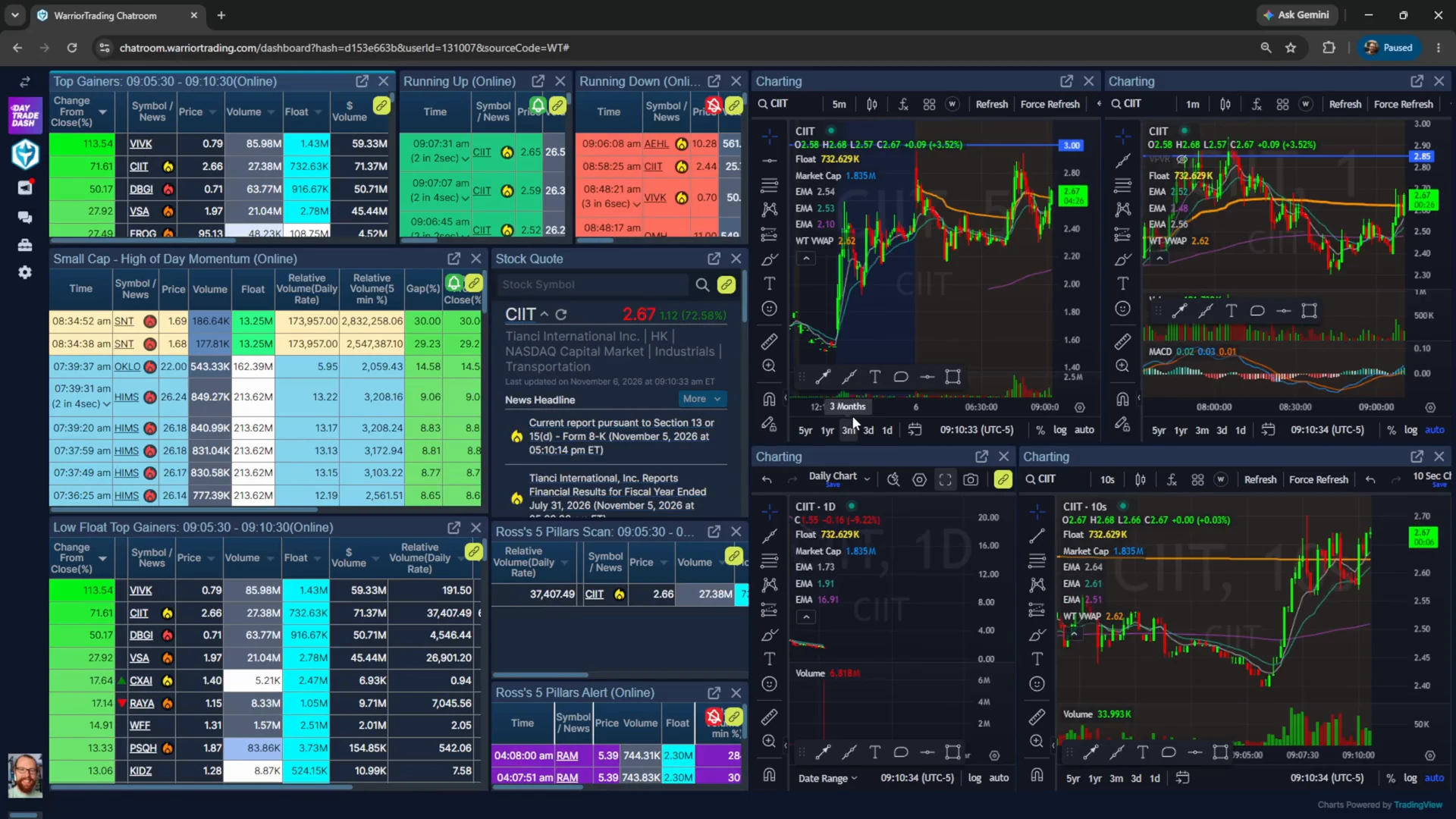
The leading gainer he names is VIVK, up 111% at about 78 cents, with roughly 84 million shares traded and relative volume near 250 times average. Relative volume just means how much a stock is trading versus its own normal day. Two hundred and fifty times normal is a crowd showing up out of nowhere.
He says he doesn't trade those well. Sub-dollar names get "thickly traded" with heavy stacks of buyers and sellers on each side, so a 10% pop is pennies and the exit is crowded.
The on-screen receipts are small, specific and mostly losses. That's the whole reason this piece isn't a cap.
| What he says | Timestamp | Shown on screen? |
|---|---|---|
| VIVK up 111%, 78 cents, ~250x relative volume | 0:00 to 1:15 | Yes, scanner |
| CIIT-type Hong Kong name, $2.66, up 71%, 27M shares | 2:07 | Yes, scanner and chart |
| First trade, out for a $50 loss | 3:09 | Described |
| Second entry, stopped out for a $55 loss on a rejection | 4:43 | Chart shown |
| Up $16,000 Tuesday, just under $10,000 Wednesday | 14:42 | Stated only |
| Gave back $16,000 to $17,000 the next day | 14:42 | Stated only |
His own framing of risk after a bad session is the line worth stealing: "keep your stop super tight. If it doesn't work right away, bail" (3:09).
The scanner workstation shot showing the Chinese small cap appears early, around the 2:05 mark, and it's the clearest window into how he filters: price, percent gained, volume, relative volume. Not vibes.
Watch it yourself before trusting any summary, including this one. Will Traders Buy The Dip? on YouTube runs about 16 minutes, posted November 6, 2026, and had roughly 41,800 views and 1,086 likes by mid-November.
Three things to watch for on your own viewing:
- The scanner, not the picks. The tickers are stale within hours. The filter logic isn't.
- How fast he exits. Both losers are gone in what sounds like under a minute.
- The disclosure. Warrior Trading states on its own support page that Cameron's results are not typical and that most day traders lose money.
A 16-minute video with two losing trades and a slow-market shrug isn't engineered to sell dreams. It's engineered to sell a $7 trial, which is a different, more honest business model. Still a funnel. Just a cleaner one.
Does the Buy the Dip Strategy Still Work?
Yes, the buy the dip strategy works in specific conditions and fails badly outside them. The condition that matters most: is the pullback happening inside an uptrend with a reason behind the move, or is it a falling knife with nothing underneath it? Everything below is Cameron's session broken into the pieces that answer that question.
VIVK up 111% at 78 cents
A stock up 111% on 250 times normal volume looks like the obvious dip-buy candidate. Cameron passes. His reason is mechanical, not emotional: cheap stocks trade in thick books, so the spread between what you make on a 10% move and what the fill costs you gets ugly fast.
Decision rule: if a 10% move in the stock doesn't cover your slippage and your stop, the setup isn't tradeable at your size. That's position sizing math, not conviction. Our breakdown of the position sizing mistake that wipes out new traders covers the arithmetic in detail.
Low float, sub-dollar names are where most beginners learn this lesson the expensive way. The chart moves. Your account doesn't.
The Hong Kong small cap at $2.66
The second name, a NASDAQ-listed Chinese small cap around $2.66 and up 71% on 27 million shares, is the one he actually trades. Cameron flags the relative volume as absurdly high versus a stock that normally trades on very light volume (2:07).
That volume imbalance is the catalyst proxy. When a quiet name suddenly trades thousands of times its average, something changed, and the pullbacks inside that move can be real dips rather than a slow bleed.
Chinese small caps carry their own baggage: thin floats, offering risk, halt risk, and a habit of giving the whole move back by the close. He got exactly that outcome.
After a red day: keep the stops tight
Cameron says he turns risk-averse the morning after a big red day. Smaller size, tighter stops, faster exits. Both trades that day die for about $50 each.
A tight stop loss means your exit price sits close to your entry, so being wrong costs little. The trade-off is you get stopped out more often on noise.
Decision rule: after a losing day, cut your normal position size in half before you cut your rules. Revenge trading is the alternative, and it's undefeated at destroying accounts.
The big rejection
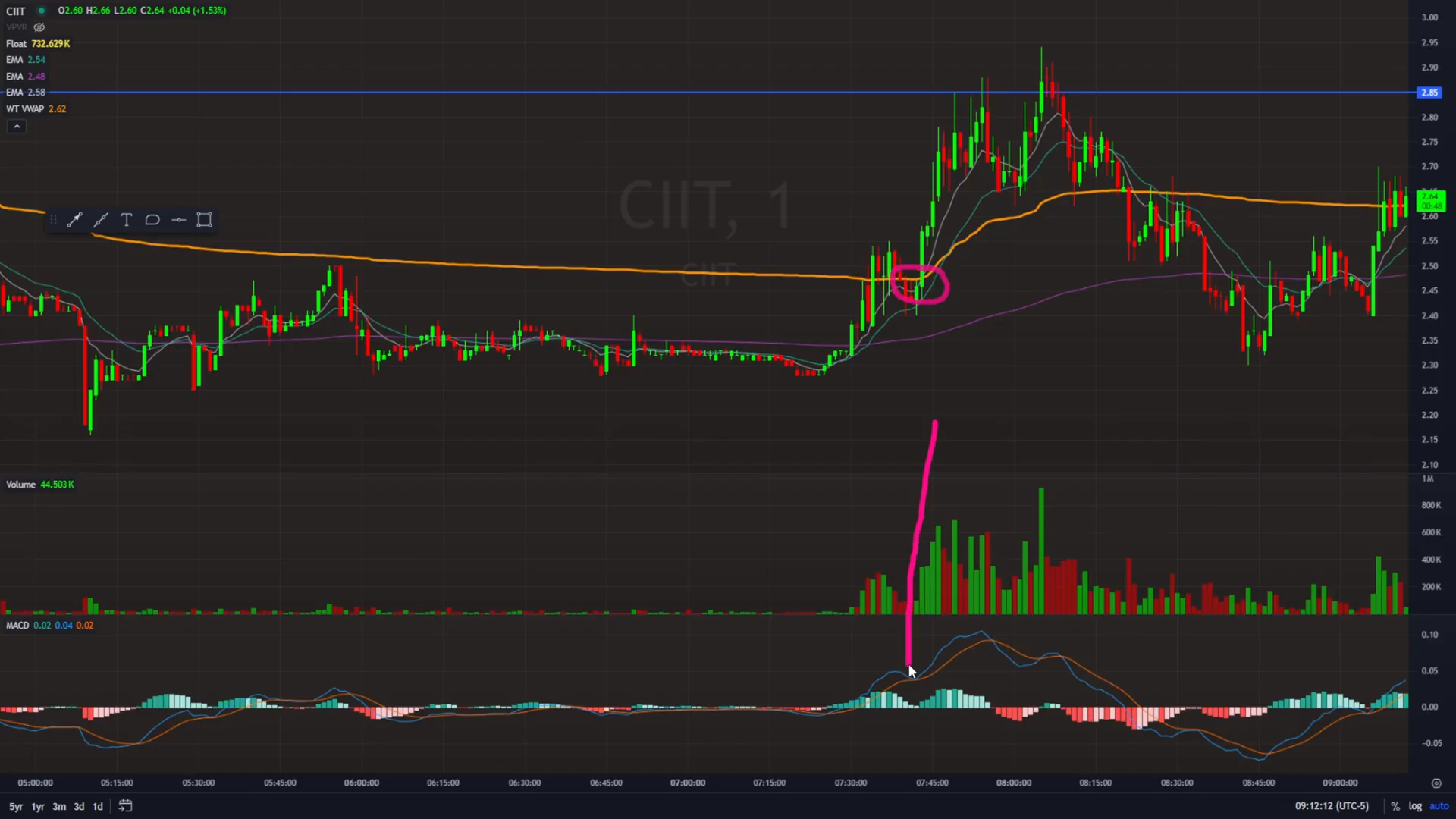
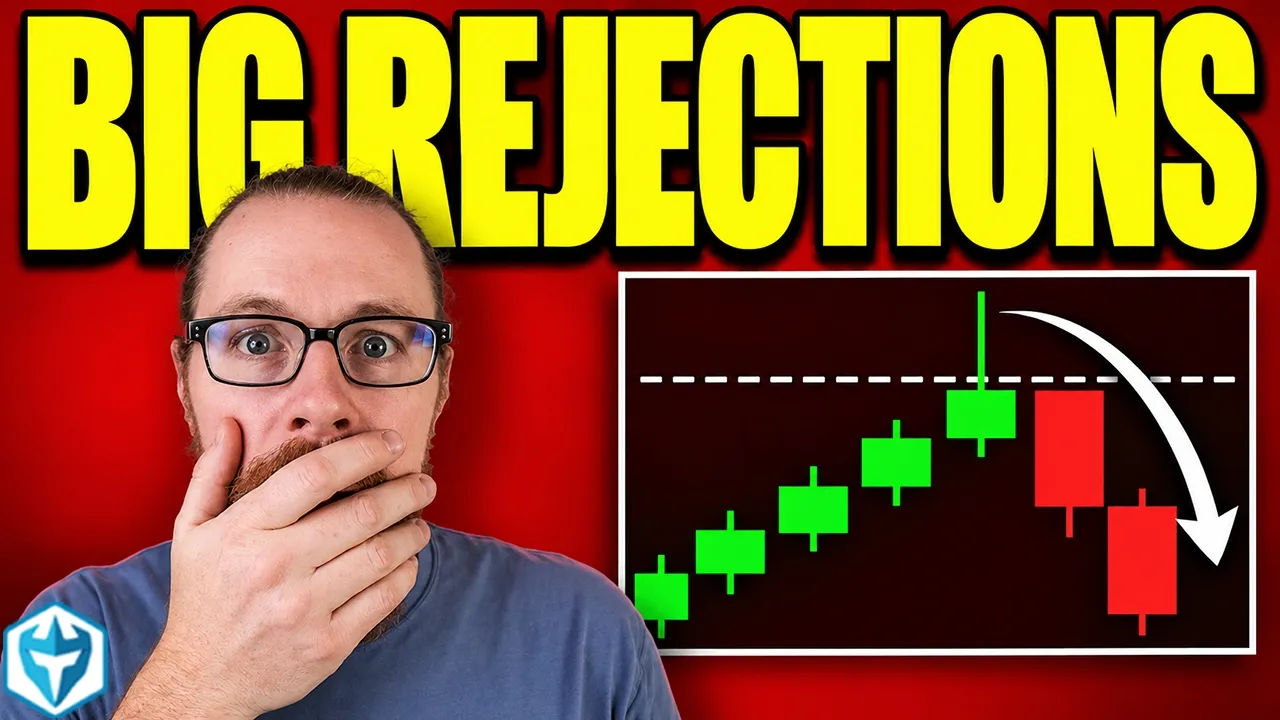
The second entry is textbook, and it still loses. He buys the first candle to make a new high, the stock rejects on high volume, he's out for $55. Then it drops hard (4:43).
High volume rejection is sellers overwhelming buyers at a level, usually near the highs. On a 1-minute chart it looks like a tall candle with a long upper wick and a volume bar that dwarfs the ones before it. That's the picture the 1-minute CIIT chart shows around the 3:43 mark: entry, volume surge, then the roll-over.
The lesson isn't that the setup was bad. The lesson is that a good setup with a bad outcome costs $55 when you have a stop, and several hundred when you don't.
A slow, grinding market
He describes the tape as a grind, with no big moves, which he says doesn't surprise him after the S&P 500's heavy down day (5:44). A choppy tape is a market with no follow-through: breakouts fail, pullbacks don't bounce, and both longs and shorts get chewed up.
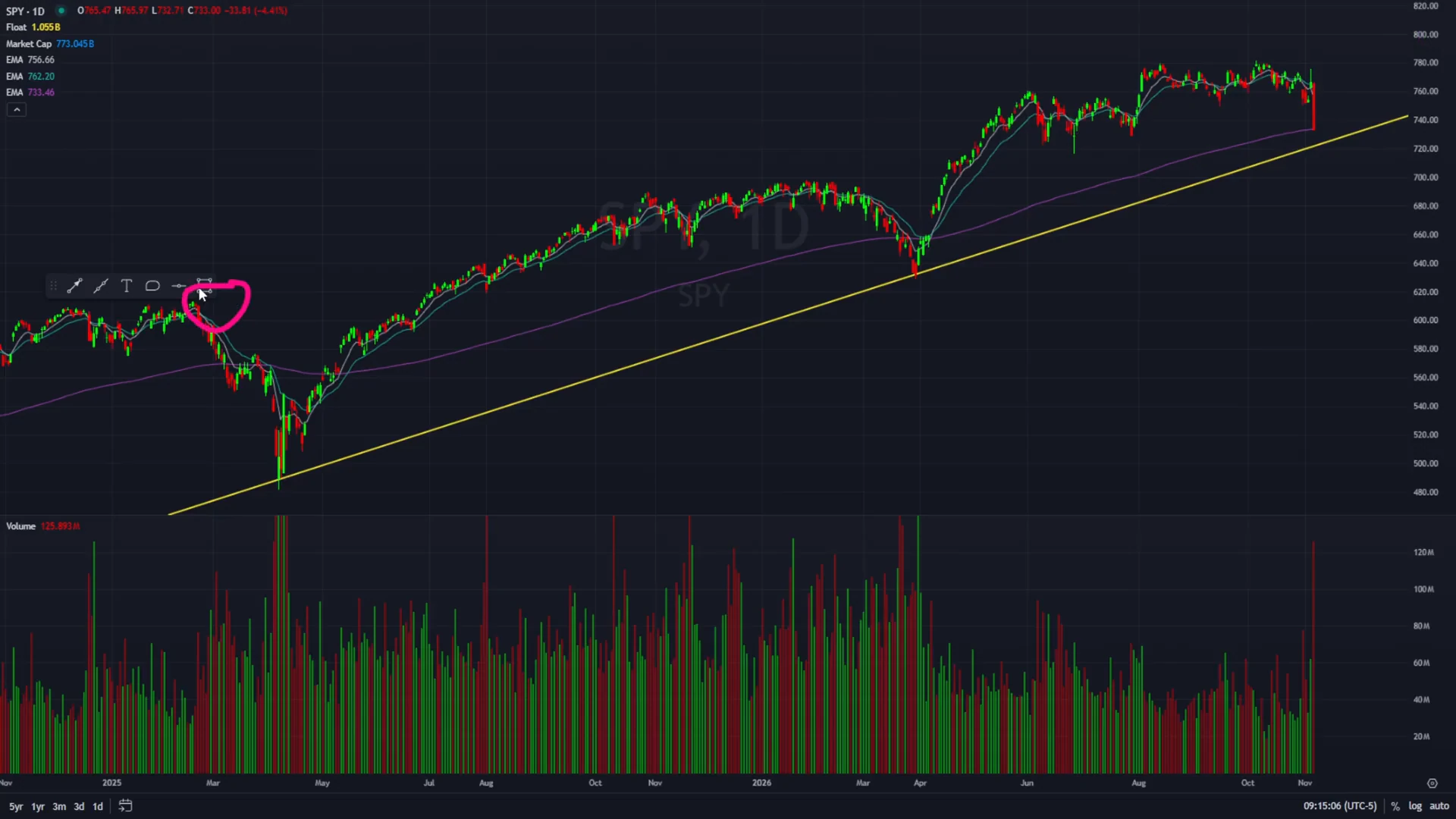
The SPY daily chart he pulls up around the 6:38 mark, with a long rising trendline underneath, is the broader context: the index is pulling back toward a level that has held before. That's the actual buy the dip strategy question for most investors, not a $2 Chinese small cap.
Slow markets punish overtrading more than anything else. Fewer, better setups beat more attempts.
His outlook: the midterms and big tech
Cameron connects the pullback to politics and AI valuations. His read: the 2026 midterm results, including Texas flipping blue, create headline risk for names tied to specific founders and policy outcomes, and Tesla's weight inside the S&P 500 means a big drop there drags the index (8:54).
On AI, his split is sensible. Google and Meta have multiple profit engines and survive a slowdown. Companies whose entire valuation rests on AI spending don't (10:01). He also notes that some policy outcomes may be good for household budgets and still not be short-term positives for the index (11:35).
That's opinion, not data. Treat it as a hypothesis to test, not a forecast to trade. Midterm elections and stocks have a messy historical relationship, and nobody at the desk has a reliable edge predicting it.
When buying the dip works and when it doesn't
The dividing line is whether the decline changed the story or just the price. Nvidia falling as much as 35% from its record in November 2026 and wiping out roughly $2 trillion in market value is the live test case. Retail bought $111 million net in a single 30-minute window.
Anna N'Jie-Konte, CEO of Poder Wealth Advisors, put the distinction well in Bloomberg's coverage: buying a decline is rational if you already believed in the company and you're now getting it cheaper. Buying because it's down, with no analysis behind it, is a gambling exercise. She also said she didn't change client portfolios over the news.
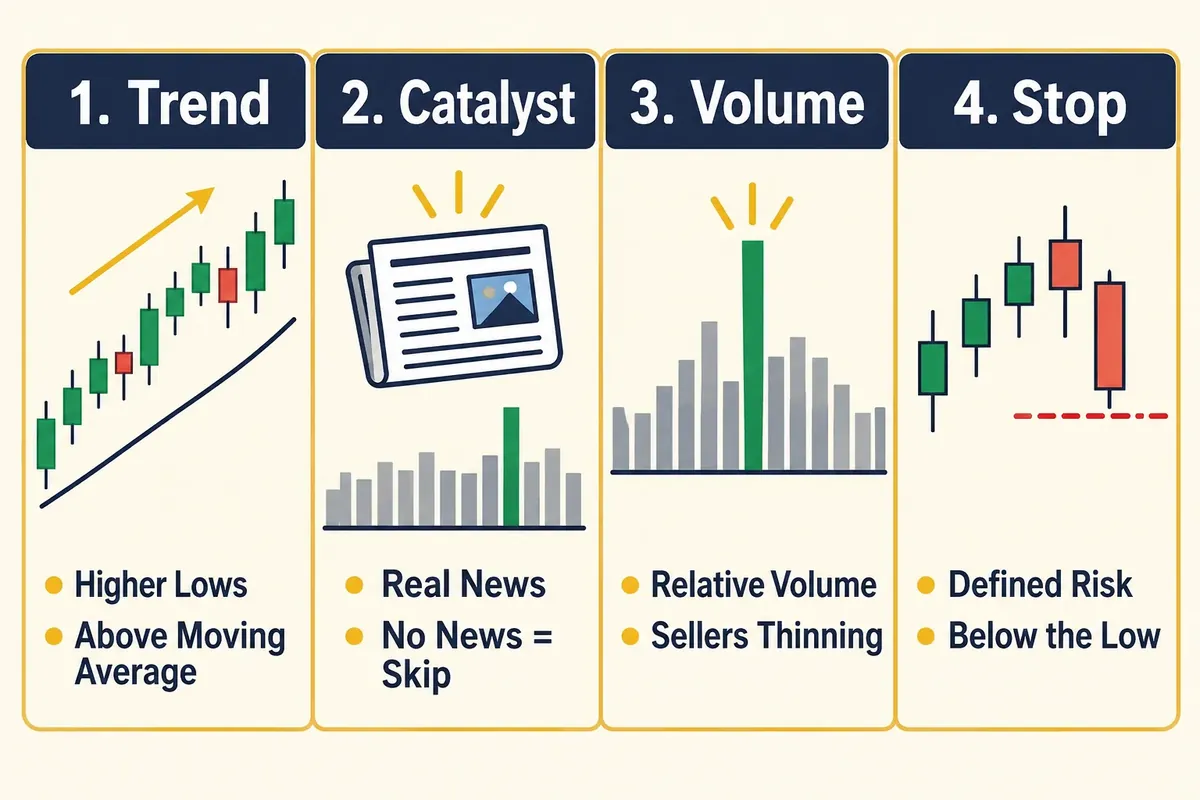
Works when: the trend above the dip is still intact, there's an identifiable reason for the drop, volume confirms buyers returning, and you've defined where you're wrong.
Doesn't work when: the drop reflects a real change in earnings power, regulation or leadership; when there's no level to lean on; or when "my stop" is a feeling instead of a price.
Scanners that flag relative volume and pullback setups help here, and we've compared the main ones in Trade Ideas vs TrendSpider for active traders.
⚠️ Things to Look Out For
The main risk isn't the strategy, it's the gap between the trader on screen and the trader watching. Cameron has years of screen time, a funded account, and a disclosed record. Most viewers have none of those and a $3,000 account.
Specific things to weigh:
- Results are disclosed as not typical. Warrior Trading's own support page, updated November 2, 2026, says the $583 to $18 million record was reviewed by accounting firm SingerLewak, that most day traders lose money, and that the company can't state typical member profitability because it doesn't see member brokerage accounts. That last part matters most.
- Day trading is characterized as extremely risky by mainstream brokers. Charles Schwab says even experienced traders may not stay consistently profitable.
- Sub-$5 and low-float names carry halt risk and dilution risk. A dip in a Chinese small cap can be a secondary offering, not an opportunity.
- Commissions, spreads and slippage eat small accounts. On a 78-cent stock, a one-cent slip is 1.3% of the price.
- The PDT rule ending in June 2026 removed the $25,000 gate, not the risk. Margin traders still need $2,000 in equity, subject to broker rules, and more access means more chances to be wrong quickly. We covered the practical side in how to day trade without $25K.
- Short-term gains are taxed as ordinary income. A $25,000 trading year is not a $25,000 take-home year.
Who this is not for: anyone trading rent money, anyone who can't watch a screen during market hours, anyone whose plan for being wrong is "it'll come back," and long-term index investors who'd be better served ignoring the whole week.
What Separates a Buy the Dip Strategy From Catching a Falling Knife?
A reason to expect buyers. A buy the dip strategy works when the dip happens inside an uptrend, at a level where buyers have stepped in before, with a stop just below it. Catching a falling knife is buying anything red and hoping.
| Buy the dip | Falling knife |
|---|---|
| Higher highs and higher lows on the daily | Lower highs, broken trend |
| Pullback to a known level or moving average | No nearby support |
| Selling volume shrinking on the pullback | Selling volume rising |
| Stop placed before entry | "I'll add if it drops more" |
Cameron's two small losses show the right version even when it fails: tight stops, quick exits. A buy the dip strategy with a stop loses small. Without one, it loses whatever the market decides.
Flex or Cap? Our Verdict
Four questions, honest scoring.
1. Receipts shown? Partly. The scanner, the 1-minute chart, the entry and the rejection are all on screen. The $25,000 two-day profit and the $16,000 giveback are spoken, not displayed. Call it half credit.
2. What can be verified? The video's upload date, view count and the Warrior Trading disclosure page are all public. The firm states a third-party accounting review of the career record. The individual trades in this clip can't be independently confirmed by a viewer.
3. Risk disclosed? Yes, and better than most. He leads with losses, names the giveback day, calls November slow, and frames the market outlook as uncertain. Warrior Trading's separate disclosure explicitly says results aren't typical.
4. Can a regular retail trader repeat it? The process, yes. The P&L, almost certainly not. Tight stops, relative-volume scanning and fast exits are learnable. Taking size on a Hong Kong small cap at 9:35 a.m. with a six-figure account is not a beginner activity.
Verdict: Flex, with a footnote. The buy the dip strategy shown here is legitimate and the losses are presented honestly, which is rarer than it should be. The footnote is that the headline profit numbers live outside the video, and the business model behind the content is a paid trial. Watch it for the method. Ignore the dollar signs.
What You Should Know Before You Try It
Start by separating the idea from the execution. The buy the dip strategy is simple to describe and brutal to run live, because every rule gets tested by a red candle at 9:41 a.m.
1. Paper trade it first, for 30 sessions minimum. Log every trade: entry, stop, exit, reason. If your paper results depend on fills you'd never get on a thin stock, your real results will be worse. Journaling tools like TradeSync and its alternatives exist for exactly this.
2. Size so a loss is boring. Risk 0.5% to 1% of the account per trade, maximum. On a $5,000 account that's $25 to $50 of risk, which is roughly what Cameron lost on each failed trade that morning with a much larger account. Read that sentence twice.
3. Price the real costs. Commissions, data fees, spread and slippage. On low-priced, thickly traded names, the spread is often the largest cost you'll pay all day.
4. Know the rules that apply to you. The pattern day trader $25,000 minimum was eliminated in June 2026, but margin accounts still require $2,000 in equity and brokers can set stricter terms. Confirm your broker's policy directly, and check FINRA and Investor.gov rather than a YouTube comment section.
5. Decide if you're trading or investing before you click buy. A buy and hold investor buying a market pullback has months to be right. A day trader has minutes. Mixing the two timeframes mid-trade is how a $55 stop becomes a $900 "long-term position."
6. Test your alert speed. If your scanner surfaces a mover four minutes late, you're reading history. Our free trader reaction time test gives you a baseline, and the AI stock tools traders actually use breakdown covers the scanners worth paying for.
Keep reading on FullStack Alpha: our AI stock tool reviews, how traders automate rules like these, day trading tools compared side by side, and more Flex or Cap breakdowns.
Frequently Asked Questions
What does "buy the dip" mean in stocks?
Buying the dip means purchasing a stock or index after it falls, on the expectation that the price recovers. A disciplined buy the dip strategy adds conditions: an intact uptrend, a reason for the drop, and a predefined exit if the recovery doesn't happen.
Is it true that 97% of day traders lose money?
The commonly cited figure is around 70%, not 97%, and it varies by study and market. Warrior Trading's own disclosure states that most day traders lose money, and Schwab describes day trading as extremely risky. Any specific percentage you see quoted should be traced to a named source before you repeat it.
What is the 7% rule in stocks?
The 7% rule, popularized by Investor's Business Daily, says to sell a stock if it falls 7% to 8% below your purchase price, no exceptions. It's a mechanical stop loss designed to cap single-position damage. It conflicts with naive dip buying, which is exactly the point.
What is Warren Buffett saying about the stock market?
Buffett's position has stayed consistent for decades: buy quality businesses at sensible prices and hold them, rather than reacting to short-term swings. He has long advised most people to use low-cost index funds. For current commentary, read Berkshire Hathaway's annual letters directly instead of secondhand headlines.
Is there likely to be a market crash in 2026?
Nobody knows, and anyone who states it confidently is selling something. What's observable in November 2026 is elevated volatility in AI-linked names, including Nvidia falling as much as 35% from its record peak and shedding roughly $2 trillion in value. Volatility is not a forecast. Plan position sizing for a drawdown instead of predicting one.
Did the stock market do better under Trump or Obama?
Both administrations oversaw strong index returns, with the specific ranking depending on which start and end dates you pick and whether you include dividends. Presidential attribution is weak evidence for any trading decision, because Federal Reserve policy, earnings growth and valuations drive far more of the move.
How much is Warrior Trading monthly?
Warrior Trading typically markets an entry trial priced at a low introductory rate, with full memberships costing substantially more on a monthly or annual basis. Prices change, so check the official site before buying and read the refund terms rather than relying on a figure quoted in a blog post.
The honest summary of Cameron's session: two small losses, a slow tape, a bearish lean, and a process that held anyway. That last part is the only transferable asset in the video.
Your next three moves, in order. One, write down the four conditions from the decision table above and tape them to your monitor. Two, run them against five real pullbacks this week without trading a single one. Three, size your first live attempt so the loss is forgettable.
Discipline beats prediction. Your market edge starts with the right tool. Stay alpha.
One video, scored four ways. There are 200+ AI stock tools catalogued in the FullStack Alpha directory, filterable by category, price and what they actually do.
Browse the directory → aistockpickerapps.com
Educational content only. Not investment advice. No returns are promised or implied.
Does a buy the dip strategy work for day trading?
It can, on stocks that are trending up intraday and pull back to VWAP or a moving average. Cameron keeps stops tight after a red day, which is how a buy the dip strategy stays survivable in a slow market.