Quick Answer
Do AI trading bots work? Based on this experiment, not the way the ads suggest: a YouTube creator's custom small-cap scanner bot took 8 paper trades across 10 sessions, won once, and finished down $728.65. The bot actually found a stock that surged nearly 50% and still lost $193 on it. That gap between finding a mover and making money on it is the whole story, and it's the honest answer most people asking "do AI trading bots work" never get.
The video comes from Loopwork Lab, a tiny channel (about 16 views when we checked) that uses an AI-generated host on its slides. No real money was risked. That makes it a reference piece, not a trading record.
What Happened, According to Loopwork Lab
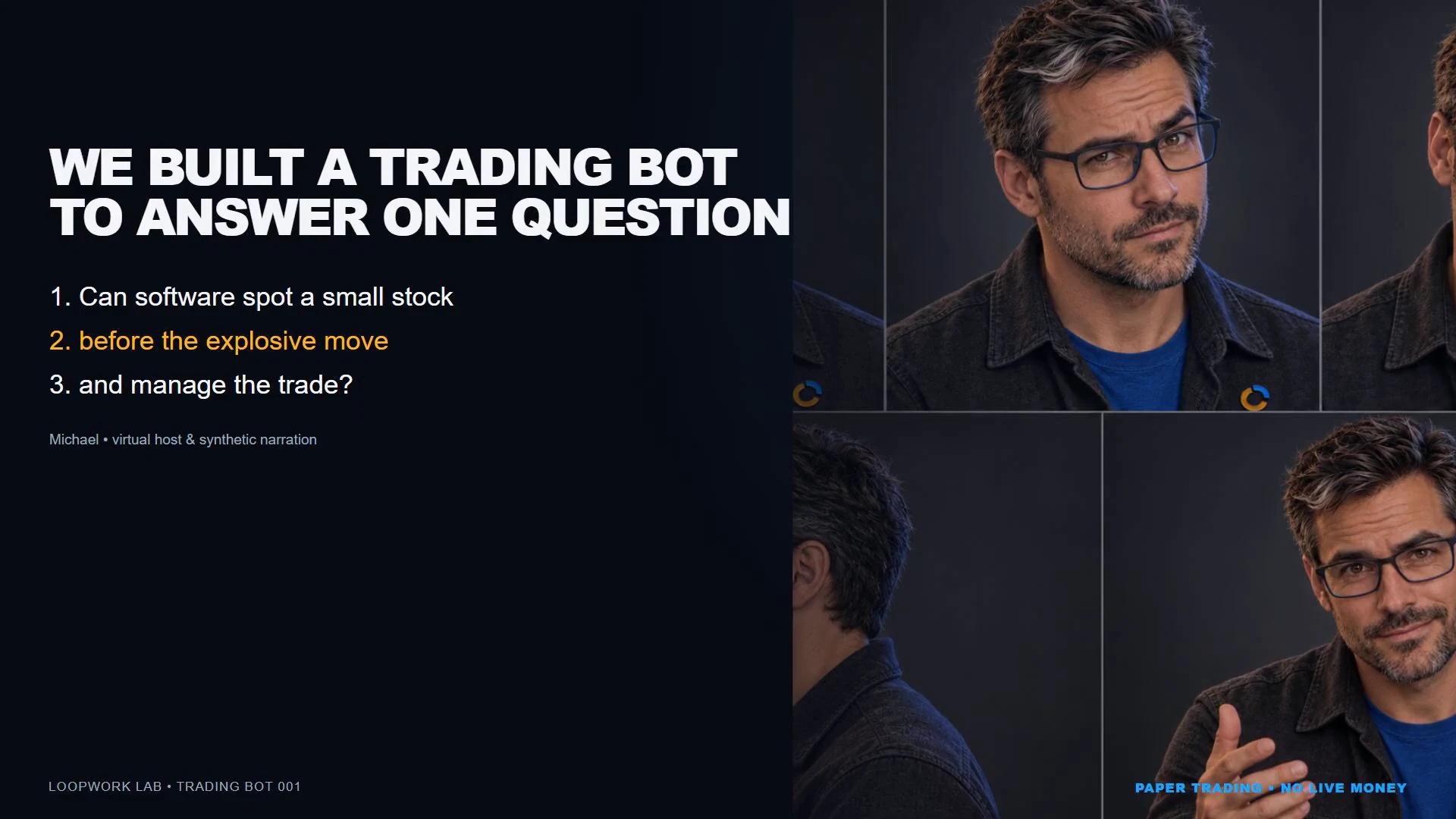
A creator built a software pipeline to answer one question: can code spot a small stock before an explosive move, then manage the trade without panic, greed, or hindsight? The answer, over ten simulated sessions, was no.
Here's the record as the creator presented it:
| Metric | Result (creator's claim) |
|---|---|
| Paper sessions | 10 |
| Completed trades | 8 |
| Winners | 1 |
| Net result | -$728.65 |
| Best trade | +$65 |
| Worst trade | -$237 |
| Profit factor | 0.08 |
| Without the single winner | -$793 |
Profit factor is just gross wins divided by gross losses. At 0.08, the bot earned roughly 8 cents for every dollar it lost. For context, most systematic traders won't touch a strategy under 1.2 in live conditions. This one wasn't close to breakeven, it was closer to a shredder.
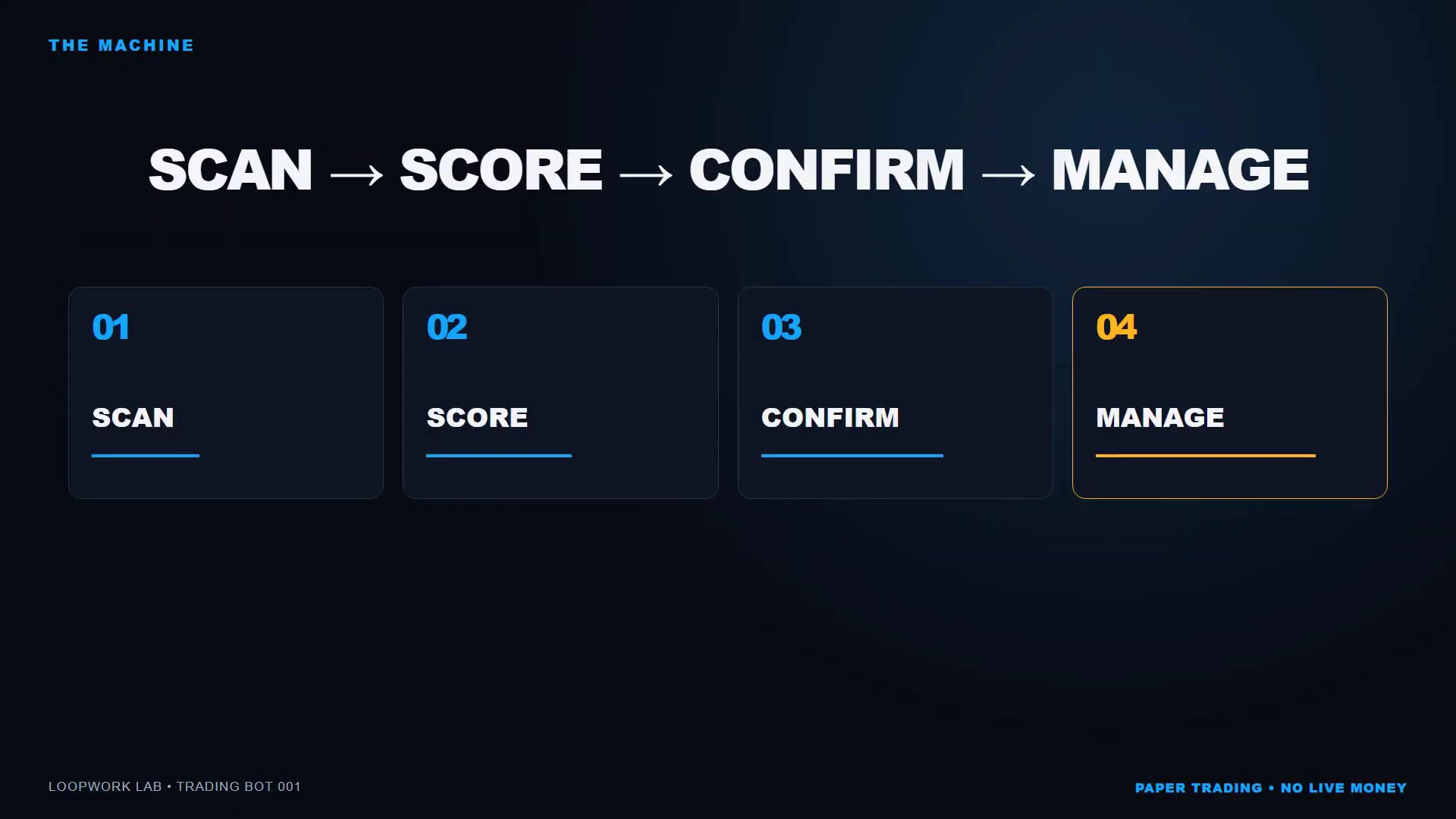
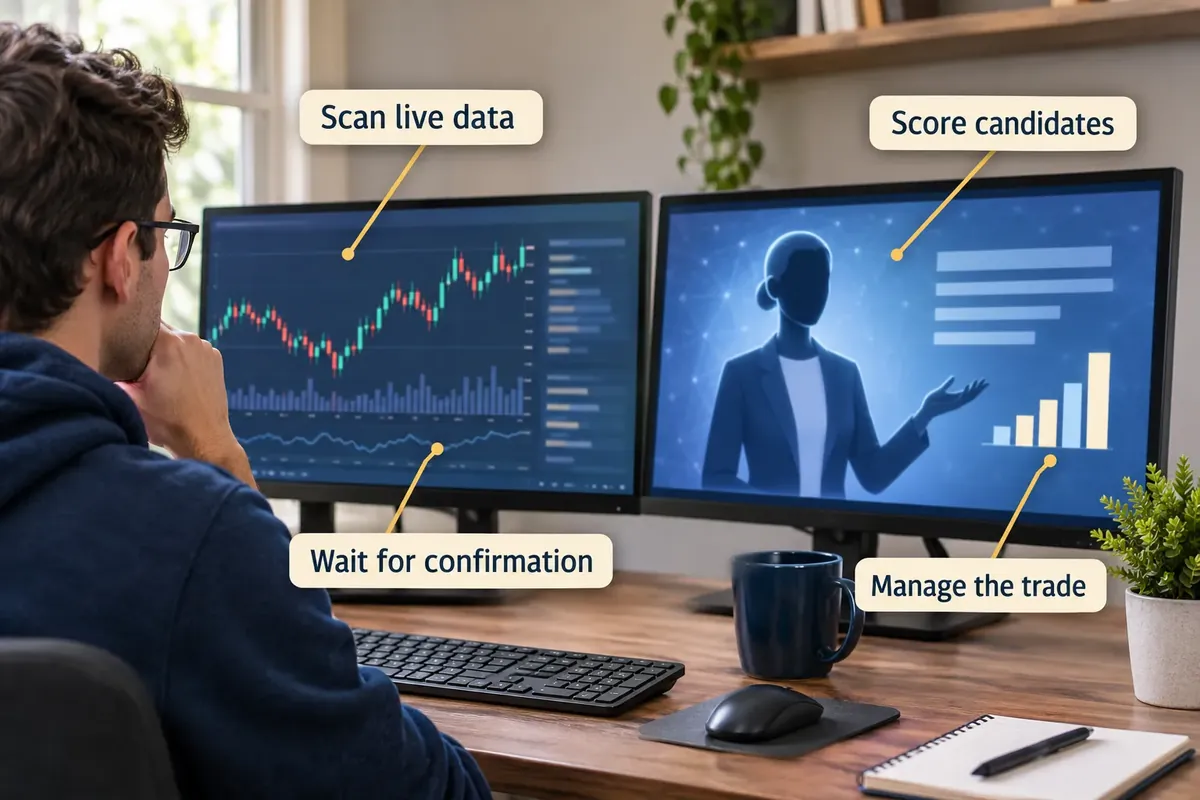
The architecture was shown on screen around (0:53) as a four-stage pipeline: scan, score, confirm, manage. The slide at (0:48) framed the mission plainly: "We built a trading bot to answer one question" (0:48). Scan for unusual price and volume. Rank candidates. Demand a completed bar before entering (a "completed bar" just means waiting for the candle to close instead of reacting to a flickering live price). Then enter with a hard stop loss and a profit target.
On paper, every one of those steps is disciplined. In the market, every one of them is a new way to be wrong.
The named tickers included MSS, WNW, EMDW, Biomerica, PPBT and CHPT (ticker spellings are from an auto-transcript, so treat them loosely). CHPT was the one that stung. The creator described a trade that moved 5% in its favor after entry, then reversed and closed down $82.73. The line that landed hardest: "It protected nothing" (2:41).
Original video: I Built an AI Trading Bot. It Lost $728., Loopwork Lab
Do AI Trading Bots Work? What This $728 Loss Shows
Do AI trading bots work at finding candidates? Often, yes. Do AI trading bots work at turning those candidates into net profit? That's a completely separate problem, and this experiment failed the second one badly. Automation is not an edge. Automation is a delivery mechanism for whatever edge you already have, and if the edge is zero, the bot just loses faster and more politely.
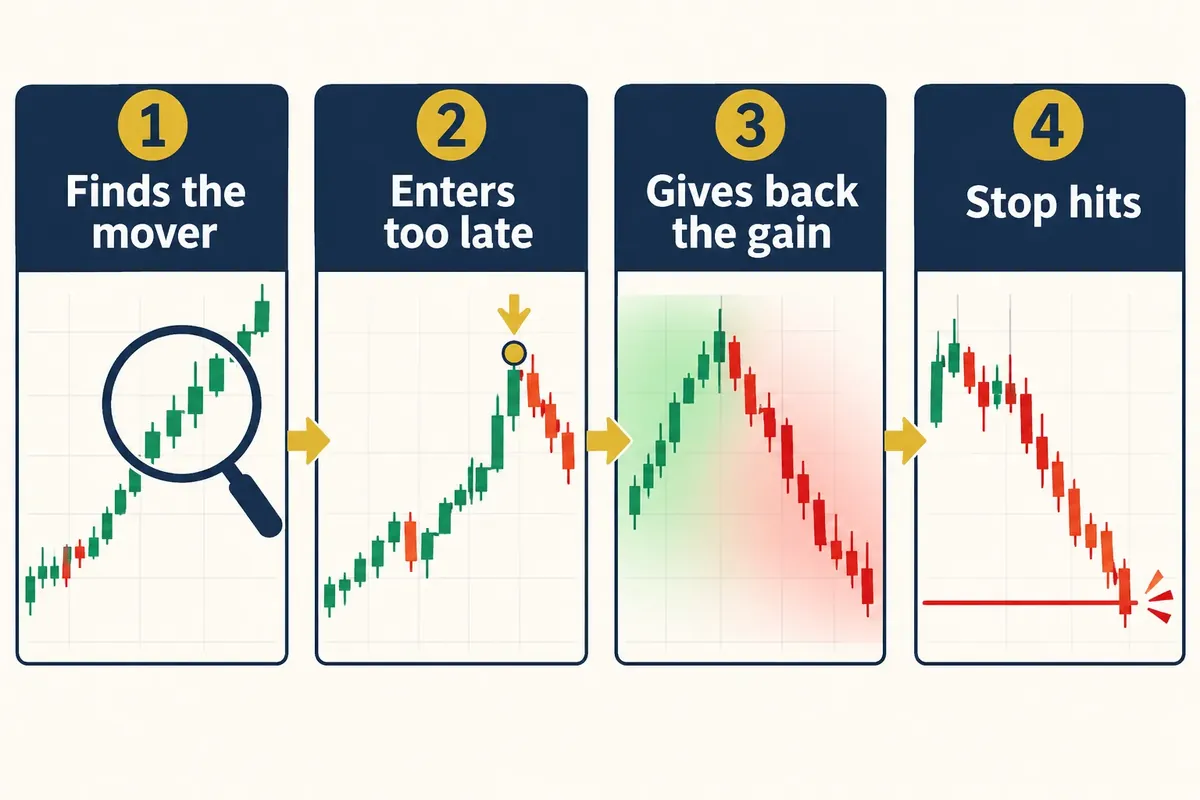
The result: 10 paper sessions, 8 trades, 1 win, -$728.65
Eight trades is not a sample. It's an anecdote with decimal places.
Any honest answer to "do AI trading bots work" starts with sample size. With 8 trades, a 12.5% win rate could just as easily have been 37.5% with different luck. You can't separate skill from noise at that count. The creator seems to know this, which is why the video ends with a bigger commitment rather than a victory lap.
Decision rule: if a bot, a signal service, or a YouTube video shows you fewer than 100 trades, you are looking at a story, not evidence. File it under entertainment.
Best trade +$65, worst -$237, profit factor 0.08
The shape of the P&L matters more than the total. The biggest winner was $65. The biggest loser was $237. That's a risk-reward profile running backwards: losses nearly four times the size of the best win, on a strategy that wins rarely.
A low win rate is survivable. Dennis-style trend followers win maybe 35% of the time and do fine, because the winners are multiples of the losers. This bot had the worst of both: it rarely won, and when it won, it won small.
A low win rate plus small winners isn't a strategy. It's a subscription to being wrong.
The stock that surged almost 50% and the bot still lost $193
This is the part worth tattooing somewhere. The scanner did its job. It flagged a small-cap name that went on to surge roughly 50%. The bot bought it. The bot lost $193 on it.
How? Entry timing, stop placement, and position management. The move happened, just not in the order or on the schedule the bot required. The stop got hit on the shakeout before the real leg. Anyone who has been stopped out an hour before their thesis played out knows that specific flavor of pain.
The lesson for anyone asking do AI trading bots work: prediction and profit are different jobs. You can be right about direction and still lose money on execution, spread, and sizing. Most retail tools sell the first job and quietly skip the second.
Why the 'fix' leaned on one lucky trade (-$113.98 without it)
After the losses, the creator tried the obvious repair: once a candle closes 5% above entry, sell half the position and lock something in. Under a hypothetical model including transaction costs, that looked better, until the single biggest winner was removed. Then the result flipped to -$113.98.
A second experiment, requiring a second completed confirmation before entry, produced a hypothetical +$379 over four trades. Strip the largest winner and it becomes -$48. It also cut the number of opportunities roughly in half.
That pattern has a name: overfitting. You tweak the rules until the past looks good, and the "improvement" rests on one or two outcomes that may never repeat. It's the backtest-versus-live-trading trap in miniature, and it's why the answer to do AI trading bots work is usually "they worked on the data they were built from."
Common mistake: judging a change by total P&L. Always ask what the result looks like with the single best trade deleted. If the edge dies, the edge was luck wearing a lab coat.
Bad data: missing price paths forced into answers
The most useful part of the video isn't the loss, it's the audit. The creator went back into the research foundation and found that some missing price paths had been forced into answers instead of staying unknown. Translation: when the data didn't say what happened, the system guessed, and the guess got treated as fact.
They rebuilt it so uncertainty stayed visible, then tested four forecasts on later data: probability of +10% before the stop, +5% before the stop, false breakout, and continuation. All four performed worse than simply predicting the historical base rates (5:20).
Read that again. The models were worse than a dumb average. That's not a tuning problem. That's a "there may be no signal here" problem, and most people never run the test that would tell them.
The new bar: 20 straight fully replayable paper sessions
Instead of declaring victory or quitting, the creator set a standard: 20 consecutive fully replayable paper sessions, control frozen. Every candidate, rejection, bar revision, decision, fill and missing path retained. Failed days count. No-trade days count. Unknown outcomes stay unknown (6:22).
That's a better protocol than most paid products publish. If a vendor won't show you the rejected trades and the flat days, you're seeing a highlight reel.
What to check before you trust any bot
Run this on any product, any creator, any "autonomous agent" that lands in your feed:
- Sample size. 100+ trades minimum, ideally across different market conditions.
- Profit factor after costs. Commissions, spread, slippage. Not gross.
- Out-of-sample results. Did it survive on data it never saw?
- Live or forward-tested, not just backtested. Backtests are auditions.
- A data audit. Were unknown outcomes left unknown, or filled in?
- The kill switch. Who can stop it, how fast, and from a phone?
If you want the longer version of this framework, we broke it down in how to find a trading edge before you risk a single dollar. And if you're comparing actual products rather than DIY code, start with the tested rankings in our guide to AI trading bots.
⚠️ Things to Look Out For
The honest risk here isn't that a bot loses $728 in simulation. It's that the same software, pointed at a funded account with real spreads and real emotions attached, loses far more and teaches you nothing because you never kept the logs.
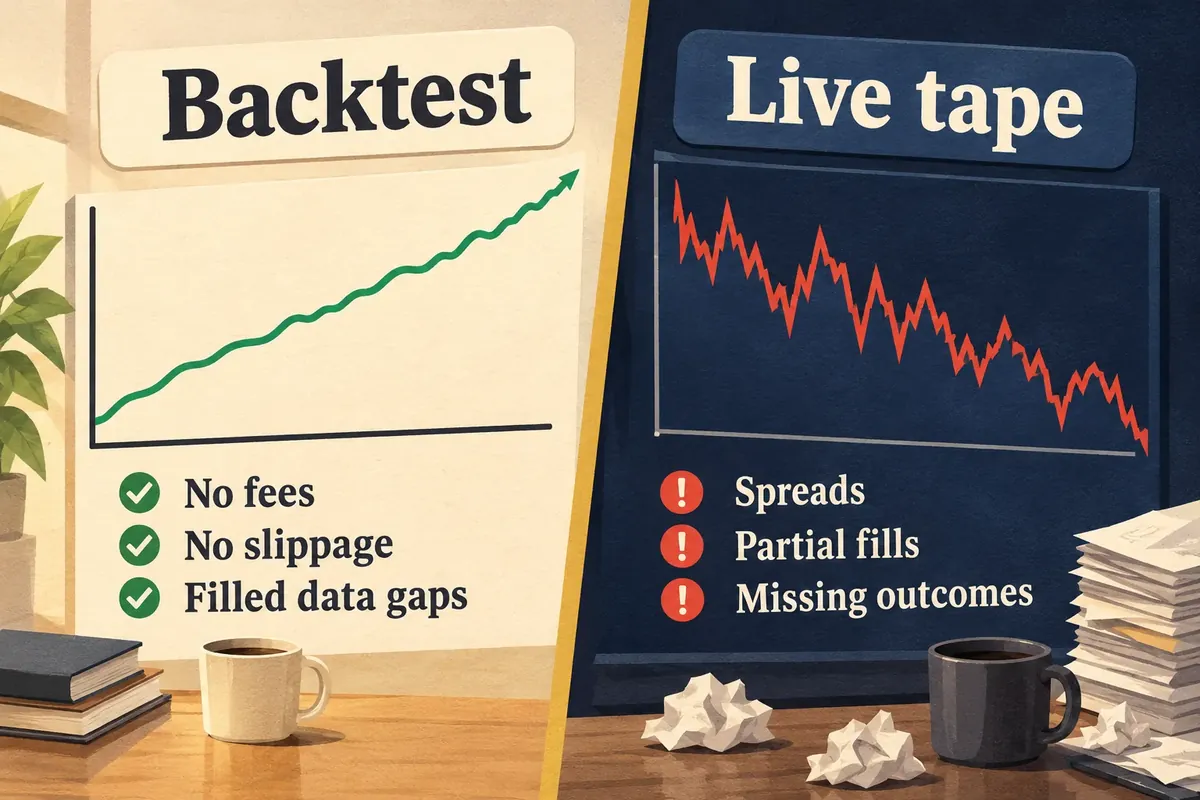
Paper trading flatters everything. Simulated fills assume you got the price you wanted. Small caps are exactly where that assumption breaks. Thin float, wide spreads, and a choppy tape mean your real entry is often worse and your stop fills lower than the number you set. A paper loss of $728 could easily be bigger live.
"AI" is a label, not a category. Some products are plain technical-rule bots with an AI sticker. Some use machine-learning forecasts. Some hand a language model the keys to asset choice, sizing and exits. And some, per SEC enforcement actions filed on September 29, 2026, don't exist at all. In one case the agency alleged roughly 1,715 retail investors lost about $2.8 million to a bot "rental" program where no trading occurred and the profits shown were fabricated. A separate case involved $12.5 million tied to purported AI trading signals. Losing money to a bad strategy and losing money to fraud are different failures with the same balance.
Regulators are explicit about the limits. The CFTC's November 2026 customer advisory, "AI Won't Turn Trading Bots into Money Machines," draws the exact line this video illustrates: automated execution is not predictive ability. Any promise of guaranteed or unusually high returns is a fraud marker, full stop. Read it straight from the source at cftc.gov.
The broader evidence isn't kind either. A Prediction Arena study tracked six frontier AI models trading real capital on prediction markets for 57 days (January 12 to March 9, 2026). All six lost money, with returns between -16.0% and -30.8%. One model hit a 71.4% settlement win rate on Polymarket and the cohort still finished negative. Win rate without payoff math is a vanity metric. In a separate live crypto-perpetuals experiment, independently recomputed results showed 31 of 38 model accounts losing money.
Who this is not for: anyone with under $2,000 who's hoping automation substitutes for a plan, anyone who can't read the code or the rules they're running, and anyone who'd take a 50%-mover headline as proof of anything. If you're starting out, free AI trading bots in paper mode will teach you more than a paid one you don't understand.
How Should You Read Any Bot's Results Before You Buy?
With five numbers and a calendar. Asking "do AI trading bots work" is the wrong first question. The better one is: what would I need to see to believe this one does?
- Number of trades: eight trades, like this bot, proves nothing either way. Look for hundreds.
- Profit factor: gross wins divided by gross losses. This bot posted 0.08. Above 1.3 after costs is a reasonable bar.
- Max drawdown: the worst peak-to-trough drop, in dollars and percent.
- Costs included: commissions, spreads and slippage, stated plainly.
- Live or paper: and for how long. Twenty straight fully replayable sessions is the creator's new bar, and it's a fair one.
Any vendor who can't show those five numbers is selling the idea of a bot, not a bot. So do AI trading bots work? Some do, narrowly, for a while. The ones that can't show their stats are the ones you'll pay to find out.
Flex or Cap? Our Verdict
Receipts shown. Strong. Eight trades itemized, best and worst named, profit factor stated, the single-winner dependency disclosed voluntarily. The creator even showed that two "fixes" collapsed when the best trade was removed. Most content creators bury that.
What can be verified. Thin. These are self-reported paper trades on an unaudited simulated account, presented by a channel with roughly 16 views, using an AI-generated host on the slides. Nothing here is independently confirmable. Ticker names came through an auto-transcript. Treat every figure as the creator's claim.
Risk disclosed. Excellent. No real money was used, and the video says so repeatedly. No returns promised. No course, no Discord, no signal group. The closing line asks viewers to subscribe for a result "before we know whether it is flattering" (6:54). That's the opposite of guru behavior.
Can a regular retail trader repeat it. Partly. Reproducing the bot requires real coding ability. Reproducing the method (log everything, keep unknowns unknown, strip the best trade and retest) is free and anyone can do it this week.
Verdict: Flex, with an asterisk. Not a flex on performance, obviously. It's a flex on honesty. The loss is the point, the audit is the value, and the 20-session standard is a better bar than most paid tools publish. The asterisk: it's unverifiable paper trading from a tiny channel with a sample size of eight. Useful as a cautionary case study. Useless as proof of anything about any specific product.
Do AI trading bots work? This video doesn't answer that question for the whole category. It answers it for one bot, and the answer was no.
What You Should Know Before You Try It
If you're still curious, and you should be, there's a sane path. It just doesn't start with funding an account.
Paper trade it first, and log everything. Not just wins. Log rejected candidates, no-trade days, and the trades you'd have taken manually. A trading journal template beats memory every time, because memory edits itself in your favor.
Set position sizing before strategy. Risk a fixed small percentage per trade. The creator's worst single loss was roughly a third of the total damage. Sizing is the only variable fully under your control, and it's the reason small accounts survive bad months.
Price in real costs. Commissions, spread, slippage, and partial fills. A profit factor that drops from 1.3 to 0.9 after costs means the strategy was never profitable, just under-measured. Backtest vs live trading is mostly a story about costs you forgot to subtract.
Know the rules that apply to you. The pattern day trader minimum is no longer the gate it was, but margin rules, settlement, and wash-sale treatment on an active bot still apply. Short-term gains are taxed as ordinary income, and a bot can generate hundreds of taxable events a quarter. Verify specifics at investor.gov.
Control the kill switch. If you can't stop the system from your phone in under 30 seconds, you don't own it. Check whether the platform you're on even offers that before you connect it to live capital. Our day trading tools breakdowns flag which ones do.
Check the vendor, not just the strategy. Registration, custody, withdrawal terms. If anyone promises fixed returns or a fee to "unfreeze" your account, you're not looking at a trading product. You're looking at the exit.
Automation is a discipline tool. It executes your rules without flinching, without revenge trading, without chasing the green candle at 3:50pm. That's genuinely valuable. It just can't invent an edge you never had, which is the short version of do AI trading bots work.
Keep reading on FullStack Alpha: our AI stock tool reviews, AI trading bot breakdowns on AI Stock Trading Bots, the AI trading bot shortlist, and more Flex or Cap breakdowns.
Frequently Asked Questions
Can you use bots to trade stocks?
Yes. Retail traders can run automated stock trading through broker APIs or platforms like Composer, Alpaca, and TrendSpider, and it's legal in the US as long as you're trading your own account. The software handles execution and rule-following. It does not supply the rules or guarantee they work.
Can you make $200 per day in day trading?
It's possible and it is not reliable. $200 a day on a $10,000 account is 2% daily, which would be an extraordinary annualized result that almost no professional sustains. Treat daily dollar targets as a red flag, because they push you into forcing trades on days with no clean setup.
What is AI quantitative trading?
AI quantitative trading uses machine learning models to find statistical patterns in market data and turn them into trade rules, instead of relying on hand-written indicators. Institutions use it with large datasets and execution infrastructure. The retail version is usually a much simpler model with far less data behind it.
Does AI trading really make you money?
Sometimes, for some systems, and rarely in a way that's been independently audited. As of late 2026, no verified public record of consistently profitable retail AI trading bots has been established, and live tests of frontier models on prediction and crypto markets mostly produced losses. Do AI trading bots work for the average retail buyer? The evidence says assume no until proven otherwise with your own forward-tested results.
What is the 3-5-7 rule in trading?
It's a risk management guideline: risk no more than 3% of your account on a single trade, keep total exposure under 5% across correlated positions, and aim for winners around 7% or at least a reward that outsizes the risk. The exact numbers vary by source. The principle, cap the downside before chasing the upside, is what matters.
Is a losing paper-trading result still useful?
Yes, if it's logged properly. A paper loss with full records tells you where the strategy breaks, which is information you'd otherwise pay for with real money. A paper loss with no logs tells you nothing except that you felt bad for a week.
One bot, eight trades, one honest post-mortem. There are 200+ AI stock tools catalogued in the FullStack Alpha directory, filterable by category, price and what they actually do.
Find a better fit → aistockpickerapps.com
Fewer tabs, fewer alerts, one process you can actually audit. Your market edge starts with the right tool. Stay alpha.