 Claude Code
 Codex
 Alpaca
 Telegram
Quick Answer
Using Claude for stock trading is real, repeatable, and mostly safe when you keep it on a paper account. Samin Yasar's video shows Claude connected to congressional-trade data and a simulated Alpaca brokerage, and it works exactly as demonstrated. The part that doesn't hold up is the implied payoff: the 45.20% return on screen is simulated money, and the data that drives the whole system can legally arrive up to 45 days late.
So is it a flex or cap? It's a flex on the plumbing and a cap on the profits. The build is legitimate. The edge is not proven. And a 45-day-old trade idea is a cold trail, not a pre-sale code.
The setup for Claude for stock trading in this video is a genuine flex on execution and a cap on the returns story, because every number shown comes from a simulated account and the congressional data behind it is delayed by law.
Here's the hook that gets people clicking anyway: a chatbot that reads what sitting members of Congress bought, decides what to do about it, and places the order while you're at your actual job. That's a compelling pitch. It's also a pitch that ignores the single most important detail about the data source, which we'll get to.
Most traders don't lose money because they picked a bad tool. They lose because they never asked what the tool's data actually measures. That's the whole story here.
What Does Samin Yasar Actually Claim?
Yasar claims Claude can now see what institutional buyers and US politicians are trading, act on that information, and run around the clock without supervision. The receipts he shows on screen are real software working. The receipts he does not show are a brokerage statement with real dollars.
What he says, in his own framing:
- Claude "just changed how we trade stocks forever" because of a new setup that connects it to smart-money data (0:00)
- The timing matters because the midterms flipped Congress and markets moved hard (0:30)
- His bot warned him before the vote and "saved me a bunch of money" (1:05)
- The build happens in three levels: connect Claude and the data, add trade automation, then let an autonomous agent run strategies (1:10)
What's actually on screen, with timestamps:
| Moment | What it shows | Verified or claimed |
|---|---|---|
| 5:11 | Claude confirming it's connected to Quiver Quantitative and pulling recent congressional trades | Verified on screen |
| 6:46 | A fresh Alpaca paper account named "AI Trader," funded with simulated capital | Verified, simulated |
| 8:24 | Generating Alpaca API keys and pasting them into Claude | Verified on screen |
| 9:29 | Claude reading existing positions (Tesla, Apple) and buying a share of Nvidia on request | Verified, paper fill |
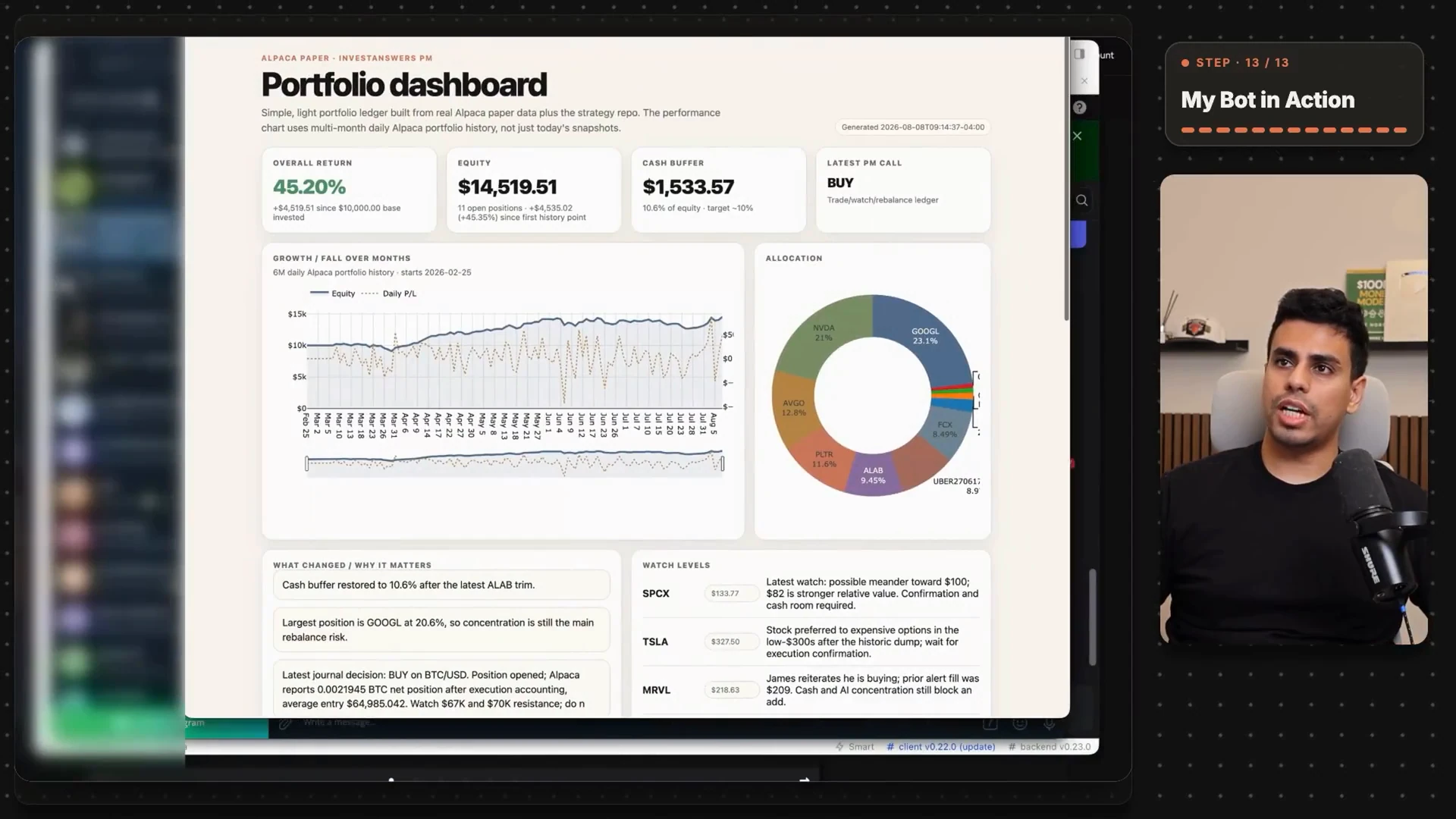
| 32:02 | A dashboard reading 45.20% overall return and $14,519.51 | Paper account, not real money |
That last line is the one that matters. A 45.20% return with no slippage, no real fills, no emotional interference, and no tax drag is a demo, not a track record. Paper money doesn't flinch.
Market truth: a screenshot of a number is not a track record. A track record is dated, audited, and includes the losing months.
Practical takeaway: watch the build, copy the build, ignore the return figure entirely.
Watch the source material yourself before you build anything: Claude Just Changed the Stock Market Forever! (Tutorial) by Samin Yasar. It's worth the 32 minutes if you plan to replicate it, because the API key handling is the part you don't want to improvise.
Two things to keep in mind while watching. First, Yasar never claims to be running real capital in this walkthrough, so nobody is being deceived. Second, the title does the heavy lifting the content doesn't. "Changed the stock market forever" is a thumbnail promise. What changed is how easy it is to wire a language model to a broker.
That's still a big deal. Just not the deal the title sells.
How Do You Set Up Claude for Stock Trading With Congress Data?
Setting up Claude for stock trading with congressional data takes four connections: a Claude subscription, a Quiver Quantitative connector for the trade disclosures, an Alpaca paper account for execution, and API keys linking the two. Total setup time is roughly 30 to 45 minutes if nothing breaks.
Here's the full build, step by step, with the parts the video glosses over.
The pitch: see what whales and politicians buy, trade it around the clock
The argument goes like this. Large funds and sitting politicians move money before the news catches up. If you can see those moves, you can position behind them. And if a machine watches the feed 24/7, you never miss one while you're asleep or in a meeting.
Yasar frames the always-on part well: you don't stand in your kitchen sniffing for smoke all day, you install a detector (3:06). That analogy is correct. Alerting is a genuinely good use of AI. Humans are terrible at sustained attention and excellent at reacting once something fires.
Where the pitch overreaches: "seeing" a politician's trade and "being early" are two different events separated by weeks.
Why congressional trades are like a concert pre-sale code
The video's best analogy compares insider access to concert tickets: the pre-sale crowd grabs the good seats a day early, and by the time general sale opens, you're paying triple on resale (1:34).
It's a sharp picture. It's also the exact reason this strategy needs a warning label.
Under the STOCK Act of 2012, members of Congress must disclose covered transactions within 30 days of becoming aware of them, and no later than 45 days after the transaction date. So Quiver Quantitative, which aggregates those public filings, is reporting something that already happened up to a month and a half ago.
Keeping the analogy honest: you're not getting the pre-sale code. You're reading a list of who used it, posted after the show.
That doesn't make congressional data worthless. It makes it a theme detector, not a timing signal. If five members across both parties loaded up on defense or power infrastructure names over a quarter, that's a sector tell worth researching. Chasing a single 40-day-old purchase is just catching a falling knife with extra steps.
Step 1: connect Claude to Quiver Quantitative
Claude on its own has no live feed of congressional filings or institutional positions. You bridge that gap with a connector (4:08), which is a standardized link between the model and an outside data service.
This matters more than it sounds. In October 2026, Anthropic donated the Model Context Protocol (MCP) to the Linux Foundation's Agentic AI Foundation, backed by Anthropic, Block, OpenAI, Google, Microsoft, AWS, Cloudflare and Bloomberg. MCP is the standard that makes "connect Claude to a financial data provider" a ten-minute task instead of a custom engineering project.
To connect it:
- Open Claude's settings and find the connectors or integrations panel
- Add the Quiver Quantitative connector and authorize it with your Quiver account
- Confirm the connector shows as active before you open a new chat
A Quiver account is a paid subscription for the full dataset. Budget for that before you start. Free tiers exist but lag further behind and cut the historical depth.
Common mistake: adding the connector but testing it in an old chat window. Connectors register on new conversations. Start fresh.
Step 2: ask Claude what Congress is buying
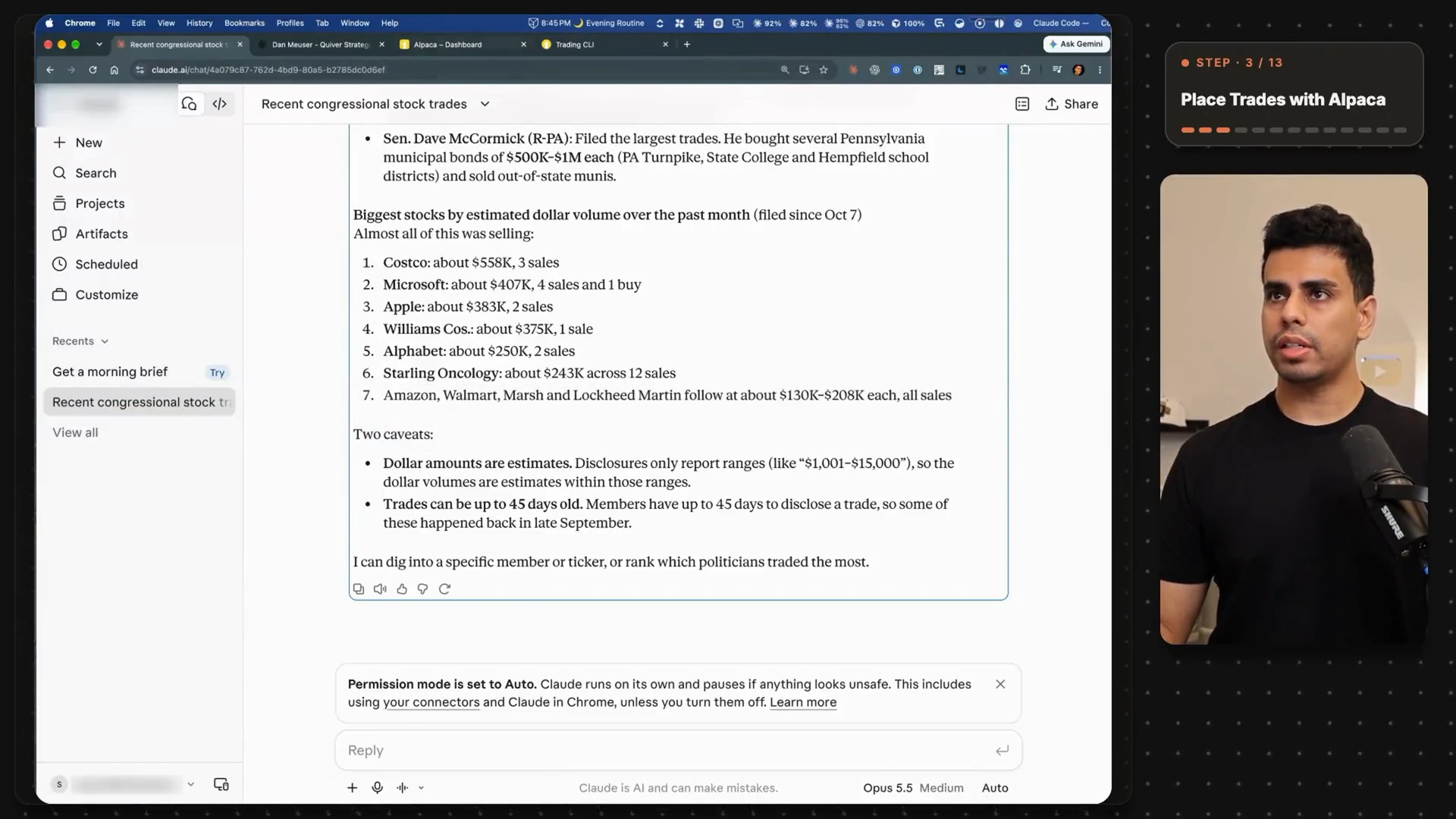
Verify the link before you trust anything downstream. Yasar does this by simply asking whether Claude is connected and requesting recent congressional trades (5:11). Claude confirms and pulls the list.
Do the same, then push harder. A connection test is not a research session. Better prompts for Claude for stock trading research look like this:
- "List congressional purchases disclosed in the last 30 days, grouped by sector, with the filing date and the transaction date side by side."
- "For each name, show how far the stock has moved between the transaction date and today."
- "Flag any ticker bought by three or more members in different committees."
That second prompt is the one that protects you. If a stock already ran 22% between the trade and the disclosure, you're not following smart money, you're buying their exit liquidity.
The screenshot from the video showing Claude pulling congressional stock research sits naturally here, at the moment the connector proves itself.
Decision rule: if the move between transaction date and disclosure date is already larger than your normal swing target, skip it. The trade happened without you.
Step 3: connect an Alpaca paper account (generate the API keys)
Alpaca is a commission-free broker with a developer API and, critically, a free paper-trading environment. Yasar creates a new paper account, names it "AI Trader," and funds it with simulated capital (6:46).
The sequence:
- Create an Alpaca account and switch the dashboard to paper trading mode
- Open a new paper account and set a starting balance that matches what you'd actually risk, not a fantasy number
- Go to the API keys panel and hit generate (8:24)
- Copy the key ID and secret, then paste both into Claude with a plain instruction like "set up a new trading account with these credentials"
- Ask Claude to confirm it's reading the paper endpoint, not live
That last step is non-negotiable. Alpaca uses separate base URLs for paper and live trading. If you ever upgrade to a funded account, one wrong environment variable is the difference between a simulation and a real fill.
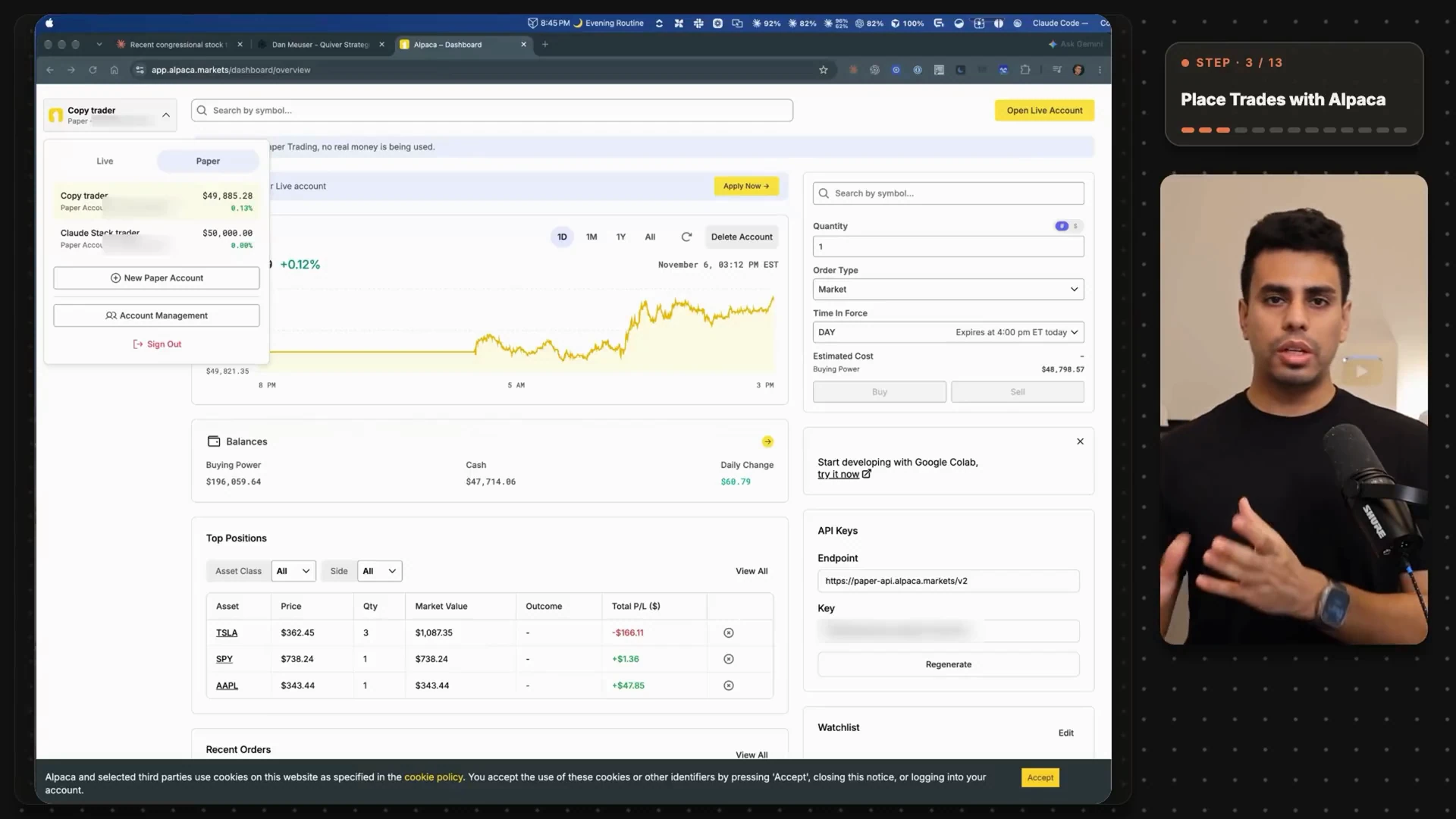
The video's Alpaca dashboard shot, with positions visible and the API key blurred, belongs right here.
Security note most tutorials skip: API keys are bearer credentials. Anyone with them can trade your account. Never paste live-trading keys into a chat window, never commit them to a public repo, and rotate them the moment a session feels off. Blur them in screenshots, like Yasar does.
Match your paper balance to reality. A $10,000 simulated account teaches you position sizing. A $500,000 one teaches you nothing except how good you look when nothing is at stake.
Step 4: let Claude read the account and the positions
Once the keys are in, Claude can query your holdings in plain English. Yasar asks what he owns, and Claude lists three shares of Tesla and one Apple, then buys a share of Nvidia on a single conversational request (9:29).
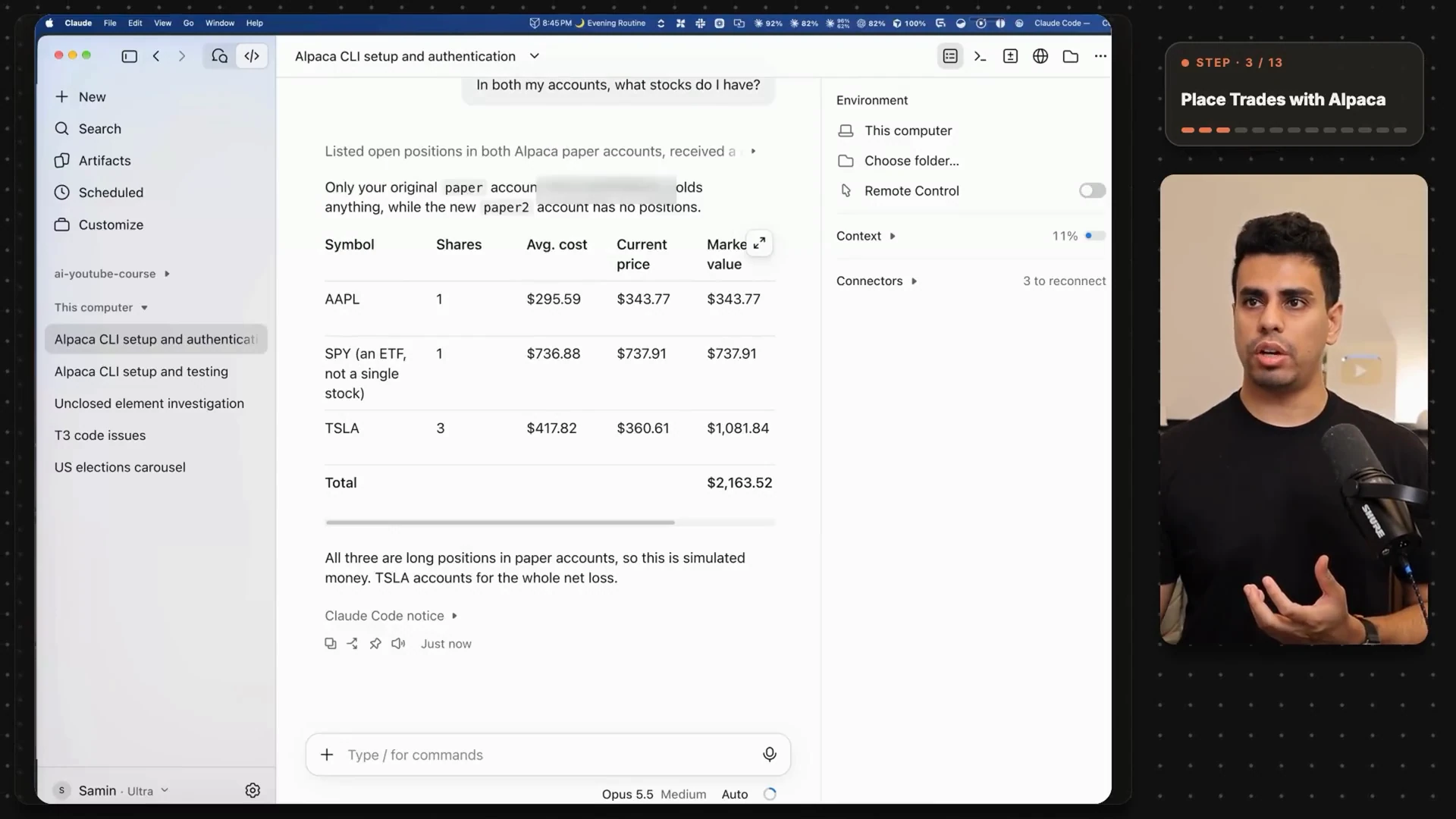
The screenshot of Claude reading the Alpaca positions illustrates this exact moment.
That's the whole magic trick. No code, no order ticket, no platform. You type a sentence and a position appears.
Which is also the scary part. There's no confirmation dialog in a chat window. If you type "buy Nvidia" and mean one share, make sure the model knows that, because ambiguous instructions produce ambiguous order sizes.
Guardrails to write into your system prompt before you let it trade anything:
- A hard maximum position size in dollars, not shares
- A maximum number of orders per day
- A requirement to state the entry, the stop loss, and the risk-reward before any order
- A rule that it must ask for confirmation on anything above a set threshold
Writing those rules is the actual skill. The connection is a plumbing job; the rulebook is the trading system.
The concepts: agents, Claude Code and Hermes
Yasar pauses the build to explain the architecture, and it's the most useful stretch of the video. His analogy: the model is the engine, the harness is the car (10:31).
"When Claude said it can only do paper trades, that wasn't the engine, that was the car." (11:34)
Translated:
- The model (Claude Opus, for example) is the reasoning engine. It thinks, but it can't touch your files or your broker on its own.
- The harness is the software wrapper that gives the model hands, memory and permissions. Claude Code is Anthropic's own harness.
- An agent is a model plus a harness plus a goal, running on a loop without you babysitting each step.
He then introduces Hermes, a free open-source agent framework, and compares harnesses to hiring help: a contractor builds what you ask and leaves, while an assistant sticks around, keeps context and improves (12:37). Hermes keeps memory, writes its own reusable skills after solving a hard task, and can read your browser sessions, so a Discord or Telegram trade call can be checked against your rules automatically (13:38, 17:18).
Is that overkill for most readers? Yes. If you're new to AI trading tools, stop at Step 4. Claude plus Alpaca paper is already more automation than 90% of retail traders have. If you want to compare what else exists at that level, our roundup of the best AI trading platforms for 2026 covers the managed options that don't require you to run your own agent.
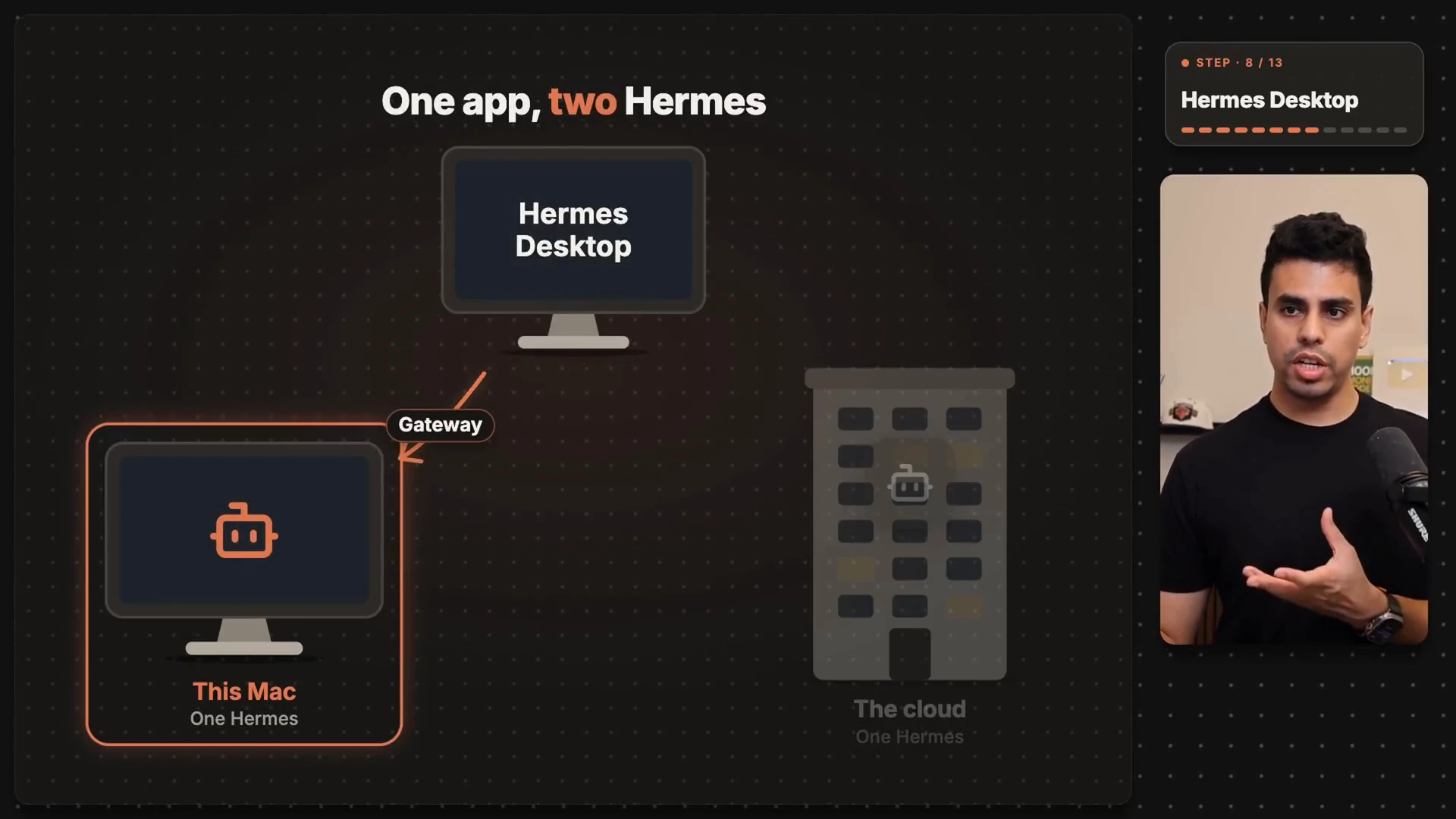
One app, two Hermes: desktop vs cloud
Hermes runs in two places, and the choice determines whether your bot sleeps when your laptop does.
| Desktop Hermes | Cloud Hermes | |
|---|---|---|
| Runs when your machine is off | No | Yes |
| Cost beyond model tokens | Free | Server/hosting fees |
| Access to local files and logged-in browser sessions | Yes | Limited |
| Setup difficulty | Moderate | Higher |
| Best for | Testing, research, learning the system | Scheduled or always-on tasks |
The video's side-by-side of desktop and cloud Hermes in one app appears at 22:10 and fits here.
Decision rule: run desktop until your strategy has survived at least 30 days of paper trading. Paying for cloud hosting to run an untested system around the clock is just paying to be wrong faster.
The bot in action: 45.20% and $14,519.51 on a paper account
The closing demo shows a bot reporting 45.20% overall return and a balance of $14,519.51, with written explanations for each holding and ongoing updates (32:02). Yasar notes he can change or remove strategies whenever he wants.
That final dashboard screenshot belongs here, with the paper-account caveat directly beneath it.
Let's be precise about what that number is and isn't.
What it is: evidence the system runs, executes, tracks and reports. That's real and it's useful.
What it isn't: a return. Paper fills assume you got the price you asked for. They ignore slippage on thin names, partial fills, halts, borrow costs, commissions where they apply, and the tax bill on short-term gains. They also ignore the thing that destroys most accounts, which is the human sitting there at a 12% drawdown deciding to override the system.
Simulated performance consistently flatters strategies. Anyone who has run a backtest that looked brilliant and a live account that didn't knows the gap. Play stupid games with a demo number and you'll win stupid prizes with real capital.
⭐ Top 5 Features We Love
Five things this build genuinely does well, each tied to something visible in the video or to documented platform capability.
1. The paper-trading default. Yasar builds the entire thing on an Alpaca simulated account, not live capital (6:46). Plenty of AI trading videos skip straight to real money for drama. This one doesn't. Paper trade it first is the right default, and he follows it.
2. The engine-versus-car explanation. The model/harness distinction (10:31 to 11:34) clears up the single biggest confusion beginners have about AI tools. People blame "the AI" for limitations that belong to the software wrapper around it. That one analogy is worth the watch by itself.
3. The connector architecture is real and standardized. This isn't a hack that breaks next month. MCP moved to the Linux Foundation's Agentic AI Foundation in October 2026 with backing from Anthropic, Google, Microsoft, OpenAI, AWS and Bloomberg. Financial data connectors built on it are infrastructure now, not a weekend project.
4. Claude explains its reasoning for every position. At 32:02, the bot lists what it bought and why, then keeps updating. Most retail traders can't articulate why they're in a position. A system that writes its thesis down forces a process, and a written thesis is what lets you judge whether you were right for the right reason.
5. Memory and self-written skills in Hermes. The agent saving a step-by-step guide after solving a hard task (13:38) is the difference between a tool and a system. It compounds. That's the same reason traders keep a journal, just automated.
For context on where tools like this sit against conventional software, our comparison of AI stock screeners versus the old filters covers what actually changes when a model does the filtering.
⚠️ Things to Look Out For
Now the uncomfortable part. Six specific problems, and who should skip this entirely.
1. The 45-day disclosure delay is a structural flaw, not a detail. The whole premise is being early. STOCK Act filing windows make that mathematically impossible on a single trade. Quiver can only report what's filed. No amount of AI fixes a data source that arrives after the move.
2. The 45.20% figure is simulated. $14,519.51 in a paper account is a demo balance. Live trading adds slippage, partial fills, short-term capital gains tax, and your own hands on the keyboard during a drawdown.
3. Running costs add up fast. A Claude subscription or API spend, a Quiver subscription, cloud hosting for an always-on agent, and token costs that climb with every scheduled task. Agents that run 24/7 burn tokens 24/7. Price it out before you build, because a system costing $150 a month needs to clear $1,800 a year just to break even.
4. API key exposure is a genuine risk. Chat interfaces are not credential vaults. Keep live keys out entirely until you've run paper for weeks, and rotate anything you've pasted anywhere.
5. AI trading fraud is an active enforcement area. In September 2026, the SEC charged multiple entities over schemes totaling at least $15 million involving claimed AI trading bots, alleging in one case that there was no genuine trading activity and the bots didn't exist. Building your own transparent system is the opposite of that risk. Paying a stranger for their "proprietary AI bot" is exactly that risk. Check any firm on Investor.gov before sending money.
6. Adoption is not the same as profitability. Morningstar's 2026 US survey of 2,000 respondents found 21% had used generative AI for financial advice and 44% expressed high trust, but only 2% relied on AI for most investment decisions. A separate Investing.com survey of 938 US investors in March 2026 found 62% had used AI to inform a decision, while just 4.5% used automated trading algorithms. Lots of people are experimenting. Very few are handing over the wheel.
Who this is not for: anyone with under three months of trading experience, anyone who can't define a stop loss, anyone who'd be tempted to connect live keys on day one, and anyone looking for a system that makes decisions so they don't have to.
What Can Claude for Stock Trading Do Well, and What Can't It Do?
It's a sharp research assistant and a weak fortune teller. That's the split to keep in mind with Claude for stock trading.
| Good at | Not good at |
|---|---|
| Pulling and summarizing congressional trade filings | Knowing why a politician traded |
| Reading your positions through an API | Predicting tomorrow's price |
| Writing and scheduling a rules-based bot | Fixing a strategy with no edge |
| Explaining filings, earnings and jargon | Making delayed data current |
The delay is the big one. Congressional disclosures can arrive weeks after the trade, so by the time Claude for stock trading sees the filing, the market has had plenty of time to react. That doesn't make the data useless. It makes it slow, and slow data needs slow strategies.
Use Claude for stock trading to do the reading you'd skip. Keep the decisions, and keep it on paper until the results earn real money.
Flex or Cap? Our Verdict
Scored on four questions.
Receipts shown? Strong. The connector works, the account is real, the orders fill, the dashboard reports. Everything claimed about the software is demonstrated on camera with timestamps. Pass.
What can be verified? The architecture, fully. MCP's standardization, Anthropic's tool-use and code-execution capabilities, Alpaca's paper API, and the STOCK Act's 45-day window are all independently checkable. The 45.20% return is not verifiable as real-money performance, because it isn't. Partial pass.
Risk disclosed? Weak. Paper trading is used throughout, which is responsible. But the disclosure delay, the running costs, the API key exposure, and the gap between simulated and live results are never addressed. A viewer could reasonably walk away thinking they've found an early-warning system. Fail.
Can a regular retail trader repeat it? Levels 1 and 2, yes, in under an hour with a card on file. The Hermes agent layer needs comfort with terminals and hosting, which rules out a chunk of the audience. Mostly pass.
Verdict: Need More Receipts.
Not cap. Nothing here is fabricated, and the tutorial delivers a working build. But the headline promise rests on a performance number from a simulation and a data edge that the law delays by up to six weeks. Using Claude for stock trading this way is a legitimate research and automation upgrade. Calling it a change to the stock market forever is thumbnail economics.
The honest framing: this is a very good way to automate research and order entry. It is not a way to front-run Congress. Treat it as the former and it earns its keep.
If you want tools that are scored rather than demoed, see our honest AI stock tool reviews based on what real users say.
What You Should Know Before You Try It
Five things to lock in before you touch a keyboard.
1. Paper trade it first, with a real-sized account. Thirty trading days minimum, at least 20 closed positions, with a simulated balance matching what you'd genuinely risk. Judge the system on its losing stretch, not its winning one. If you can't sit through the drawdown in a simulation, you won't survive it live.
2. Write your position sizing rules before the bot writes anything. Decide the maximum dollar risk per trade and the maximum concurrent positions, then put those numbers in Claude's instructions as hard limits. A model with no size constraint will happily build a portfolio you'd never build yourself. Risk management comes before setups, always.
3. Price the full stack. Claude subscription or API usage, Quiver Quantitative, optional cloud hosting, and token costs that scale with how often your agent wakes up. Write the monthly total on a sticky note. That's your hurdle rate before you've made a dollar.
4. Know the tax treatment. In a US taxable brokerage account, positions held under a year are short-term capital gains taxed at ordinary income rates. An automated system that trades frequently generates a lot of those, plus wash-sale complications if it re-enters names it just stopped out of. Talk to a tax professional before scaling frequency.
5. Verify the underlying data yourself. Don't take a connector's word for a filing. Congressional disclosures are public through the House and Senate disclosure portals, and company filings live on SEC.gov. Spot-check a few entries. If the data doesn't match, nothing downstream matters.
6. Keep live keys out until the system has earned them. Paper environment only, every time, until the process is boring. Boring and repeatable beats clever.
Keep reading on FullStack Alpha: our Alpaca review, AI trading bot breakdowns on AI Stock Trading Bots, the AI trading bot shortlist, and more Flex or Cap breakdowns.
Frequently Asked Questions
Can Claude help with the stock market?
Yes, for research, screening, summarizing filings, and automating order entry through a broker API like Alpaca. Claude supports tool use, code execution, web search and external data connectors, which is what makes Claude for stock trading workflows possible. It can't predict prices, and no model can.
How to buy Anthropic stock?
You can't directly. Anthropic is a private company as of November 2026, so no publicly traded shares exist. The common indirect routes are large shareholders with disclosed stakes, including Amazon and Alphabet, or private-market funds, though exposure through those is small and indirect. Be skeptical of anyone offering pre-IPO Anthropic shares.
How to make $1000 a month trading stocks?
There's no reliable formula, and anyone selling one is selling something. Mathematically, $1,000 monthly on a $50,000 account means 2% a month, which is a demanding and inconsistent target even for experienced traders. Roughly 70% of active day traders lose money. Build a process that survives first and let the dollar figure be an outcome, not a goal.
Can you make $200 per day in day trading?
Some traders do on some days, and the same traders lose $200 or more on other days. Daily income targets encourage overtrading and revenge trading, which is how small accounts die. Judge yourself over 50 trades, not one session.
How much money do day traders with $100,000 accounts make per day on average?
There's no credible average, because the distribution is dominated by losses. Academic studies of retail day traders consistently find the large majority lose money net of costs, with a small minority persistently profitable. Any site quoting a tidy daily average for a $100,000 account is guessing.
How did one trader make $2.4 million in 28 minutes?
Stories like that usually involve a concentrated options position into a surprise catalyst, which is a lottery ticket that happened to hit. The same structure wipes out accounts far more often than it makes headlines, because nobody posts the losing version. Survivorship bias is the whole explanation.
One tool, examined end to end. There are 200+ more catalogued in the FullStack Alpha directory, filterable by category, price and what they actually do.
Browse the directory → aistockpickerapps.com
Related reading: AI stock research tools worth testing and the stock market terms glossary if any of the jargon above needs a plain-English definition.
Build the system, run it on paper, keep the receipts. Your market edge starts with the right tool. Stay alpha.
This article is educational and not investment advice. Some links may be affiliate links.
Is it safe to use Claude for stock trading with a real account?
Start on a paper account, as the video does. Claude for stock trading through an Alpaca API can place real orders if you give it live keys, so test the bot, set position limits and keep a kill switch before switching accounts.