 Claude
 Codex
 Alpaca
Quick Answer
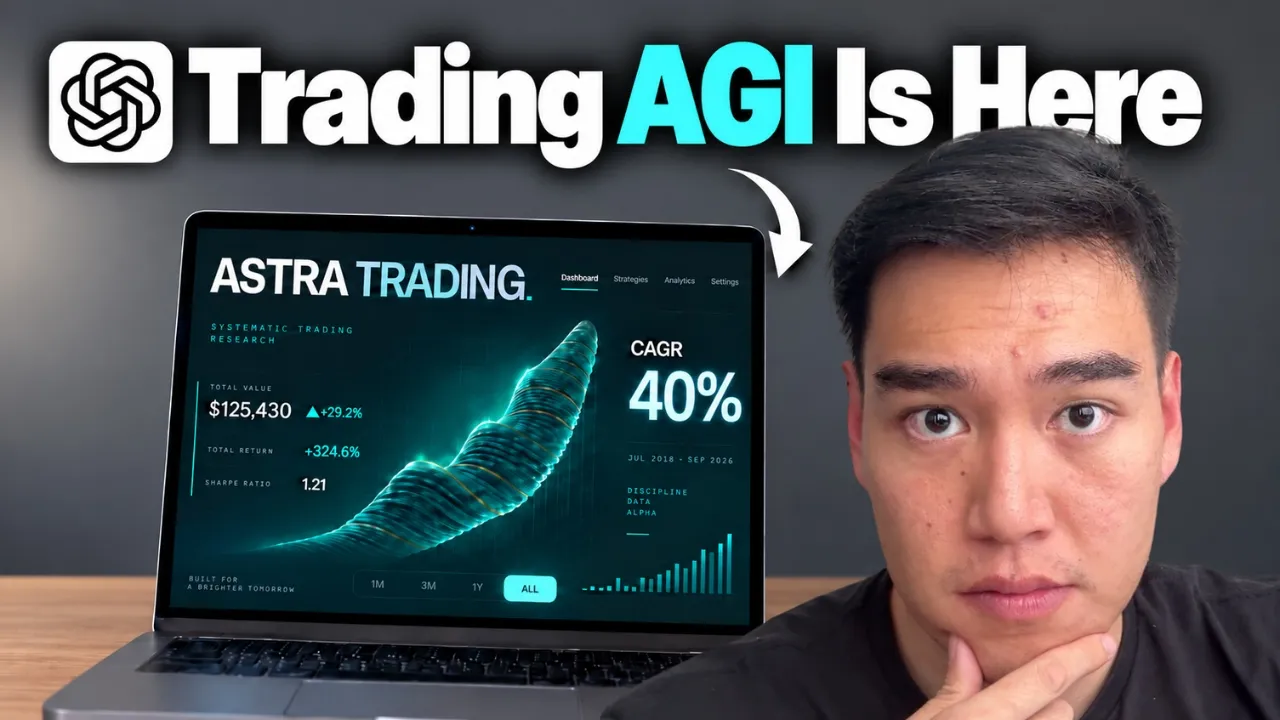
Nate Herk's GPT-6 Astra tutorial is a legitimate build guide for an AI stock trading bot, and it's also missing the one thing that matters: audited results. The setup works. Codex, Alpaca, scheduled routines, file-based memory... all real, all repeatable. What's thin is the performance evidence, and what's misleading is the "24/7" framing for a bot that only touches equities during U.S. market hours. Verdict up front: Flex on the build, Need More Receipts on the returns.
Here's the part that should slow you down. A November 17, 2026 preprint titled LLM Trading Agents Earn Beta, Not Alpha tested 91 runs across six models from four vendors. Not one run produced statistically significant alpha. Market and style exposure explained a median 78% of returns. Translation: the agents mostly bought the market and called it genius.
So build it. Just don't confuse the build with an edge.
What Does Nate Herk | AI Automation Actually Claim?
Herk claims he previously gave Claude $10,000 of real money to trade for a month and finished roughly 8% ahead of the S&P 500. That's his number, from his earlier challenge, with no third-party audit. The September 7, 2026 tutorial is him re-running the same experiment with GPT-6 Astra, and he's explicit that it hadn't produced results yet when he published.
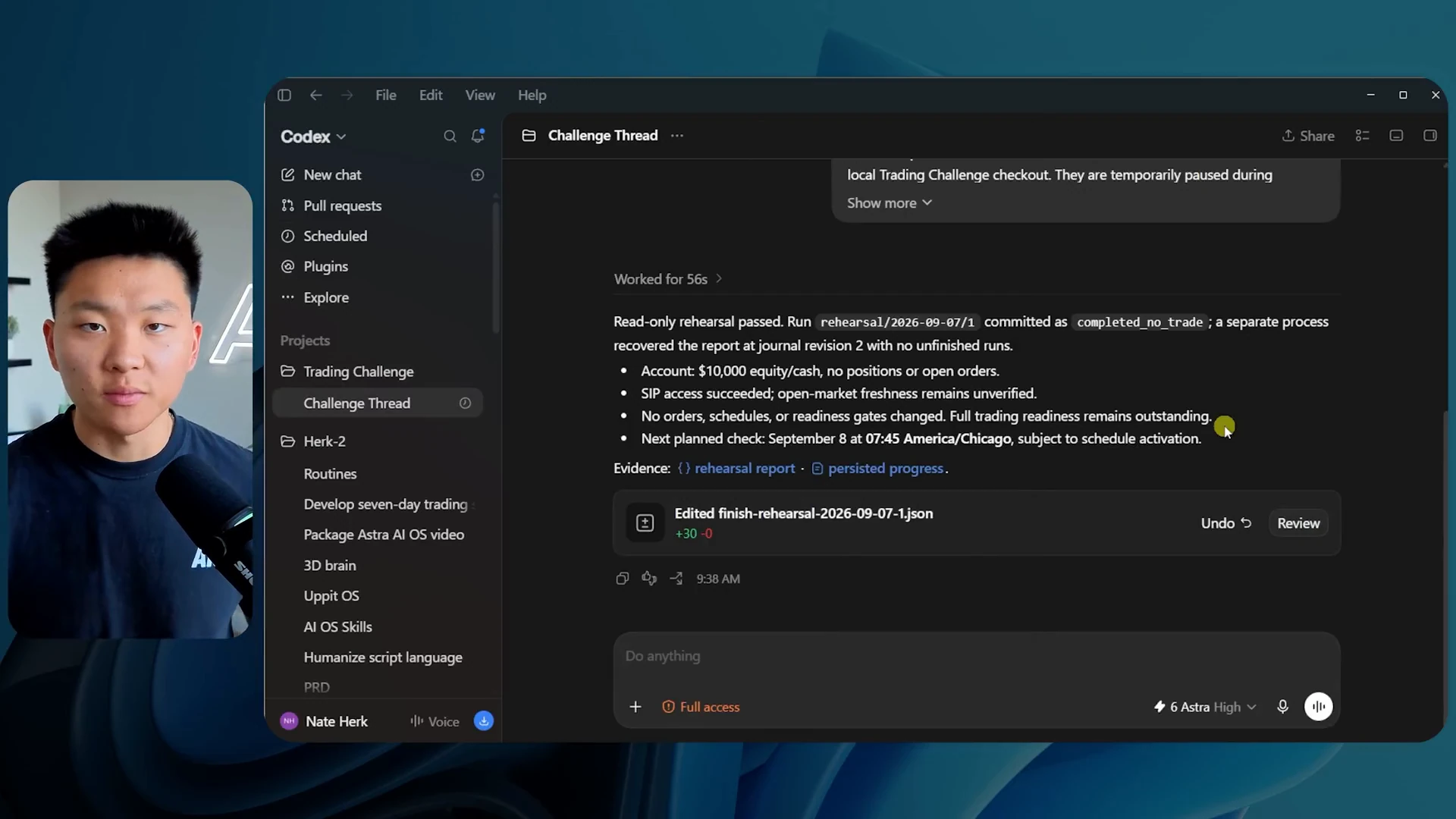
To his credit, he opens with a disclaimer most finance YouTubers skip. In the first ninety seconds he says this isn't financial advice and that he isn't recommending you hand an agent $10,000. He recommends paper trading first and automating only a strategy you already understand (0:58). That's a more honest framing than 90% of the "AI trading bot" content clogging YouTube right now.
What's actually shown on screen
The tutorial is heavy on receipts for the build and light on receipts for the outcome. What you can see with your own eyes:
- (6:11) The Alpaca dashboard with filled orders, API key masked. Real broker, real fills.
- (7:45) The
.envtemplate in Codex where API keys live, keys redacted. - (8:55) The Codex plugins panel with Alpaca connected.
- (14:18) The scheduled routines list, six wake-ups, each pointing at specific files.
- (15:47) A rehearsal results report from the dry run.
What you don't see: a profit and loss curve, a trade log, or a brokerage statement.
What later reporting says happened
Secondary coverage indicates the seven-day live run ended near $9,900. That's about $100 down, and roughly 0.8 percentage points behind the S&P 500 over the same stretch. Herk reportedly called the sample too short to judge, which is correct. Seven days of data tells you nothing about a strategy. It's a coin flip with extra steps.
One more wrinkle from later reviews: the execution leg may have been handed to a separate Grok-based component after Astra was judged too cautious to pull the trigger. If that's accurate, you're not evaluating GPT-6 Astra as a trader. You're evaluating a multi-model relay where one model researches and another one presses the button. That changes what the experiment proves.
The video has pulled somewhere between 546,000 and 589,000 views depending on which analytics source you check, making it one of the channel's biggest. Views measure curiosity. They don't measure fills.
Watch the original here: I Turned GPT-6 Astra Into a 24/7 Stock Trader
How Do You Turn GPT-6 Astra Into an AI Stock Trading Bot?
You build an AI stock trading bot by wiring four pieces together: GPT-6 Astra running inside Codex as the brain, Alpaca as the broker, a set of scheduled routines as the clock, and plain text files as the memory. No continuously conscious robot. Six scheduled jobs that each read a file, do one task, and write down what happened.
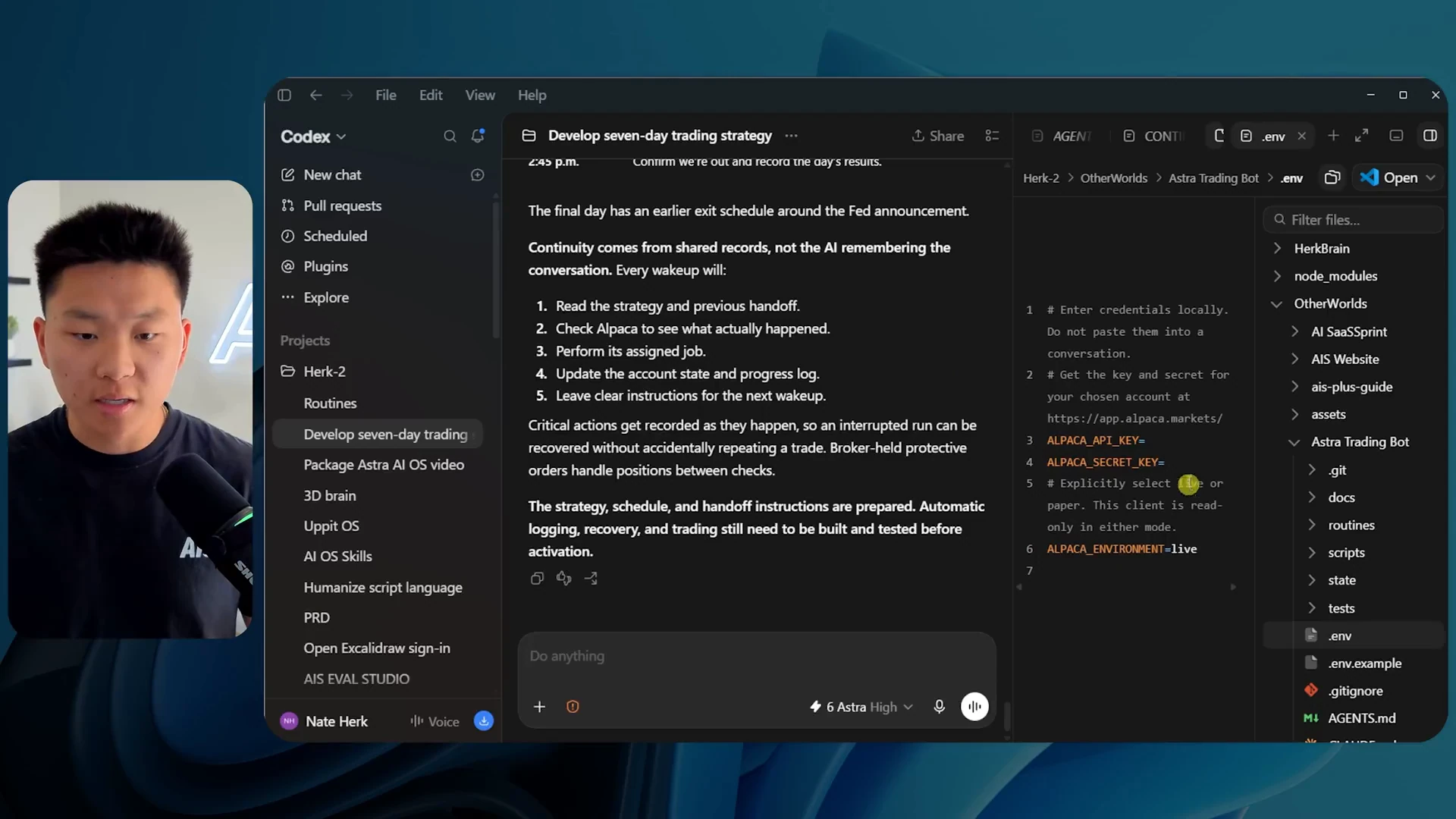
That last point is the whole architecture, and most people miss it. Let's walk the build.
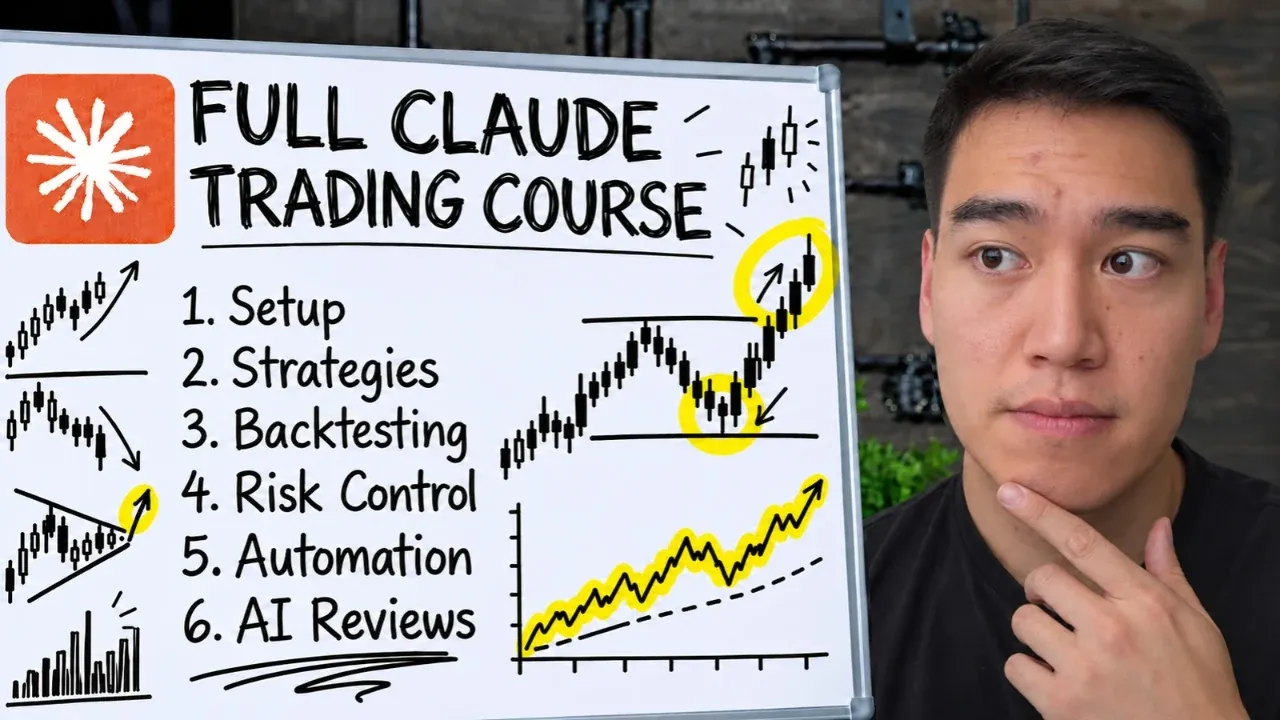
The backstory: the $10,000 Claude challenge he says beat the S&P by about 8%
Before Astra, Herk ran the same experiment with Claude. One month, $10,000 of his own money, and by his telling it finished about 8% ahead of the S&P 500. Take that as a creator claim, not a verified track record. No audited statement, no trade-by-trade log, no independent review.
One month is also a sample size that proves nothing. A trader who flips a coin on direction will beat the index over 30 days roughly as often as they lose to it. If someone shows you one good month and calls it a system, you're looking at a story, not evidence.
A strategy with no losing period in its record just hasn't run long enough yet.
What the Claude run did provide was a template: define the strategy, give the agent a broker, give it a schedule, make it write everything down. Astra inherited that skeleton.
Two paths: AI research assistant or daily trader
Herk splits the audience in two, and picking the wrong side is the fastest way to lose money here.
| Research assistant | Automated trader | |
|---|---|---|
| Who it's for | You don't have a tested strategy yet | You already trade a written, repeatable setup |
| What the agent does | Builds watchlists, summarizes news, flags setups | Places and manages live orders |
| You do | Every click of every trade | Review the logs, override when needed |
| Risk level | Low. Worst case is a bad idea you ignore | High. Worst case is a drained account |
| Prerequisite | Curiosity | A strategy you've already traded manually |
Choose the research path if you can't write your entry, exit, and position size rules on an index card from memory. Automating a strategy you haven't tested doesn't speed up profits, it speeds up losses. If you're still at the research stage, a scanner is a better first purchase than a bot. Our breakdown of AI stock screeners versus the old filters covers that end of the stack.
The daily schedule: the agent wake-ups (open, 11:00 a.m. review, close)
Six wake-ups, all on Central time, all on market days. This is where the "24/7" label falls apart... the bot is awake maybe seven hours, five days a week.
- 7:45 a.m., Scan overnight news, build the watchlist.
- 9:30 a.m., Look for the first qualifying trade.
- 11:00 a.m., Review open positions, consider one new entry.
- 1:00 p.m., Manage what's open. Trail stops, trim, hold.
- 2:15 p.m., Begin closing remaining positions.
- 2:45 p.m., Confirm flat, record the day's results.
Flat by the close means no overnight gap risk. That's a deliberate, conservative choice and a good one for a first build. Herk describes it as leaning day-trading in style (2:33).
The decision rule worth copying: cap new entries per wake-up. One trade at 9:30, at most one more at 11:00. Without a cap, an agent reading choppy tape will keep finding "opportunities" and churn your account into commissions and slippage. Overtrading doesn't need a human to happen.
Memory lives in files: the strategy, the handoff and the progress log
Each run starts cold. The agent doesn't recall yesterday, or the last hour. As Herk puts it at (4:06), continuity comes from shared records, not from the AI recalling the conversation.
Three files carry the state:
- The strategy document. Your rules. Entry criteria, position size, stop loss placement, what you won't trade. Read at the start of every single wake-up.
- The handoff note. Written by each run for the next one. "Holding 40 shares of X from $21.40, stop at $20.80, trim half at $22.50."
- The progress log. Running history of trades, outcomes, and account state. This is your audit trail.
Every wake-up follows the same loop: read the strategy, read the last handoff, check Alpaca for what actually happened, do its assigned job, update the state, write the next handoff.
That Alpaca check matters more than it sounds. The agent's belief about your positions and your broker's record of your positions will drift. Orders get partially filled. Stops trigger. Rejections happen. The file says one thing, the account says another. Always treat the broker as the source of truth, never the log file.
Step 1: open an Alpaca account (paper first)
Alpaca is a commission-free U.S. broker built API-first, which is why agent tutorials keep landing there. Signing up gets you two separate environments: live and paper.
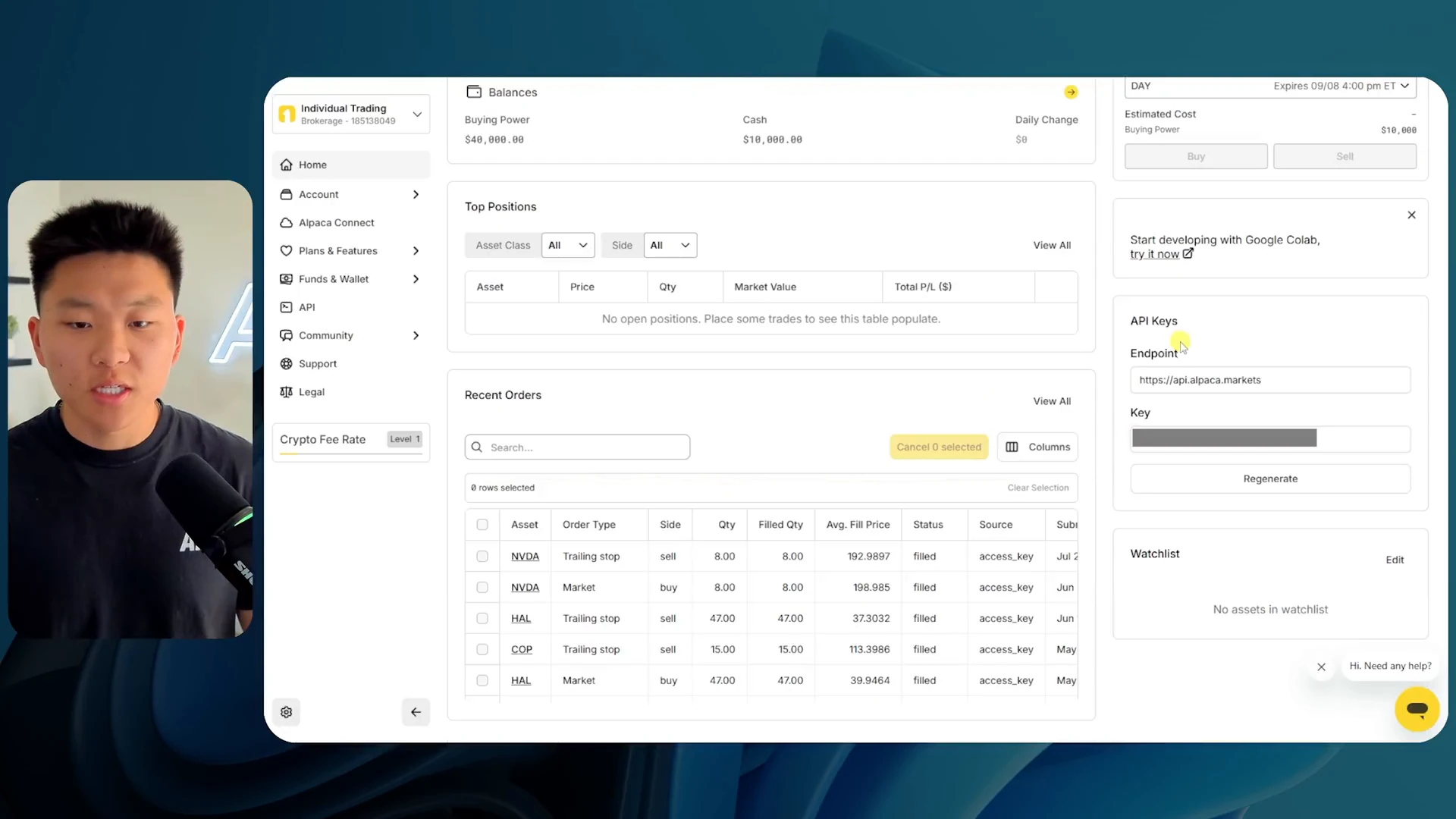
Paper trading is simulated money against real market data. Same API, same order types, same code, fake dollars. Herk shows the paper option on the dashboard and suggests running there for weeks or months until you're comfortable (5:37).
Do that. Minimum 30 market days before a single real dollar goes in. You want to see the bot handle a gap down, a halted stock, a rejected order, and a day where nothing qualifies. The last one is the hardest test... can it sit on its hands?
One cost trap worth knowing up front. Alpaca's Basic market data plan is free, but real-time equity coverage runs through IEX only, which is a slice of total volume. The Algo Trader Plus plan runs $99 per month for broader exchange coverage and unlimited websocket subscriptions. If your strategy depends on precise intraday prices, the free tier will quietly feed your bot an incomplete picture. Test how stale your data actually is with our trader reaction time test to see why latency matters more than most people assume.
The screenshot at (6:11) shows the Alpaca dashboard with filled orders, key masked. That's what a working connection looks like.
Step 2: put the keys in the.env file, never in the chat
Your API key and secret go in a .env file. Never in a chat message, never in a prompt, never in a screenshot, never in a GitHub repo.
An Alpaca live key is a bearer instrument. Whoever holds it can place orders in your account. There's no password prompt, no two-factor check on each trade. The key is the permission.
The template at (7:45) shows the structure: variable names on the left, blank values on the right, keys redacted. You paste your key and secret, save, and the agent reads them from the environment instead of from anything you typed.
Three rules that cost nothing:
- Generate a paper key first. Live keys stay unissued until you've completed the paper run.
- Add
.envto.gitignorebefore you write a line of code. - Rotate keys immediately if one ever appears in a screen recording, a support ticket, or a shared folder.
Herk notes you can verify the connection by having Codex read the account state after saving. If it returns your buying power, you're wired correctly.
Step 3: add the Alpaca plugin in Codex
Codex ships with a plugin directory. Search "Alpaca" or "stocks" and you'll find connectors, which Herk walks through around (8:43). The screenshot at (8:55) shows the Alpaca plugin in the list.
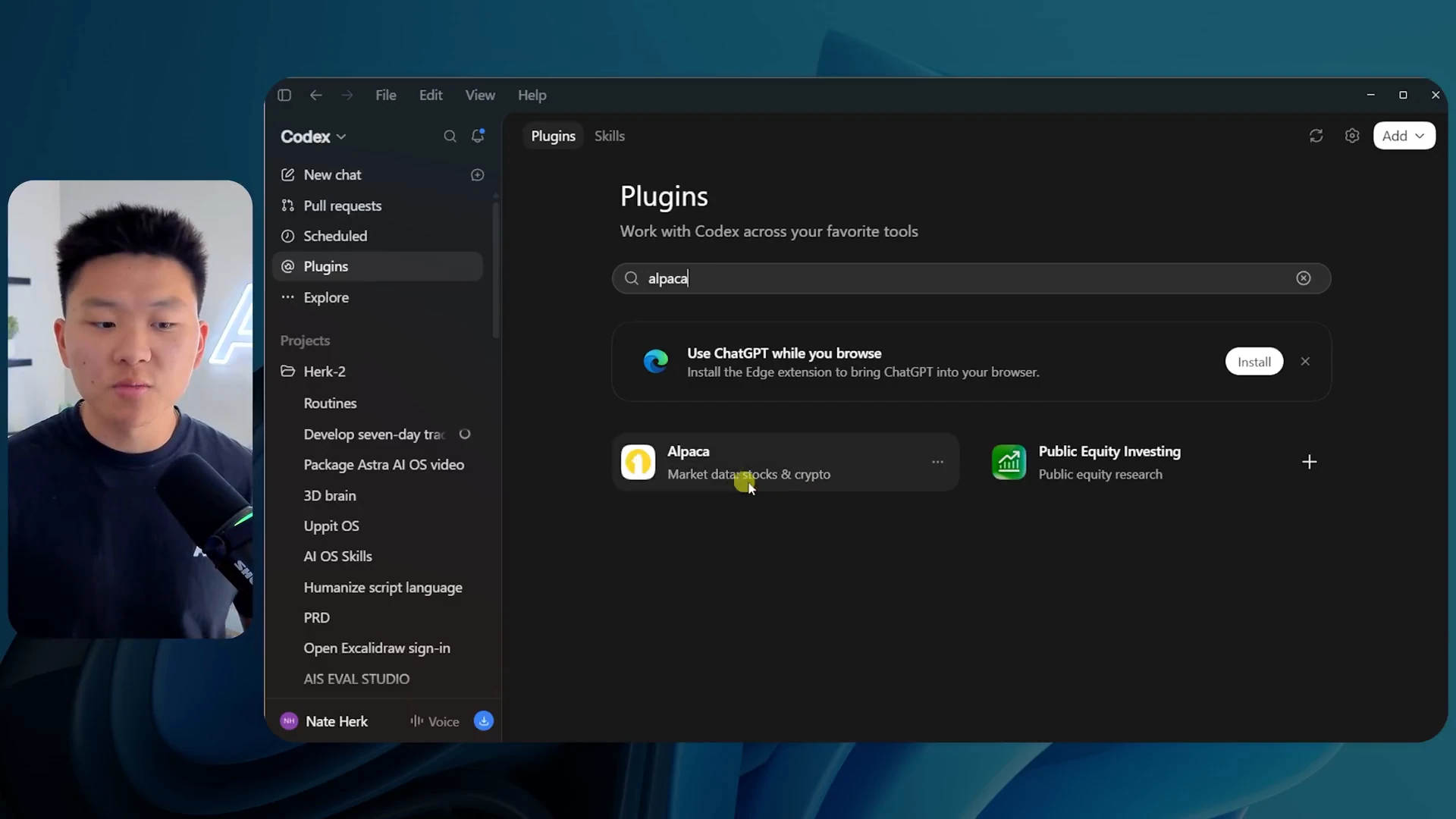
Important distinction he flags: some of these connections provide market data rather than trade execution. Reading prices and placing orders are different permissions and sometimes different integrations. Confirm which one you've installed before assuming your bot can trade.
Alpaca expanded its agent tooling in November 2026 with MCP-based access covering trading, account, portfolio, and market data functions, with separate live and paper endpoints. The paper environment is the default in several of these tools. Live trading requires explicit live credentials or a configuration change, which is a sensible safety default... and also something to verify, because a bot you think is live and isn't will waste a month of your testing.
Edge case to check now, not later: what does your setup do when Alpaca's API returns an error or times out mid-session? An agent that assumes success and writes a fake handoff will compound that error all day.
Step 4: create the scheduled routines
Scheduled routines are how the agent gets a clock. In Codex, you define a task, a time, and a thread to return to, and it runs without you.
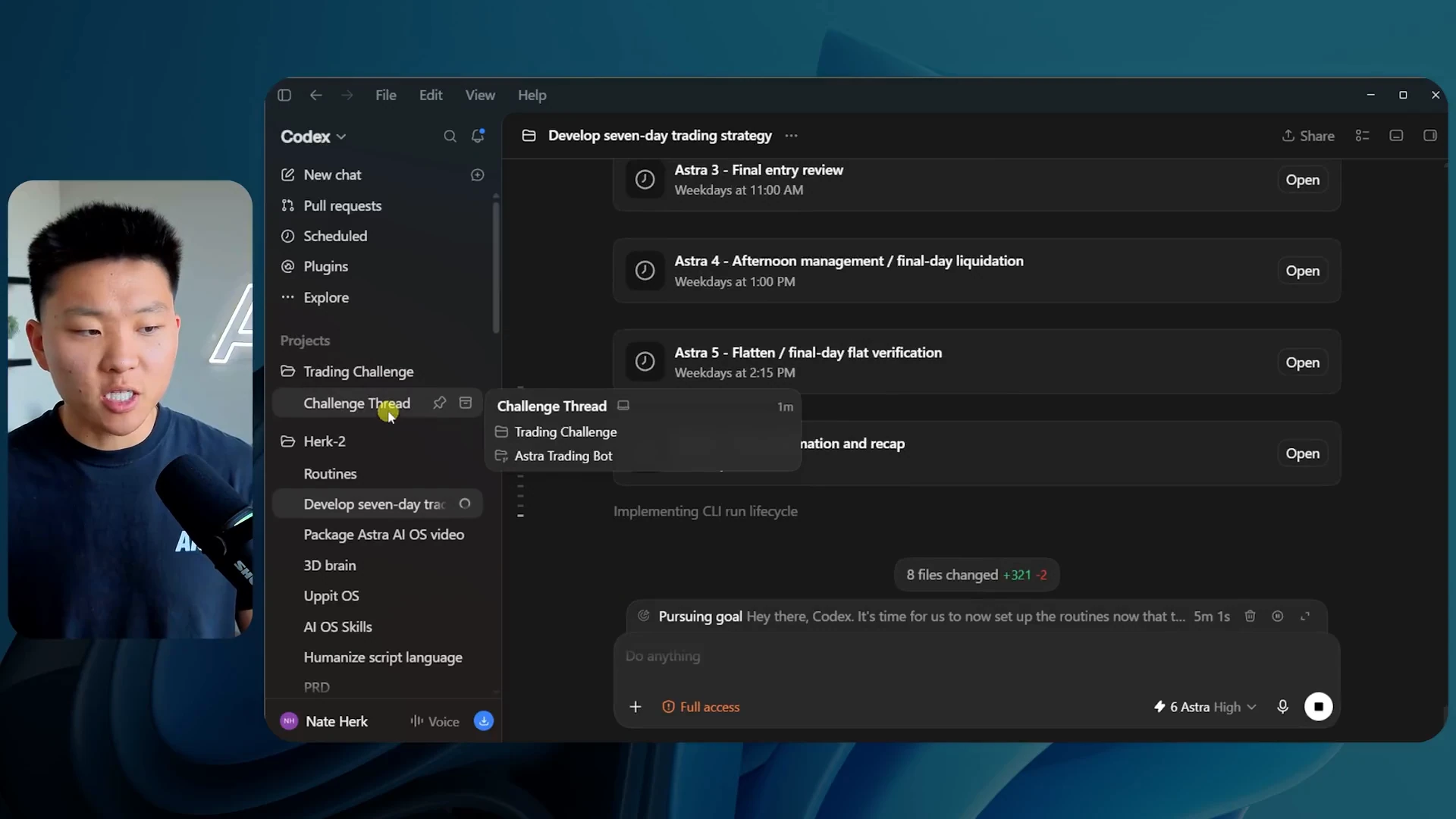
Herk kicks these off with a goal prompt that generates all six slots, then inspects each one (12:46). Each routine contains the same bones:
- When it fires, in a stated time zone.
- Which thread it writes back to, so everything stays in one conversation.
- Which files it must read before acting: strategy, handoff, progress log.
- What its one job is. Not "trade well." Something like: "Review open positions. Trim or exit any position that hit its target. Do not open more than one new position."
- What it must write before finishing.
The screenshot at (14:18) shows the full set of scheduled routines in the Codex interface.
Two settings that prevent the ugliest failures:
Daily loss limit. If the account drops past a set amount, every later wake-up reads that flag and does nothing except close positions. No revenge trading from a machine that doesn't know it's tilted.
Explicit no-trade conditions. Name them. Earnings day. First fifteen minutes after a Fed statement. Any stock under a volume threshold. An agent without a "don't trade" list will always find a reason to trade.
Step 5: the rehearsal run and the results report
Before anything goes live, run a rehearsal. The agent walks the full day's sequence against simulated or historical conditions and produces a report of what it would have done and why.
The rehearsal report at (15:47) is the single most useful artifact in the tutorial. It's where you find out that your 11:00 a.m. routine misread the handoff format, or that the agent sized a position at 40% of the account because you never wrote a cap into the strategy file.
Read the rehearsal looking for four things:
- Did it read all three files, every time?
- Did its position sizing match your written rule, to the share?
- Did it place a stop loss on every entry?
- When conditions didn't qualify, did it pass... or invent a reason?
Number four is the one that fails. Language models are agreeable. Given a job and no qualifying setup, a weakly-instructed agent will stretch the criteria to produce output. Your strategy file needs to say, in plain words, that doing nothing is a valid and expected outcome.
Running it remotely from your phone
Codex has a remote interface that syncs with your local setup. Herk shows his staying perfectly in sync, letting him open the challenge thread from anywhere and see what the agents did (16:18).
That's the real convenience payoff. You're in a meeting at 11:15 and want to know whether the bot bought anything. Two taps, the handoff note tells you.
It's also a discipline risk. Checking an automated system fourteen times a day defeats the point of automating it. Set a rule: review once after the 2:45 p.m. close, and once on Sunday for the week. If you're overriding the bot from your phone mid-session, you don't have an AI stock trading bot. You have a slow, annoying manual trading app.
Automation only pays off if you let it finish its sentence.
⭐ Top 5 Features We Love
The build quality here is genuinely good, and five specific choices deserve credit.
1. File-based memory instead of chat memory. Herk's line at (4:06) about continuity coming from shared records is the most important sentence in the video. Chat context decays and gets truncated. A strategy document on disk doesn't. This design makes the system auditable... you can read exactly what the bot believed and when.
2. Flat by 2:45 p.m. No overnight positions means no gap risk, the thing that quietly kills small accounts. You wake up to the same balance you went to bed with. For a first automated build, that constraint is worth more than any clever entry signal.
3. The paper trading insistence. He shows the paper account and recommends weeks or months there (5:37). Alpaca's agent tooling defaults to the paper endpoint in several configurations, so the platform agrees. A tutorial that pushes you toward simulation before real money is a tutorial written by someone who's been punched by the market.
4. The rehearsal run before go-live. The report at (15:47) catches configuration failures before they cost money. Most people skip this step and discover their position sizing bug on a live fill. Checking your work isn't a feature... it should be, and most builds don't have it.
5. The upfront disclaimer. Inside the first minute he says this isn't financial advice and he isn't recommending you fund an agent with $10,000 (0:58). Compare that to the SEC's September 29, 2026 action against entities that allegedly promised returns from rented "AI trading bots," where the complaint alleged no real bots or trading existed and at least $2.8 million was taken from investors. The gap between "here's how to build one, start on paper" and "rent our bot, collect returns" is the gap between education and a case number.
⚠️ Things to Look Out For
Five real problems with this build, and one group of people who shouldn't attempt it.
The "24/7" label is marketing. The equity bot runs six scheduled checks across roughly seven hours on market days. Call it what it is: a scheduled day-trading agent. Nothing wrong with that. Just don't expect it to work the overnight session.
The returns evidence is thin to negative. Secondary reporting puts the seven-day Astra run at about $9,900, roughly $100 down and around 0.8 points behind the S&P 500. The earlier 8% Claude claim is a one-month, self-reported figure with no audit. And the November 17, 2026 preprint across 91 runs and six models found zero statistically significant alpha, with 78% of returns explained by plain market exposure and model picks performing no better than random same-sector selections.
It may not have been Astra trading. Later reviews suggest a separate Grok-based component handled execution after Astra proved too cautious. If true, the title oversells what was tested.
Costs stack faster than you'd think. Alpaca's free Basic data tier is IEX-only, with real-time coverage of a fraction of volume. Algo Trader Plus is $99 per month. Add a Codex or GPT-6 subscription and your fixed monthly burn can clear $150 before a single share trades. On a $2,000 account, that's a 90% annual drag you have to beat before you break even.
The failure modes are silent. An AI stock trading bot with no daily loss limit will keep trading through a bad day. A bot that can't distinguish "no setup" from "find a setup" will manufacture trades. An agent that trusts its own log instead of the broker will act on positions it doesn't have.
Who shouldn't build this: anyone without a written, manually traded strategy. Anyone who'd be hurt by losing the funded amount. Anyone who thinks automation substitutes for risk management. And anyone tempted to sell access to it... the SEC charged Nathan Fuller in May 2026 over alleged AI crypto-bot representations, with a complaint alleging roughly $12.3 million raised from about 150 investors while only about $380,000, near 3%, actually went to buying assets. Building a bot for yourself is fine. Marketing one with performance promises is a different legal category entirely.
Which Settings Should You Lock Before an AI Stock Trading Bot Touches Real Money?
Five, and none of them are about the strategy. They're about what happens when the strategy is wrong.
- Max position size as a percent of the account, written into the strategy file.
- A daily loss limit that stops the routine for the rest of the session.
- Allowed symbols only. A whitelist keeps the agent from wandering into thin, jumpy names.
- Market hours only. Despite the "24/7" label, equities trade during U.S. sessions. Block anything outside them.
- A human review step for any order above a set dollar amount.
An AI stock trading bot is a very fast intern with your login. Give it rules it can't argue with, and read the progress log every day for the first month.
Flex or Cap? Our Verdict
Scored on four questions:
| Question | Grade | Why |
|---|---|---|
| Receipts shown | Strong on build, weak on results | Alpaca fills,.env template, plugins, routines, rehearsal report all on screen. No P&L curve, no statement. |
| What can be verified | Partial | The architecture is independently reproducible. The 8% Claude claim and the $9,900 Astra outcome are both unaudited. |
| Risk disclosed | Yes, clearly | Disclaimer at 0:58, paper trading recommended, no return promises made. |
| Can a retail trader repeat it | Yes, with effort | Alpaca account is free, paper trading is free, data and model subscriptions are the real cost. Expect a weekend of setup. |
Verdict: Flex on the tutorial, Need More Receipts on the performance.
As a build guide for an AI stock trading bot, this is one of the better things on YouTube. The file-based memory pattern, the flat-by-close rule, the paper-first advice... those are the choices of someone who thought about failure modes. Most AI trading content skips straight to the dashboard screenshot.
As evidence that an AI stock trading bot beats the market? Not close. One month of unaudited outperformance, one week of slight underperformance, and a peer benchmark across 91 runs finding no alpha anywhere. The honest read is that these agents currently buy beta and dress it up as skill.
Build it to learn the plumbing, not to beat the index. If you want tools with published scoring instead of single-run anecdotes, our honest AI stock tool reviews and the AI trading platforms list are a better starting point than copying one creator's experiment.
Process over prediction.
What You Should Know Before You Try It
Six things to settle before you write a line of config.
1. Paper trade for 30 market days minimum. Not seven. Not "until it works once." Thirty days gives you a gap down, a choppy tape, a day with no qualifying setup, and at least one API failure. If the bot can't handle those four, it isn't ready for a dollar.
2. Write position sizing as a number, not a vibe. "Risk 1% of account per trade" is a rule. "Trade a reasonable size" is an invitation. Calculate shares from your stop distance: account risk divided by (entry price minus stop price). Put that formula in the strategy file verbatim.
3. Use broker-held stops, not agent-held stops. If your stop only exists as an instruction in a file, it doesn't exist when Codex crashes, your internet drops, or a routine fails to fire. Send the stop order to Alpaca at entry. The broker holds it whether your agent is awake or not.
4. Know your real monthly cost. Alpaca Basic data is free but IEX-limited. Algo Trader Plus is $99/month. Model access is extra. Add it up, then divide by your account size. If fixed costs exceed 2% of your account annually, you're starting in a hole.
5. Day trading creates tax paperwork. Frequent round trips mean short-term capital gains, taxed as ordinary income, plus wash sale rules that can disallow losses when you re-enter the same name within 30 days. A bot generates these at machine speed. Export your Alpaca trade history monthly and talk to a tax professional before year end, not in April.
6. Verify everything independently. Alpaca's own docs for API behavior and data tiers. Investor.gov for how automated trading products are regulated and what claims should set off alarms. And your own broker statement for what actually filled, because the log file is a story and the statement is the fact.
One more for the pile: if you'd rather have an agent read filings than place orders, that's a lower-risk use of the same technology. The AI stock research tool that reads every 10-K covers that path.
Keep reading on FullStack Alpha: our Alpaca review, AI trading bot breakdowns on AI Stock Trading Bots, the AI trading bot shortlist, and more Flex or Cap breakdowns.
Frequently Asked Questions
Can ChatGPT do stock trading?
Not by itself. ChatGPT and GPT-6 Astra can't place orders natively... they need a broker connection through an API or plugin, like Alpaca, plus a scheduler to run on a clock. The model does the reasoning, the broker does the execution. Without that wiring, you have a chatbot with opinions.
What are the best AI trading bots?
There's no single best, and anyone naming one without disclosing how they tested it is selling something. For a DIY build, Alpaca plus an LLM agent is the common stack because the API is free and paper trading is built in. For pre-built platforms, compare on transparency of method, real cost including data fees, and what unsolicited users say on Reddit rather than solicited reviews. Our comparison hub runs tools head to head.
Does Robinhood have an AI stock trading bot?
Robinhood does not offer a built-in autonomous AI stock trading bot for retail users. It has added AI-assisted research features, but order placement remains manual or rule-based. Traders who want agent-driven execution typically use API-first brokers like Alpaca instead, because Robinhood's API access for third-party automation is limited.
Are trade bots illegal?
No. Automated trading is legal in the U.S. for retail accounts, and brokers like Alpaca provide APIs specifically for it. What is illegal is market manipulation, spoofing, and selling a bot with false or unsubstantiated performance claims. The SEC brought actions in May and September 2026 against operators who allegedly marketed AI trading bots that didn't function as represented.
Do AI trading bots really make money?
The current evidence says mostly no, at least not through skill. A November 17, 2026 preprint evaluating 91 runs across six models from four vendors found no statistically significant alpha in any run, with market and style exposure explaining a median 78% of returns. The models' stock picks performed no better than random same-sector selections. A bot can make money when the market goes up. That's beta, not an edge.
How much does a trading bot cost?
Building your own, the broker side can be free... Alpaca charges no commissions and paper trading costs nothing. The real costs are data and model access. Alpaca's Algo Trader Plus plan is listed at $99 per month for full exchange coverage, and LLM access adds a subscription on top. Budget $100 to $200 monthly for a serious DIY setup, and weigh that against your account size before starting.
Who is Nate Herk?
Nate Herk runs the YouTube channel Nate Herk | AI Automation, focused on building AI agents and automation workflows rather than on trading education specifically. His GPT-6 Astra trading tutorial, published September 7, 2026, has drawn roughly 546,000 to 589,000 views depending on the analytics source. He is not a registered investment adviser and explicitly states his content isn't financial advice.
Conclusion: Build the System, Doubt the Returns
The tutorial earns its views. Herk shows a real broker connection, a real scheduler, and a memory design that survives a model restart. That's more rigor than most AI trading content manages, and the paper-first advice at (0:58) is the part that'll actually save someone money.
What it doesn't show is an edge. A one-month unaudited 8% claim with Claude, a seven-day run that finished about $100 down with Astra, and a 91-run academic benchmark finding zero alpha across six models. Three data points pointing the same direction: the agent is buying the market and the market is doing the work.
So here's what to actually do this week:
- Open an Alpaca paper account today. Free, five minutes, no funding required.
- Write your strategy on one page before touching Codex. Entry trigger, stop placement, position size formula, max trades per day, no-trade conditions. If you can't write it, you can't automate it.
- Run the six scheduled routines on paper for 30 market days. Log every day. Review once a week, not fourteen times a day.
- Compare the paper results to simply holding SPY over the same window. If the bot didn't beat buy-and-hold on paper, it won't beat it with real money, and now you've saved the tuition.
- Only then consider a live key, funded with an amount that wouldn't change your week if it went to zero.
An AI stock trading bot is a tool for executing a strategy you already trust. It's not a strategy. The traders who do well with this are the ones who had the edge first and added the automation second.
Your market edge starts with the right tool. Stay alpha.
One tutorial examined in depth. There are 200+ AI stock tools catalogued in the FullStack Alpha directory, filterable by category, price and what they actually do.
Browse the directory → aistockpickerapps.com