 ChatGPT
 GrokBot
Quick Answer
This Grok AI stock trading experiment is a partial flex with a big asterisk: a real $100,000 was real, the orders were real, and the research process was genuinely more rigorous than "hey Grok, give me tickers." What's missing is a verified return. The video ends mid-experiment with roughly $32,000 deployed and nothing resolved, so the headline promises a result it never delivers.
Here's the hook that makes it worth your 16 minutes anyway: the creator didn't hire the AI because he thought it was smarter than him. He hired it because he knew he wouldn't execute. That's a confession most finance YouTubers would never make on camera, and it's the most useful thing in the whole video.
What Does Handsome Finance Actually Claim?
The claim: Handsome Finance (Antoine) took $100,000 of his own money, built a custom agent on Grok's $30-a-month plan, had it research an investment thesis, stress-test that thesis against itself, and then place live orders through Interactive Brokers. Published October 18, 2026. Around 7,800 views and 63 likes when we checked. He labels it entertainment and education, not advice.
He opens by naming the real problem, and it isn't stock picking:
"Most people don't miss great investments because they had no idea. They miss them because they got lazy." (0:00)
The receipts actually shown on screen:
| What he claims | Timestamp | Receipt shown? |
|---|---|---|
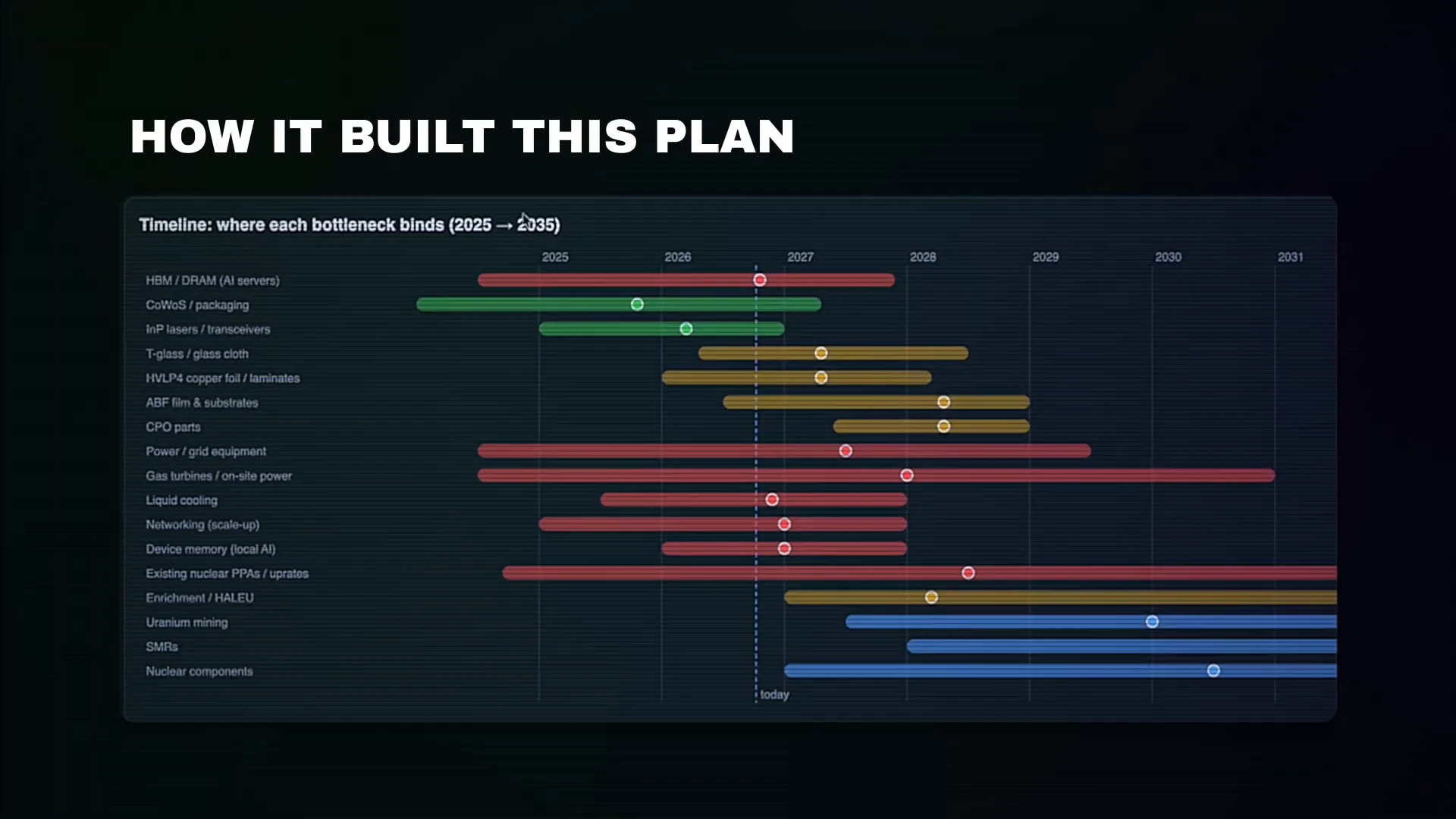
| Grok built a "bottleneck timeline" plan | 0:36 | Yes, on-screen map |
| He's on the $30 Grok plan and burned through it | 4:43 | Stated, not shown |
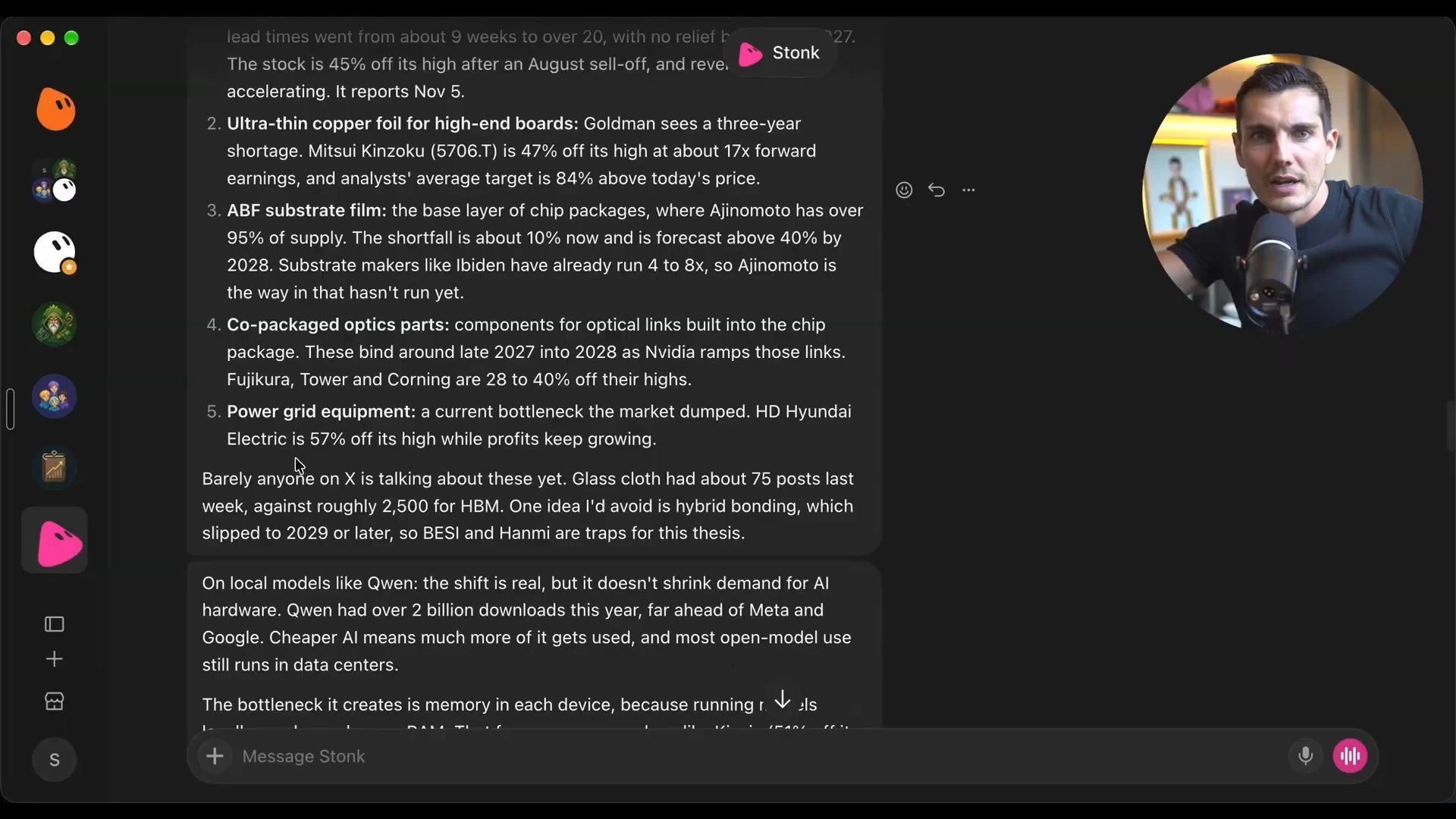
| Research chat sourcing the thesis | 7:15 | Yes, chat visible |
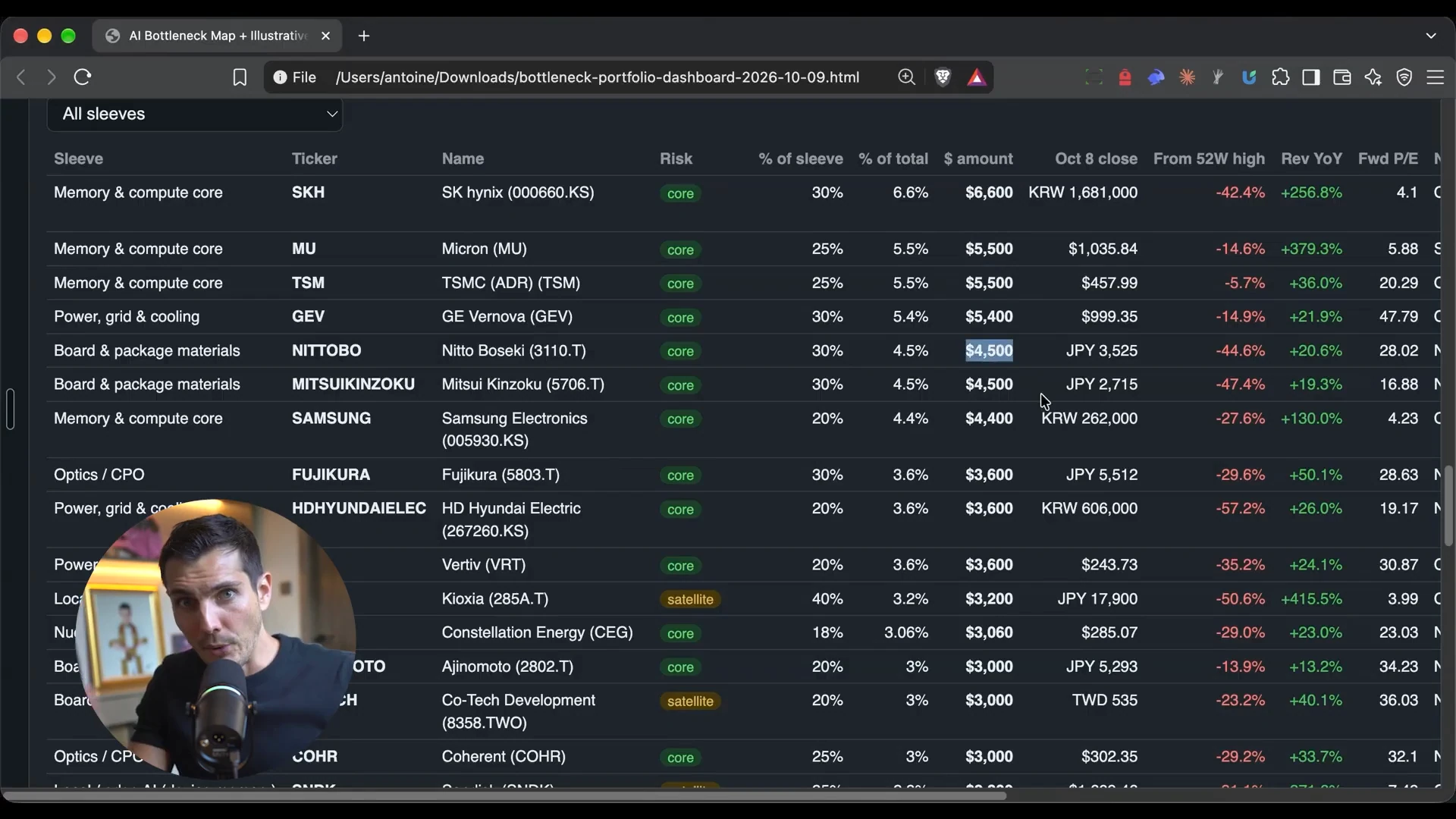
| Full bottleneck portfolio dashboard | 7:59 | Yes |
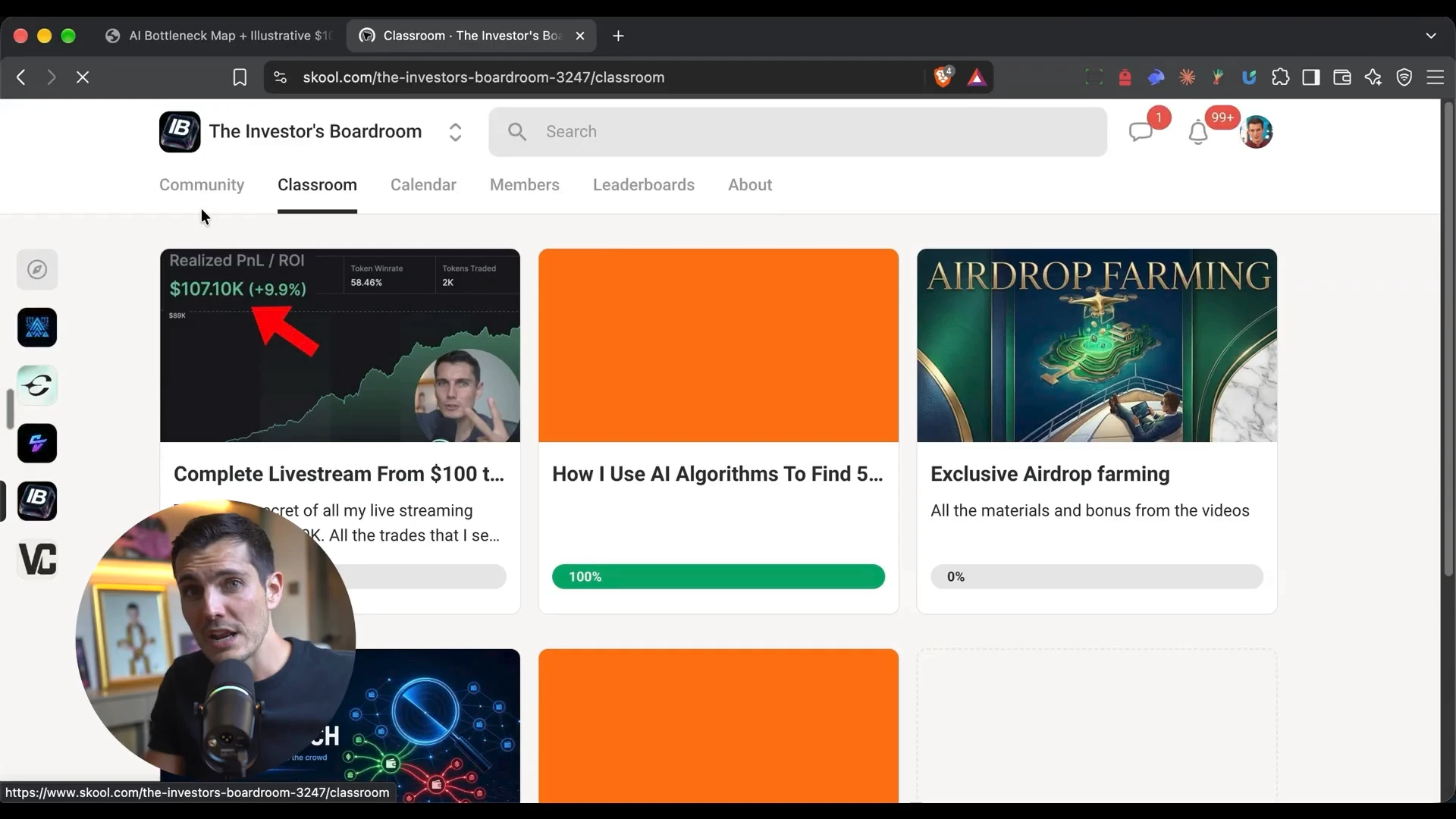
| Community page showing $107.10K realized P&L | 8:02 | Shown, unaudited |
| AI order instructions prepared for IBKR | 13:09 | Yes |
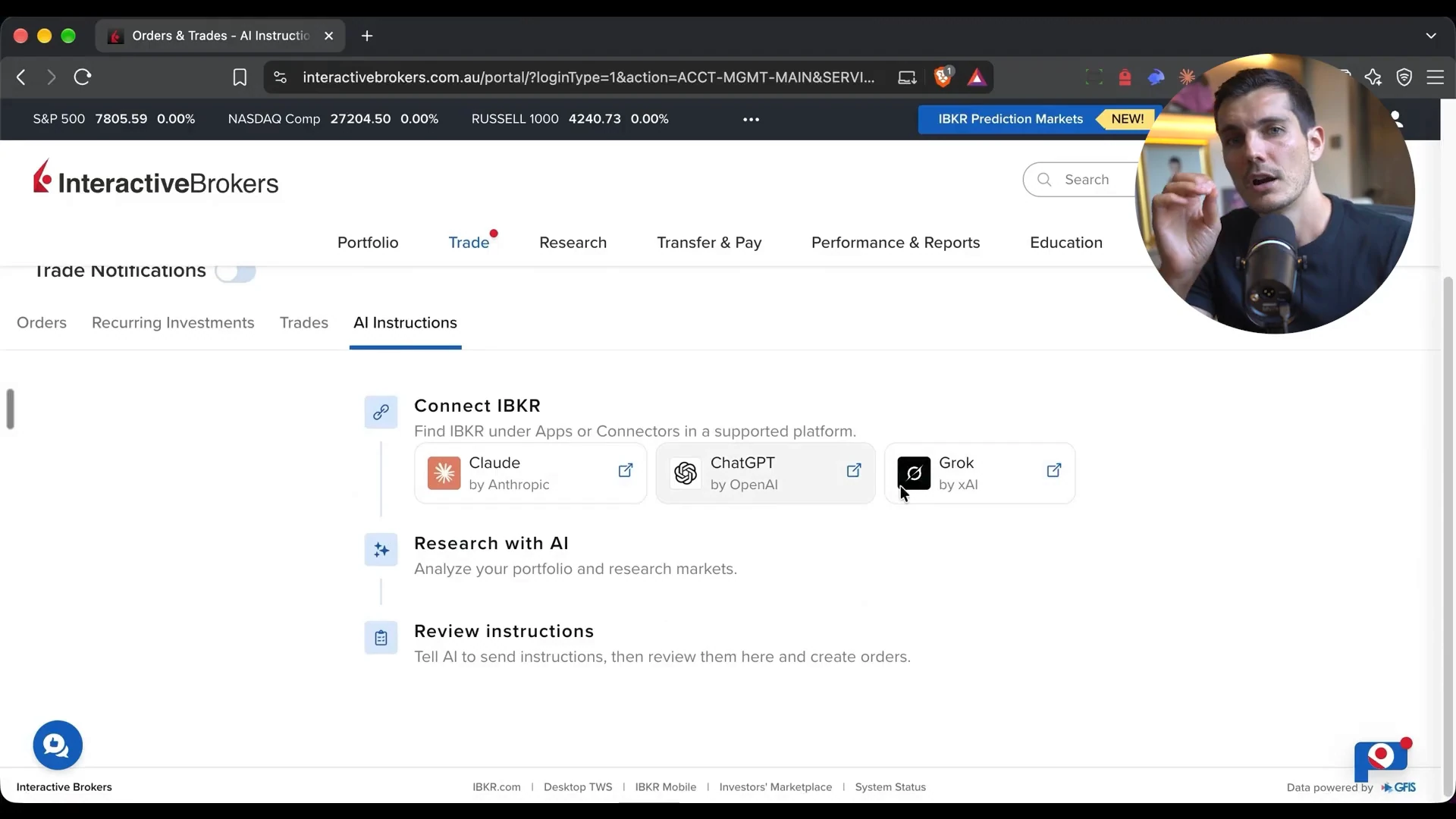
| IBKR's own AI instructions page (Claude, ChatGPT, Grok) | 13:11 | Yes |
| Micron order filled, ~$32,000 deployed | 14:18 | Stated on camera |
Note what's on that list and what isn't. There's a dashboard, there's an order flow, there's a filled trade. There is no brokerage statement, no cost-basis export, and no closing return. The $107.10K realized P&L figure flashes on a community page at 8:02 with no date range and no audit trail attached to it.
We'll set the first screenshot here: the bottleneck timeline the AI built at 0:36, which is the backbone of everything that follows.
He also says the exact prompt and the research files live in his paid community, the Investor's Boardroom. Worth saying plainly: the most replicable part of the experiment sits behind a paywall. That's a legitimate business model. It also means you're watching a demo, not getting a manual.
Original video: I Gave GrokBot $100,000 of My Real Money to Trade Stocks
How Did Grok AI Stock Trading Work With $100,000 of Real Money?
The workflow was five steps: define a job, build a thesis, force the AI to attack its own thesis, set hard position rules, then route orders to Interactive Brokers in batches. Not one prompt. Closer to a week of back-and-forth with a persistent agent.
Here's the whole thing, broken into the pieces you could actually copy.
Why he handed the job to AI: discipline, not ideas
The honest framing is the best part of the video. He doesn't claim Grok picks better stocks than he does. He claims he doesn't place the orders, and he's filming so he can't back out.
That's an execution problem, not a research problem. And it's the single most common failure mode among self-directed investors: a watchlist full of good ideas, zero of them bought. You had Nvidia in a note in 2023. You know you did.
Market truth: an AI that forces you to act on a documented plan beats a human who researches brilliantly and then does nothing. Process over prediction.
Practical takeaway: before you blame your stock selection, count how many of your last ten ideas you actually executed. If it's under five, your problem is a process gap, and no new tool fixes that by itself. We covered the same trap in how to find stocks for swing trading before everyone else does.
The setup: Grok on the $30 plan, agents given different personalities
He used Grok Bot at the $30-per-month standalone tier, and says the project consumed the entire allowance because he went deep (4:43). The setup is simple: create a bot, give it a job description, done.
The clever bit is that he created multiple agents with different personalities. One researches. One argues. He describes it as building a team, and it's effectively a cheap version of an investment committee.
Why this matters mechanically: a single chat session agrees with you. Agreeable AI is the most dangerous AI in finance, because it will validate whatever thesis you walked in with. Two agents with opposed jobs produce friction, and friction is where real analysis lives.
Grok Bot itself is not a trading product. It launched in beta in August 2026 for selected SuperGrok and Cursor subscribers, and version 1.0 arrived November 11, 2026 with shared team bots, proactive task initiation, better browser operation, and Slack and Teams connectors. Nowhere in the official positioning is there a validated investment track record. It's a persistent assistant with computer access. Everything financial on top of that is the user's design.
The thesis: buy the next bottleneck after memory
The investment idea is the part a long-term investor can actually evaluate. The AI was told to find what the market hasn't priced in yet, and it landed on bottleneck investing: find the physical chokepoints the AI buildout can't run without, then buy the companies that own those chokepoints.
Memory was last year's bottleneck. The question becomes: what breaks next?
The map it produced (7:21) covered:
- Memory and compute, the already-crowded trade
- Boards and chip packaging, how chips get stacked and assembled
- Optics, moving data between racks
- Power and cooling, including grid equipment
- Nuclear and fuel, the long-dated power bet
- Local AI infrastructure
- Musk-adjacent names
His attention check at 7:21 is genuinely smart: roughly 75 posts in a week on one bottleneck theme versus about 2,500 on memory. Thin coverage can mean an under-followed idea. It can also mean nobody cares because the thesis is wrong. He says exactly that out loud, which is more intellectual honesty than most tool demos offer.
The portfolio skewed heavily international, lots of Japan and Korea, with names he admits he couldn't have identified two years ago (8:27). That's the real value of AI stock research: it widens the universe past the 40 tickers you already know.
The second screenshot fits here: the Stonk AI research chat at 7:15 where the bottleneck reasoning gets built out ticker by ticker.
Round one: 40% of the $100,000 goes into the first batch
The plan allocated 40%, or $40,000, to the first tranche (8:27). The rest was staged for later rounds, with round two timed after earnings between October 21 and 30. Final shape: roughly 32 positions plus cash.
Before any order, the bot set the rules. The headline rule: no single position above 7% of the portfolio.
Set aside whether the stocks are right. The structure is sound. Staged entries, a hard position cap, and a written rule set before capital moves is textbook risk management, and most retail investors do none of it. If 7% feels arbitrary, it is arbitrary... but an arbitrary cap you follow beats a perfect cap you invent after you're already down 40% in one name. More on that in the position sizing mistake that wipes out 90% of new traders.
Thirty-two positions on $100,000 averages about $3,100 per name. That's diversification bordering on an index fund with a theme. Nothing wrong with it. Just know that at 32 names, your return will look a lot like the sector's return, and any single brilliant pick barely moves the needle.
Screenshot three belongs here: the bottleneck portfolio dashboard at 7:59, with every sleeve and weight laid out.
Where GrokBot cut corners: it did not recheck its own research
This is the most valuable 90 seconds in the video, and it's the part most viewers will skip.
When he forced the bot to audit its own plan, two things surfaced (10:36):
- It had not rechecked its own research. It built conviction on a first pass and moved on.
- It admitted roughly half the portfolio was "stories ahead of fundamentals." His translation on camera: buzz ahead of real profit. Mostly the nuclear sleeve and the Musk-linked names, both dependent on politics and timelines nobody controls.
An AI telling you half your book is narrative is useful. An AI that only tells you when asked is a warning. The agent wasn't skeptical by default. Skepticism had to be prompted into it.
That lines up precisely with what FINRA flags about autonomous AI agents: excessive scope, weak auditability, insufficient domain knowledge, and misaligned objectives. A model optimizing for "find what isn't priced in" will naturally drift toward thin, speculative, under-covered stories... because that's where things genuinely aren't priced in, and also where things are priced correctly as garbage.
Build the challenge step into your process, not as an afterthought. One agent proposes, a second agent attacks, and you only act on what survives.
Placing the orders through Interactive Brokers AI instructions
Interactive Brokers publishes instructions for connecting AI assistants, and the video shows that page listing Claude, ChatGPT and Grok (13:11). The bot prepared order instructions (13:09) and he approved the round.
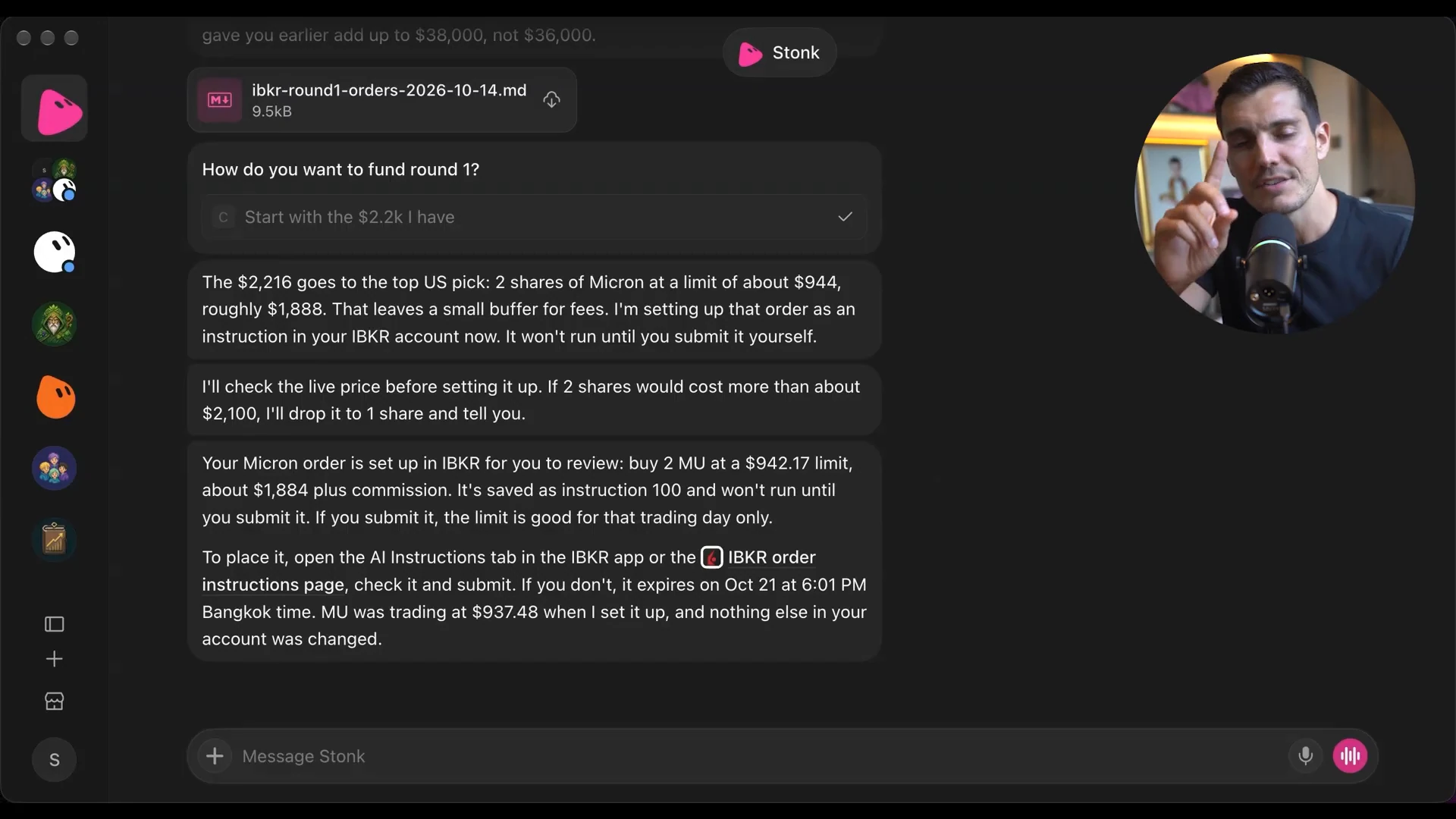
Important nuance the transcript itself makes clear: the agent could not simply execute every purchase unilaterally. Some orders it prepared, some it submitted, and approvals sat in between. His phone and watch lit up with notification after notification from IBKR (12:11), which is what supervised execution actually feels like.
The distinction matters more than the buzz suggests. Research, browsing and order preparation are not the same as unrestricted trading authority. Any brokerage connection that gives software order entry rights deserves a slow read of the permissions screen and a hard look at what the agent can do if it misreads the market. If you're comparing execution venues for this kind of setup, see Interactive Brokers vs Tastytrade.
Screenshots four and five sit here: the AI order instructions at 13:09 and the IBKR connection page at 13:11.
Early results: Micron filled, one name down 16% since October 14
What the video actually reports: Micron filled cleanly. Round one came in around $20,000, total deployed by that morning was about $32,000, and roughly $70,000 remained in cash (14:18).
Then the good part. One holding was down 16% since October 14 and the bot didn't know why. His response was correct: leave it alone until a human checks.
There's also a live-market stress test at 12:11. TSMC reported, the bot re-priced the plan and rechecked the round before continuing. Good behavior, at least once.
So the scoreboard at the credits: one filled trade, one unexplained drawdown, two-thirds of the money still uninvested, and zero verified return. The title sold a result. The video delivered a setup.
For context on what small live AI trading accounts actually produce, a separate October 2026 test gave an AI agent $50 of real money through Alpaca for about a week. It finished down $0.38 after fees, while a $10,000 paper stock account lost $88 and a paper crypto account dropped roughly 2% to 2.7%. Tiny samples, but notice the pattern: no fireworks, and fees quietly eating the edge. More numbers in do AI trading bots actually make money.
⭐ Top 5 Features We Love
Five things this method genuinely gets right, each tied to a specific moment on tape or to documented product behavior.
1. It names the real problem: execution, not ideas. Opening the video by admitting he doesn't trust his own discipline (0:00) is the kind of honesty that makes the rest credible. Most investors underperform their own research. Automating the boring part is a legitimate fix.
2. Multiple agents with opposed jobs. Creating separate bots with different personalities (4:43) turns a yes-machine into something closer to a debate. Grok Bot 1.0 added shared team bots in November 2026, which makes this pattern easier to run properly.
3. Rules written before capital moved. The 7% maximum position cap and staged 40% first tranche (8:27) existed before a single order. Risk management first, setups second. That ordering is what separates an investor from a tourist.
4. The self-attack step. Forcing the bot to audit its own plan produced the admission that half the book was story ahead of fundamentals (10:36). Any AI stock research workflow without an adversarial pass is just an expensive confirmation tool.
5. Supervised execution, not blind autonomy. Interactive Brokers' published AI instructions (13:11) plus approval prompts and notification storms (12:11) kept a human in the loop. He also parked the unexplained 16% decliner rather than averaging into it (14:18). Catching a falling knife you can't explain is how accounts get hurt.
Worth adding: the widened search universe. He ended up in Japanese and Korean industrial names he couldn't have named two years ago. If you want tools built for that kind of discovery, start with AI stock research tools.
⚠️ Things to Look Out For
Now the honest column. Five real problems, none of them small.
No verified result. The title says $100,000 traded. The video ends with roughly $32,000 deployed and nothing closed. The $107.10K realized P&L on the community page (8:02) has no date range, no audit, and no statement behind it. Treat every on-screen P&L you can't tie to a brokerage document as a marketing asset until proven otherwise.
The method is paywalled. The exact prompt and research files sit inside the Investor's Boardroom, his paid community (15:53). Fine as a business. It also means the video functions as the top of a funnel, and that's worth holding in mind while you watch.
Regulators are pointing at exactly this setup. FINRA's 2026 oversight materials flag autonomous AI agents for autonomy risk, excessive scope or authority, weak auditability, data sensitivity, thin domain knowledge, and misaligned objectives. They also warn that unusual conditions, extreme volatility, geopolitical shocks, disasters, fall outside a model's training distribution and can produce unreliable outputs. The bot not knowing why a holding was down 16% is that risk, live on camera.
Herding is a real second-order problem. FINRA specifically notes that if many AI systems train on similar data and react to similar signals, you get feedback loops and crowding. If thousands of retail investors ask the same model "what's the next bottleneck after memory," the under-followed trade stops being under-followed, fast.
Thirty-two thematic positions is one bet, not thirty-two. Memory, packaging, optics, power, nuclear, they all rise and fall with AI capex sentiment. The correlation is near one when the theme cracks. That's concentration dressed up as diversification.
Who this isn't for: anyone with a small account who can't absorb a 30% drawdown on speculative names, anyone who'd grant an agent unsupervised order authority, and anyone looking for a tested system rather than a filmed experiment. If you're working with a smaller balance, how to day trade without $25k is a better starting point.
How Would You Run Your Own Grok AI Stock Trading Experiment Safely?
Shrink it and write it down. Handsome Finance used $100,000 because big numbers make good videos. Your version of a Grok AI stock trading experiment should be built to teach you something, not to impress anyone.
- Start on paper or with a small slice. Pick an amount you could lose without changing your month.
- Write the thesis before the tickers. He framed it as "buy the next bottleneck after memory." Your thesis should fit in one sentence too.
- Cap every position. Decide the maximum percent per stock before Grok suggests anything.
- Make it check its own work. The video's weakest moment is GrokBot skipping a recheck of its research. Ask it to verify every number with a source and date.
- Place the orders yourself. Keep the human between the model and the broker until you trust the process.
- Log and review monthly against a plain index fund over the same window.
Run Grok AI stock trading like a science fair project and you'll learn whether the research is any good. Run it like a lottery ticket and the only thing you'll learn is your tolerance for pain.
Flex or Cap? Our Verdict
Scored on four questions.
| Question | Result |
|---|---|
| Were receipts shown? | Partially. Dashboards, chats, order screens, one named fill. No statements, no closed P&L. |
| What can be verified independently? | The Grok Bot product, the $30 tier, and IBKR's published AI connection instructions. The portfolio returns: nothing. |
| Was risk disclosed? | Yes, better than most. Position caps, the "half of this is story" admission, the unexplained decliner left alone. |
| Can a regular retail investor repeat it? | Mostly. A $30 subscription and an IBKR account get you there. The exact prompt is paywalled, and the stock selection is nobody's to copy. |
Verdict: Need More Receipts, leaning Flex on process.
The Grok AI stock trading workflow here is real and more disciplined than 95% of AI trading content. The money moved. The orders filled. The risk rules existed on paper before the first buy. That part earns respect.
But the headline sold a $100,000 AI portfolio result, and the video delivered a $32,000 setup with the other $70,000 still in cash. No return, no benchmark, no follow-up window inside the video. An experiment without a published outcome is a trailer.
What would move this to a clean Flex: a dated brokerage statement at 90 days, a benchmark comparison against something like SMH or a global AI capex basket, and a plain accounting of what the thesis got wrong. Until then, study the method and ignore the number.
And the obvious: a filmed experiment is not a strategy you own. The tickers are his. The discipline gap is yours.
What You Should Know Before You Try It
Five things to settle before you connect any chatbot to a brokerage account.
1. Paper trade the workflow first, for at least 30 days. Not the stocks, the process. Run the research agent, run the adversarial agent, log what each recommends, then check 30 days later which calls held up. You'll learn more about your agent's blind spots in a month of free testing than in a quarter of live money. Our AI trading bots guide covers the setup questions.
2. Set your position cap in writing before the first order. His was 7%. Yours might be 3% or 10%. The number matters less than the fact that it exists before you're emotionally involved. Write it down. Date it.
3. Count all the costs, not just the subscription. The $30-a-month Grok Bot tier is the smallest line item. Add market data fees, FX conversion on international names (that Japan and Korea exposure converts twice, in and out), commissions on 32 separate positions, and the bid-ask spread on thinly traded foreign tickers. Fees are why that $50 Alpaca test finished slightly red on a flat week.
4. Understand the tax and rule mechanics. Thirty-two positions means thirty-two cost bases and potentially a wash-sale minefield if the agent rebalances frequently. Foreign holdings can carry withholding on dividends. Short-term gains are taxed as ordinary income. An agent rebalancing on its own schedule can create a tax bill it never considered, because nobody told it to.
5. Decide who presses buy, in advance. Full agent authority, human approval on every order, or approval above a dollar threshold. Pick one before you link the account, because the middle of a gap-down is the worst time to discover what your bot is allowed to do.
6. Verify independently. Check filings at SEC EDGAR before trusting any AI summary of a company's financials. Models hallucinate revenue figures with total confidence. And before you pay for any tool, read honest AI stock tool reviews.
Keep reading on FullStack Alpha: our AI stock tool reviews, AI trading bot breakdowns on AI Stock Trading Bots, the AI trading bot shortlist, and more Flex or Cap breakdowns.
Frequently Asked Questions
Is Grok traded on the stock market?
No. Grok is built by xAI, which is privately held and not listed on any public exchange. There's no Grok ticker. Exposure to the company is limited to private markets, and anything advertised as "Grok stock" on a retail platform is either a different company or a scam. Publicly traded adjacency exists through Musk-linked listed companies, but that's not the same thing as owning xAI.
How to make $1000 a month trading stocks?
There's no reliable formula, and anyone selling one is selling something. The honest math: $1,000 monthly is $12,000 a year, which would require a 12% annual return on $100,000 or a 60% return on $20,000. The first is roughly a market return. The second is not repeatable. Focus on the return you can defend, not the dollar figure you want.
Can I use AI in stock trading?
Yes, and brokers including Interactive Brokers publish instructions for connecting assistants like Claude, ChatGPT and Grok. AI is strongest at research, screening, summarizing filings and stress-testing a thesis. It's weakest at judgment under unusual conditions, which FINRA specifically flags as outside most models' training distribution. Keep a human on the approval button.
Which AI stocks are a good buy right now?
FullStack Alpha doesn't make stock recommendations or price predictions, full stop. What the bottleneck framework offers is a way to think about the sector: ask which physical inputs the buildout can't run without, then ask whether the market has already priced that in. Attention is the tell. Heavily discussed means heavily priced.
What stock will skyrocket in 2026?
Nobody knows, including the AI. Anyone naming one with confidence is guessing in public. More useful question: what's your position size if you're wrong? A portfolio that survives being wrong six times out of ten beats a portfolio built on one conviction call.
What AI company is Elon Musk investing in?
xAI, the company behind Grok and Grok Bot, is Musk's AI venture. Grok Bot 1.0 shipped November 11, 2026 with team bots, browser operation, and Slack and Teams integration, priced at $30 per month standalone and included with some eligible plans. The video's portfolio also held Musk-adjacent listed names, which the AI itself flagged as dependent on politics and timelines rather than current profits.
Is Grok AI stock trading legal?
Yes. Using Grok to research stocks and then placing your own orders is legal, the same as using any research tool. Fully automated Grok AI stock trading through a broker's API depends on that broker's terms, and you're still responsible for every trade.
How much does Grok AI stock trading cost?
In the video, the creator uses Grok on a plan of about $30 a month, plus normal brokerage costs through Interactive Brokers. Treat the subscription as the cheap part of Grok AI stock trading. Bad position sizing is the expensive part.
Can beginners try Grok AI stock trading?
Yes, as long as it starts small or on paper. Grok AI stock trading is mostly a research workflow: the model suggests ideas, you check them and you place the orders. The beginner risk is trusting the research without verifying it, which is the exact mistake the video catches.
The Takeaway
The $100,000 isn't the story. The confession at 0:00 is: he didn't hire an AI because it picks better, he hired it because he doesn't execute. That's the most common and least discussed reason portfolios underperform, and it has nothing to do with which stocks you chose.
Three things to do this week:
- Run the audit checklist above against whatever process you have now. Count the unchecked boxes.
- Build the adversarial step. One prompt proposes, a second prompt attacks. Only trade what survives both.
- Write your position cap and max loss per name on paper, dated, before your next order.
The AI didn't make him a better investor. The written rules and the camera did. Your market edge starts with the right tool. Stay alpha.
One experiment, examined in depth. There are 200+ AI stock tools catalogued in the FullStack Alpha directory, filterable by category, price and what they actually do.
Browse the directory → aistockpickerapps.com