 TradingView
 Claude
 Codex
Quick Answer
Humbled Trader's October 2026 video on how to use AI for day trading is mostly a flex, and a defensible one, because the AI work she shows is post-trade analysis of her own broker data rather than a prediction machine. She claims roughly $400,000 in verified profits this year and about $20,000 lost before she turned profitable, and both are her claims, not audited numbers we can check. What's repeatable is the method: export your trade history, let an AI model break it down, and act on what the data says about your own behavior.
The hook that makes it worth your 12 minutes? She says out loud what most trading channels won't: the AI didn't create the edge. It just found the one that was already buried in her fills.
What Does Humbled Trader Actually Claim?
The headline claim is roughly $400,000 in verified profits this year, with about three losing years and $20,000 gone before profitability. Receipts shown on screen are her own dashboards and trade statistics, not a third-party audited track record, so treat the dollar figures as self-reported.
Here's what she actually puts on screen, with timestamps:
- (0:00-1:15) The framing. She says plainly she didn't get there by "asking ChatGPT whether I should just buy AMD tomorrow." The AI was used to analyze trading data and surface uncomfortable truths about her behavior.
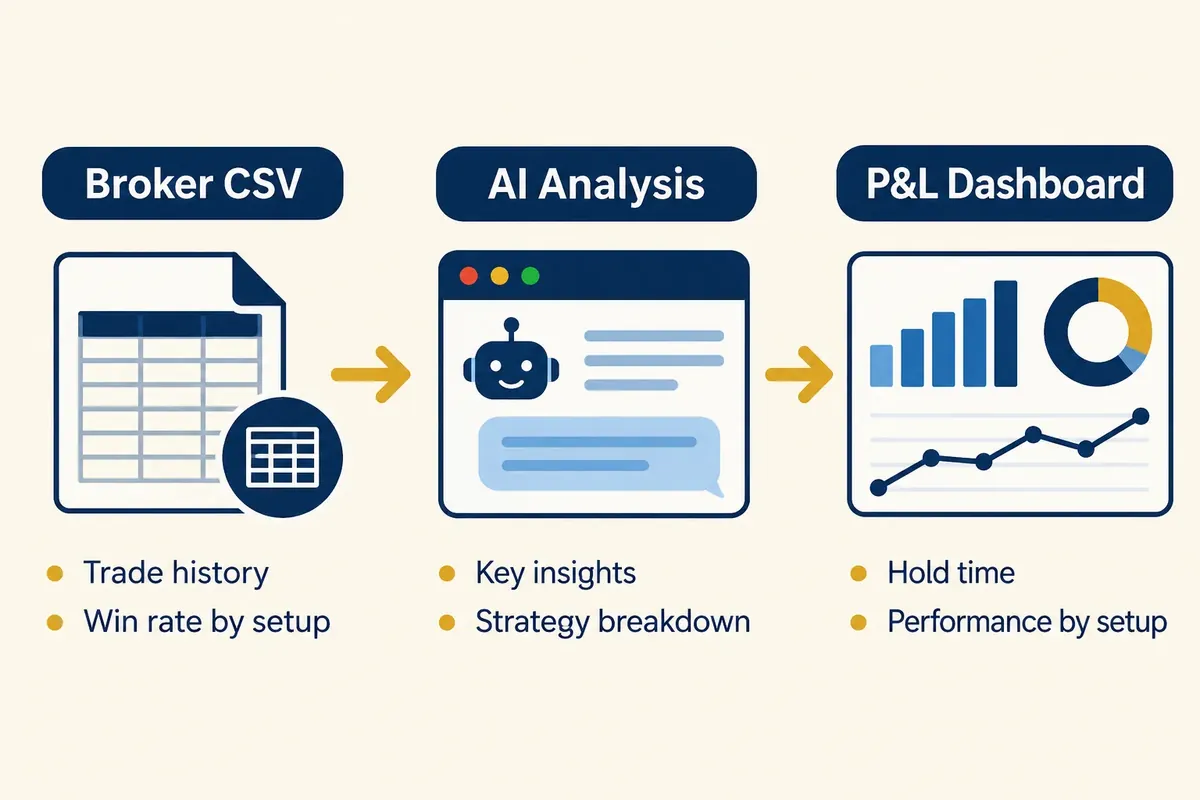
- (1:32) The mechanic. Download your broker's trading activity as a CSV file, drop it into Claude or Codex, and ask for an analysis dashboard.
- (2:32) The result. Her P&L dashboard showed overnight and swing trades outperforming same-day longs.
- (3:36) The filter. She screens for stocks with an average daily range above 4%, favoring semiconductors and memory names in this year's momentum sectors.
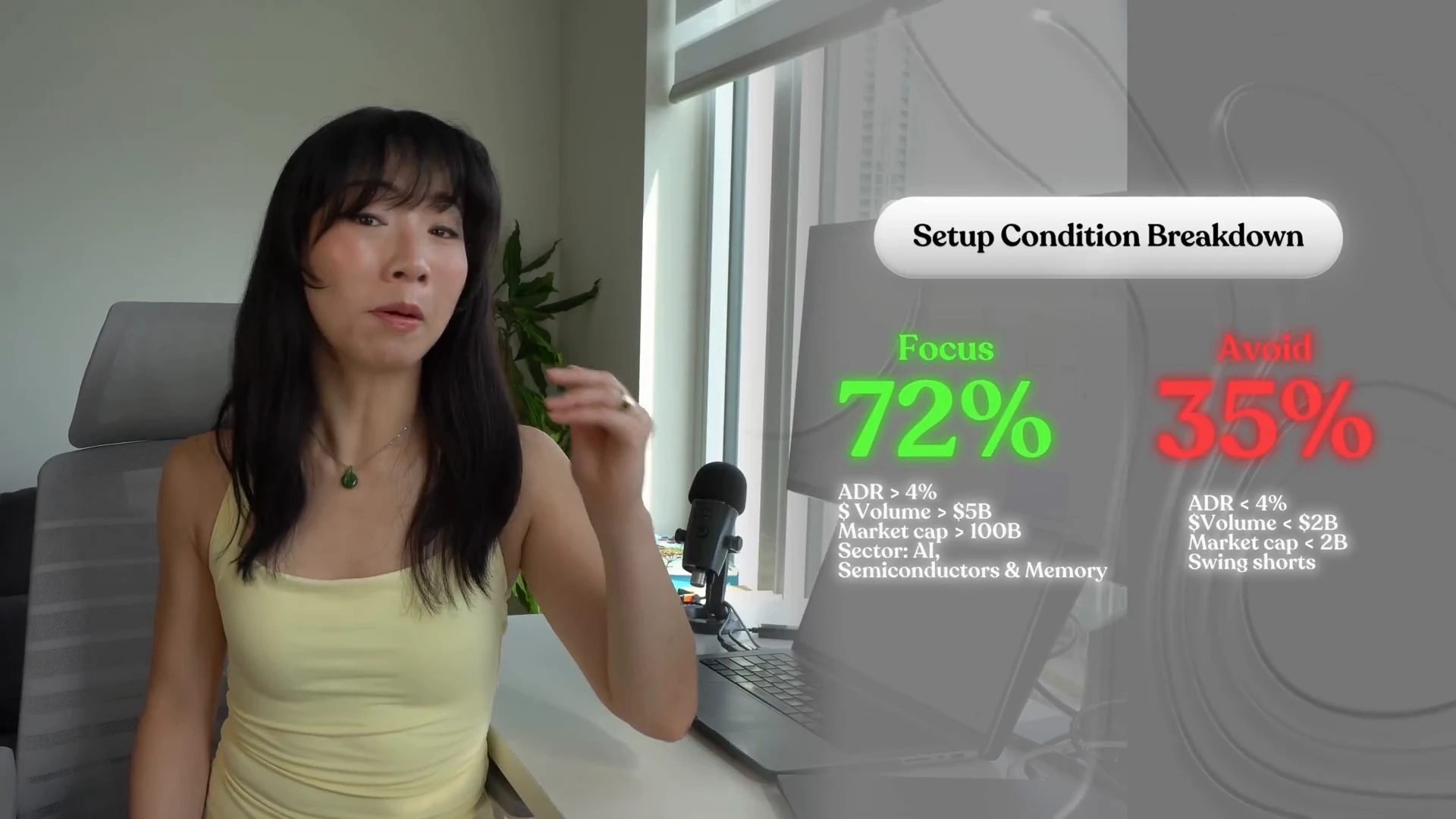
- (7:21) The number everyone will screenshot. Grouping trades by higher volatility, stronger liquidity and larger market cap produced a 72% historical win rate in that focus group.
- (8:58) The sizing concept. "Exponential bet sizing," which in plain English means heavier size on your best setups and token size on everything else.
Watch the original here: I'm a Verified 7 Figure Trader, Here's how I use AI for Trading.
One thing to flag early: the 72% win rate is a backward-looking segment of her own closed trades, not a forward-tested strategy. Filtering history to find your winners always flatters the numbers. That's not a scam, it's just arithmetic, and she doesn't fully caveat it on camera.
She also mentions a news-aggregation tool in beta near the end (11:35). One sentence, noted, moving on.
How to Use AI for Day Trading Without Asking It What to Buy
You use it on data you already own. Large language models are terrible at forecasting tomorrow's open and genuinely good at reading 400 rows of your own fills and telling you which habits are costing you money. That distinction is the whole lesson in how to use AI for day trading responsibly.
Most traders ask AI to predict. The useful question is diagnostic: where does my money actually come from?
Action step 1: feed your broker CSV to Claude or Codex and build a P&L dashboard
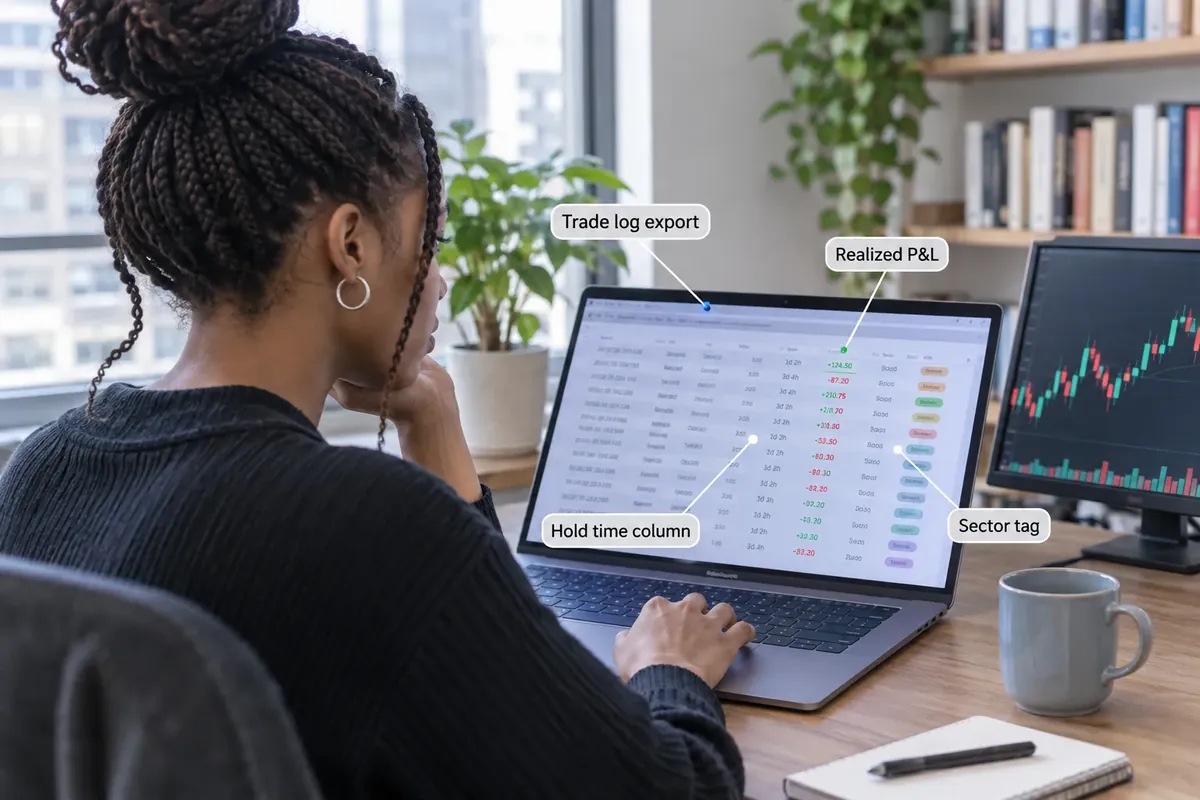
Every US broker lets you export trade history. Fidelity, Webull, Interactive Brokers, Tastytrade, Schwab, look for "statements," "trade confirmations," or "activity," and choose CSV format. That file is the raw material.
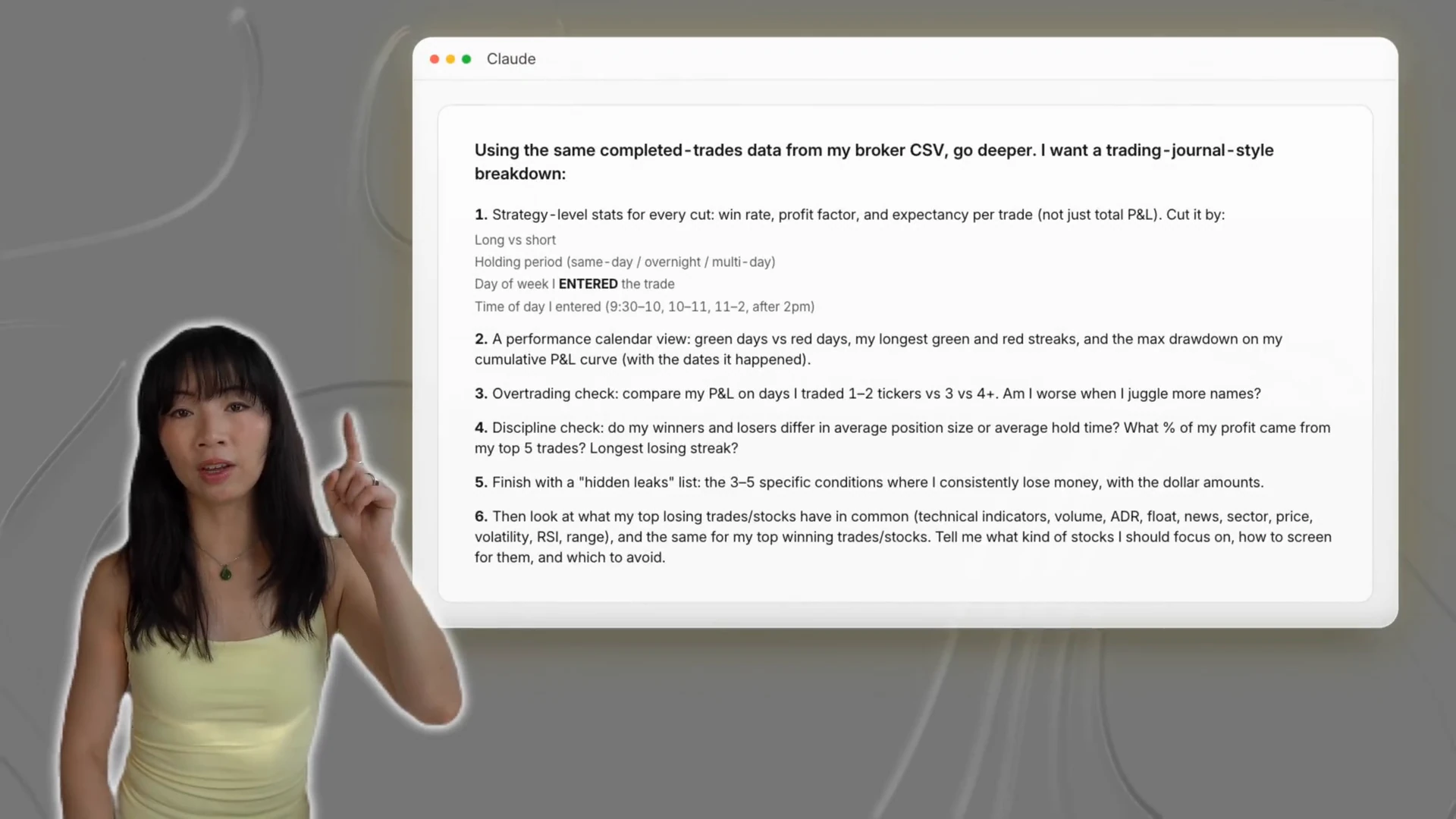
At (2:40) the video shows a Claude prompt asking for a trading-journal breakdown straight from the CSV. Don't copy a prompt off a blog without understanding it. Write your own. A workable version, in your own words:
"Here is my broker trade export. First, confirm the file parsed correctly and tell me total rows and date range. Reconcile your realized P&L total against the broker's reported figure before analyzing anything. Reconstruct completed round trips, then break down win rate, average win, average loss, and net P&L by: ticker, sector, hold time (same-day, overnight, multi-day), day of week, and time of entry. Flag any group where I lose money. Do not give me trade advice."
That reconciliation step matters more than it sounds. If the model's P&L total doesn't match your broker's, every downstream number is garbage. Make it prove the math first.
If you'd rather start with a structured format before touching AI, our trading journal template covers the fields worth logging.
What her dashboard showed: overnight and swing trades beat same-day longs
Her stated finding: the held trades did the heavy lifting. In related material she's published, one sample of 392 fills across 26 stocks produced a 61% overall win rate with average wins about 2.3x average losses, while the overnight bucket ran a 78% win rate and held trades made up roughly a quarter of trade count but around 80% of profits.
That's the uncomfortable truth AI is actually good at finding: you're probably busiest in the bucket that pays you least.
Think of it like a restaurant where the kitchen runs 40 dishes and three of them cover rent. Nobody wants to cut the other 37. The numbers don't care. If your 9:45 a.m. scalps net zero across 180 trades, those trades are a hobby with commissions attached.
Focus on stocks with an average daily range of 4% or more
Average daily range, or ADR, is the typical percentage a stock moves between its high and low on a given day. She argues at (3:36) that anything under 3-4% ADR isn't worth a day trader's attention, no matter the share price, because the range is too tight to pay you after slippage and fees.
That's a sensible rule and easy to verify yourself. A 2% ADR stock needs you to be right about direction and catch most of the move. A 6% ADR semiconductor name gives you room to be approximately right.
Choose this filter if you day trade momentum. Skip it if you trade mean reversion on liquid ETFs, where tight range is the point. For finding candidates systematically, see our breakdown of how to find stocks for swing trading before everyone else does.
Action step 2: know when to put more risk on
Her second step (4:42): finding an edge only matters if your sizing reflects it. Most traders do the opposite, equal size on everything, or worse, biggest size on the revenge trade after a loss.
The AI's job here is identification, not permission. It tells you the conditions under which you historically win. You decide the size.
Leveraged ETFs are trading tools, not investments
At (6:18) she's clear, and she's right: leveraged and inverse ETFs reset daily, which means holding them over multiple sessions produces returns that drift from the underlying index, especially in choppy tape. Losses compound as fast as gains.
Leverage is not a replacement for conviction. If your reason for the trade is "I want a bigger number," that's a degen play dressed up as a strategy. Play stupid games.
FINRA and the SEC both publish plain-English investor alerts on leveraged ETF decay. Read one before you touch them. FINRA's investor education site is free and not trying to sell you a course.
Her focus group: higher volatility, liquidity and market cap, a 72% win rate
The (8:40) screen shows the comparison that makes the whole video: a focus group at 72% versus an avoid group at 35%. Same trader, same year, same account. The only variable was which setup conditions were present.
| Condition group | Reported win rate | What it implies |
|---|---|---|
| Focus setups (high ADR, strong liquidity, larger cap, sector momentum) | 72% | Size up, within your rules |
| Avoid setups (low range, thin volume, no sector tailwind) | 35% | Stop taking them |
Treat these as her historical segmentation, not a forecast. Applied to your own file, the useful output isn't the number. It's the list of conditions your winners share.
Action step 3: exponential bet sizing for A+ setups
Plain translation of a fancy term: bigger size on your highest-conviction, condition-matched setups, small size on the maybes, and no trade on everything else. Three tiers, written down before the open.
A simple framework:
- A+ setup, all your focus conditions present. Full planned risk, say 1% of account.
- B setup, most conditions, one missing. Half size.
- Everything else, no trade. Not "small trade." No trade.
The failure mode is obvious and everyone does it anyway: you size up on the B trades because you're bored, and you're out of risk budget when the A+ shows up at 2:15. Position sizing is where accounts actually die, which we cover in the position sizing mistake that wipes out 90% of new traders.
Use the starter below to write your own journal prompt and check whether a ticker clears the 4% ADR floor.
⭐ Top 5 Features We Love
What holds up in this video, specifically.
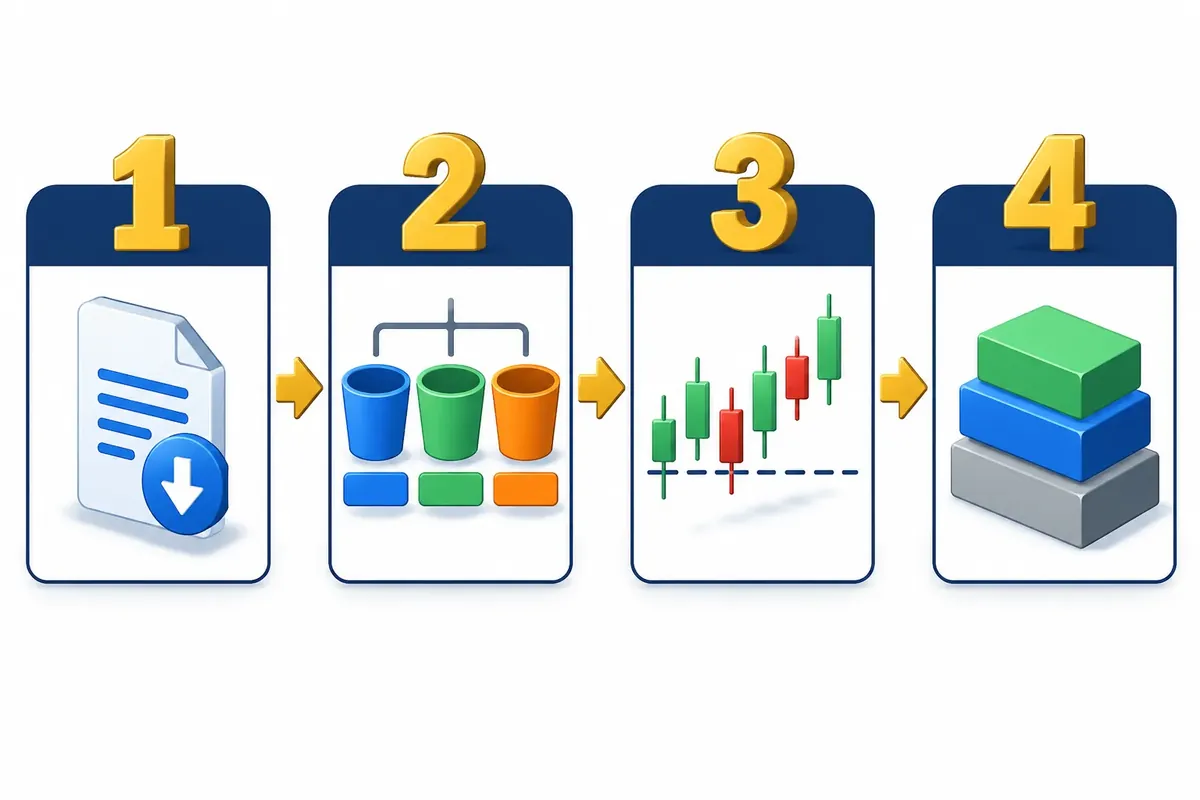
- She refuses the oracle framing. The opening line rejects asking ChatGPT what to buy. That alone separates this from 90% of AI trading content, and it's the honest answer to how to use AI for day trading.
- The input is her own data. Post-trade analytics on a broker CSV is the most defensible AI use case in trading, because the model is reading history, not guessing the future. Her published guides even instruct the AI to reconcile totals with broker-reported P&L before analyzing, a verification step almost nobody includes.
- The ADR floor is a real, testable filter. A 4% average daily range threshold is concrete, free to check, and either works for your style or doesn't. No subscription required.
- Risk sizing is tied to evidence, not mood. Sizing up only when documented conditions are present is a system. Sizing up because you feel hot is a story.
- The leveraged ETF warning is specific. Daily reset, decay in volatile markets, built for short-term use. She names the mechanism instead of waving at "risk."
Worth adding: she's extended this workflow publicly into premarket reporting pipelines and even paper-trading bots connected to Interactive Brokers' TWS API on the paper socket port. That's a real documented build, not a vibe. Related reading: AI trading bots, what to know before you automate trades.
⚠️ Things to Look Out For
Now the parts that deserve pushback.
The profit figures aren't independently audited. "Verified" in creator-speak usually means a broker screenshot or a third-party tracker, not a CPA-reviewed statement. Treat $400,000 and $20,000 as claims.
Selection bias is baked into the 72%. Filtering a year of closed trades for the conditions your winners shared will always produce a flattering win rate. It's descriptive, not predictive. The honest test is forward performance over the next 100 trades with the filter applied before entry.
Win rate is the weakest metric in trading. Her own published example shows filtered results moving from a 57% to a 75% win rate after enforcing an ADR floor, which sounds great, but expectancy, profit factor, max drawdown and holding period tell you far more. A 40% win rate with 3:1 payoff beats a 75% win rate with 1:4.
LLMs miscount. Hand a model 400 rows and it will sometimes produce totals that look plausible and are wrong. Always reconcile against the broker number. If it can't match, don't trust the breakdown.
Your data goes somewhere. A broker CSV contains your trade sizes, timing and account behavior. Strip account numbers and personal identifiers before uploading anything. FINRA's 2026 oversight material flags data sensitivity and auditability as core AI-agent risks for a reason.
The fraud environment is live. In September 2026 the SEC reported an enforcement action alleging more than $12.5 million misappropriated by one set of entities and over $2.8 million by another, using fabricated AI trading signals and bots that didn't exist. Any product promising AI-generated returns is a flashing red light.
Who this isn't for: anyone with fewer than 100 closed trades. You can't analyze an edge you haven't produced yet. Paper trade it first, build the history, then run the analysis. Start with how to find a trading edge before you risk a single dollar.
Which Prompts Help You Learn How to Use AI for Day Trading Reviews?
Ask questions about your past, not your future. Humbled Trader's method works because the AI reads her own broker data. That's the safest place to start learning how to use AI for day trading.
Export a CSV of your trades, then try prompts like these in Claude or ChatGPT:
- "Group my trades by hour of day and show win rate and average P&L for each hour."
- "Compare same-day trades with trades held overnight. Which group made more per trade?"
- "Show my results by the stock's average daily range: under 4% versus 4% and above."
- "List my 10 worst trades and what they have in common."
- "If I removed my worst setup entirely, what would my total P&L be?"
Each answer should change one rule. That's the real lesson in how to use AI for day trading: the model finds the patterns, you decide what to stop doing. Check every number against your broker statement before you act on it.
Flex or Cap? Our Verdict
Verdict: Flex, with an asterisk. The method is sound and repeatable even though the dollar figures aren't verifiable by us.
Scored on four questions:
| Question | Assessment |
|---|---|
| Receipts shown? | Partial. On-screen dashboards and segmentation at (2:40) and (8:40), no audited statement. |
| What can be verified? | The method, fully. The ADR filter, the CSV workflow, the sizing logic, all testable on your own data at zero cost. The P&L cannot be verified. |
| Risk disclosed? | Yes, better than average. Explicit leveraged-ETF warning at (6:18) and a closing line that AI won't magically make you profitable. |
| Can a regular retail trader repeat it? | Yes, if you have at least a few months of real fills and a broker that exports CSV. |
The reason this clears the bar: nothing in the core workflow requires buying anything. A free AI tier, your own export, and an afternoon. Compare that to the usual funnel where the "strategy" is the upsell.
The useful version of how to use AI for day trading isn't prediction, it's a mirror. The model shows you the trades you'd rather not look at.
Our wider testing of what these tools actually deliver is in we tested 10 AI trading tools so you don't have to.
What You Should Know Before You Try It
Six practical points before you run this on your own account.
- Paper trade the filtered version first. Once the AI tells you your A+ conditions, run 30 trades on paper taking only those setups. If the edge survives contact with the future, scale in. If it evaporates, you found a backtest artifact, not an edge.
- Write your sizing tiers down before the open. Full risk, half risk, no trade. Numbers on paper. A rule you decide at 10:12 a.m. isn't a rule.
- Costs eat small accounts. Commissions, data fees, and spread on low-float names are real drag. Run the ADR calculator above and ask whether the typical move actually covers your round-trip cost at your size.
- Know the tax reality. Short-term trades are taxed as ordinary income in the US, and wash-sale rules apply to frequent traders in taxable accounts. Mark-to-market election under section 475(f) exists but has strict deadlines. Talk to a CPA before year-end, not in April.
- The PDT floor changed in 2026, the risk didn't. Access to intraday margin with a small account is a privilege and a trapdoor. See how to day trade without $25k.
- Verify against primary sources. Investor.gov, SEC.gov and FINRA.org publish free material on leveraged products, day-trading rules and AI-related fraud. They're drier than YouTube and considerably more reliable.
Keep reading on FullStack Alpha: our TradingView review, AI trading bot breakdowns on AI Stock Trading Bots, the AI trading bot shortlist, and more Flex or Cap breakdowns.
Frequently Asked Questions
What is the 30% rule for AI?
There's no official "30% rule for AI" in trading or finance regulation. The phrase floats around social media with several meanings, most commonly the idea that AI should handle no more than about 30% of a decision process while a human reviews the rest. Treat it as a rule of thumb somebody invented, not a standard.
What is the 3-5-7 rule in stocks?
A common risk-management guideline: risk no more than 3% of your account on a single trade, no more than 5% total exposure to any one setup or correlated group, and cap total portfolio risk around 7% at any time. It's not a regulation, just a sizing framework. For small accounts, 1% per trade is usually more appropriate.
Can you make $200 per day in day trading?
Mathematically possible, statistically uncommon. A consistent $200 a day is roughly $50,000 a year, which on a $25,000 account would require a 200% annual return. Most retail day traders lose money overall. Treat a daily dollar goal as a pressure generator, not a plan.
How to earn $5000 per day from the stock market?
That level of daily profit generally requires a seven-figure account, professional infrastructure, and an edge that survives size. No AI tool, course, or signal service produces it reliably. Anyone marketing a path to $5,000 a day is selling the dream, and the SEC's 2026 enforcement actions against fake AI trading bots show how that usually ends.
Can I make $100 a day with day trading?
Some experienced traders do, with sufficient capital and a tested process. On a $5,000 account, $100 a day is a 2% daily return, which isn't sustainable. The realistic sequence is: build a process, measure expectancy over 100+ trades, then let the dollar amount follow account size.
Is $500 enough to start day trading?
It's enough to learn, not enough to earn. With $500, commissions, spread and slippage consume a large share of any gain, and one bad trade can remove a meaningful chunk of the account. Use small capital to build trade history and run the AI journal analysis on it. The data you generate is worth more than the P&L at that size.
Run the export, run the prompt, and read what your own trades say before you add another tool to the pile. Fewer tabs, one honest dashboard. Your market edge starts with the right tool. Stay alpha.
One method examined in depth here. There are 200+ AI stock tools catalogued in the FullStack Alpha directory, filterable by category, price and what they actually do.
Browse the directory → aistockpickerapps.com
What's the safest way to learn how to use AI for day trading?
Start with post-trade analysis of your own data, as Humbled Trader does. It's low risk because the AI isn't placing trades, and it shows you where your edge actually is. Learning how to use AI for day trading this way builds a better rulebook before any automation.
Can AI find day trading setups for you?
It can scan and filter, but scanners already do that well. Where AI adds the most is explaining why your results look the way they do, which is the part of how to use AI for day trading most traders skip.
Do you need to code to learn how to use AI for day trading?
No. Exporting a CSV from your broker and asking Claude or ChatGPT for a breakdown takes no code at all. That's the simplest way to learn how to use AI for day trading, and it's the method Humbled Trader shows.