Quick Answer
As an intro to options trading for beginners, this one's a flex. Lance Breitstein (TheOneLanceB) spends eleven minutes explaining calls and puts with a $500 bicycle, and the mechanics he teaches are accurate, plain-English, and genuinely useful if you've never touched a contract. The "$100 million in verified P&L" line, though? That's his claim, not an audited document you can pull up. Great teacher, unverified résumé. Two different things.
Here's the part worth your attention: the video never promises you'll make money. It explains why you can be right about direction and still lose. That's the single most expensive lesson in options, and most beginner content skips it entirely.
What Does TheOneLanceB Actually Claim?
Breitstein makes three claims up front, all within the first 20 seconds, and all of them are self-reported.
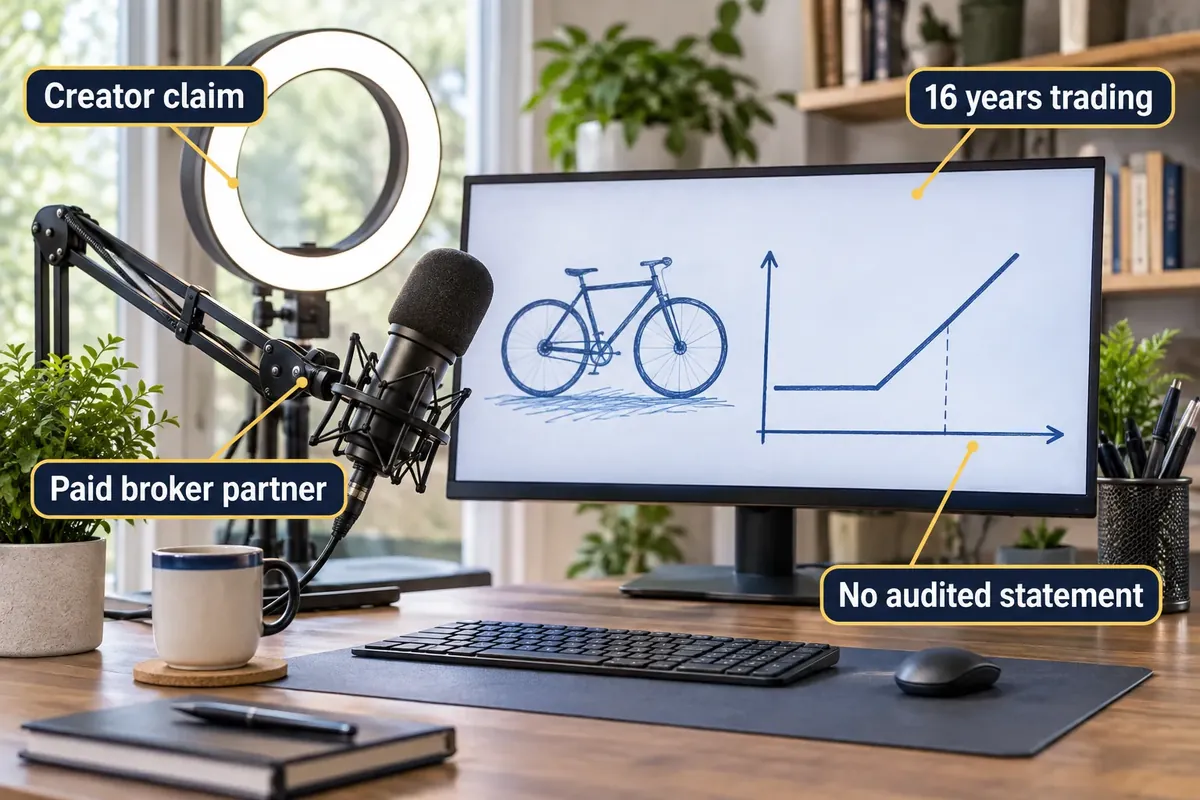
He says he's traded for 16 years, generated over $100 million in verified P&L on Wall Street, and buys and sells millions of dollars of options annually. His opening line sets the bar: options are "complicated," yet "millions of people trade them every single day without understanding what the hell they're doing" (0:00).
What's on screen as receipts? A bicycle. Not a brokerage statement, not a Form ADV, not a third-party audit. The channel bio elsewhere adds detail: over a decade trading equities at Trillium, a firm record for highest single-year P&L, a stint running Trillium's Chicago office, advisory work with SMB Capital. Those are checkable-sounding, but the public search record doesn't surface an independently accessible audit or regulator-verified performance report.
Unverified doesn't mean false. It means unverified. Score the lesson, not the legend.
One more thing a beginner should clock: Breitstein has a paid partnership with Clear Street, the prime brokerage. Their partner page names him as a paid partner, and the episode disclosure states he's compensated and also a customer. That's disclosed properly, which is more than most of YouTube manages. Still, when broker talk sits next to education, know which hat is on.
The video ran roughly 11 minutes 19 seconds, published October 17, 2026, and had 24,764 views and 569 likes as of November 18, 2026. Watch it yourself: Options Trading for Beginners ($100M Trader Explains).
How Does Options Trading for Beginners Actually Work?
An option is a contract that gives you the right, but not the obligation, to buy or sell 100 shares of a stock at a fixed price before a set date. You pay for that right up front. That payment is the premium, and if you're wrong, the premium is what you lose.
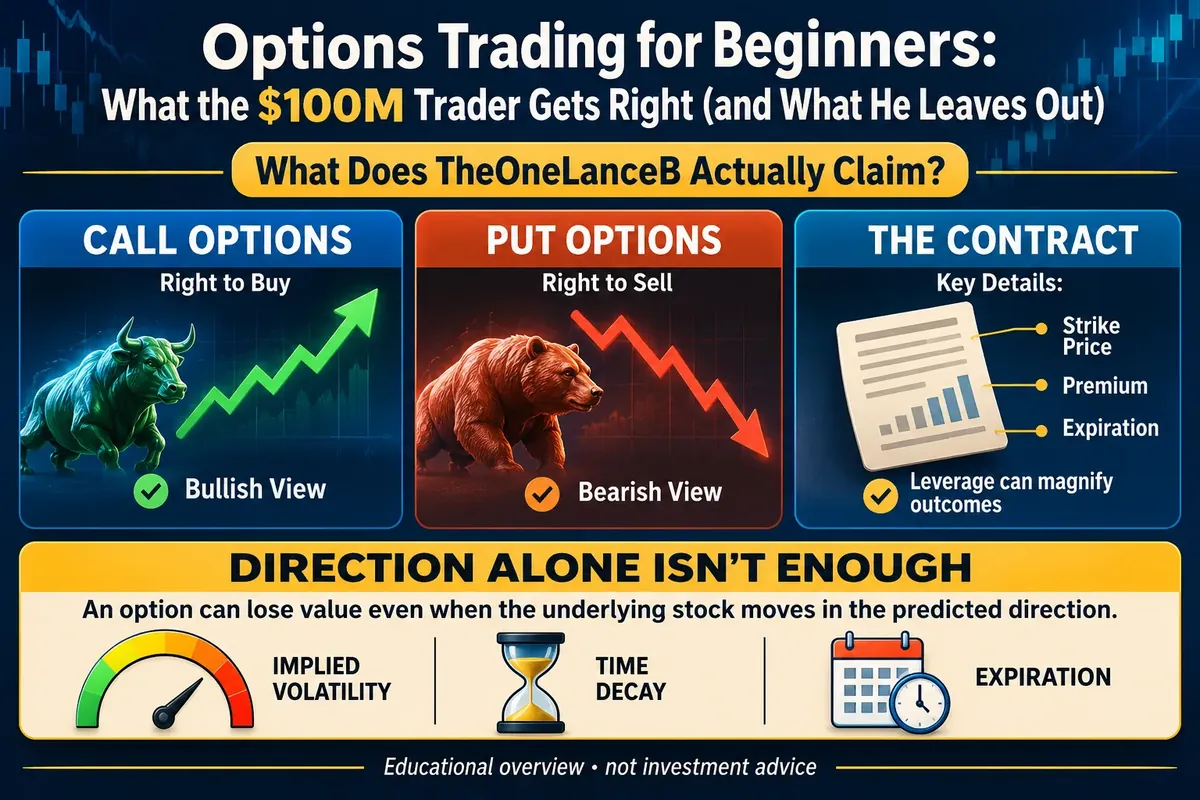
Breitstein's bicycle walkthrough is the cleanest version of this explanation on YouTube right now. Here it is, rebuilt.
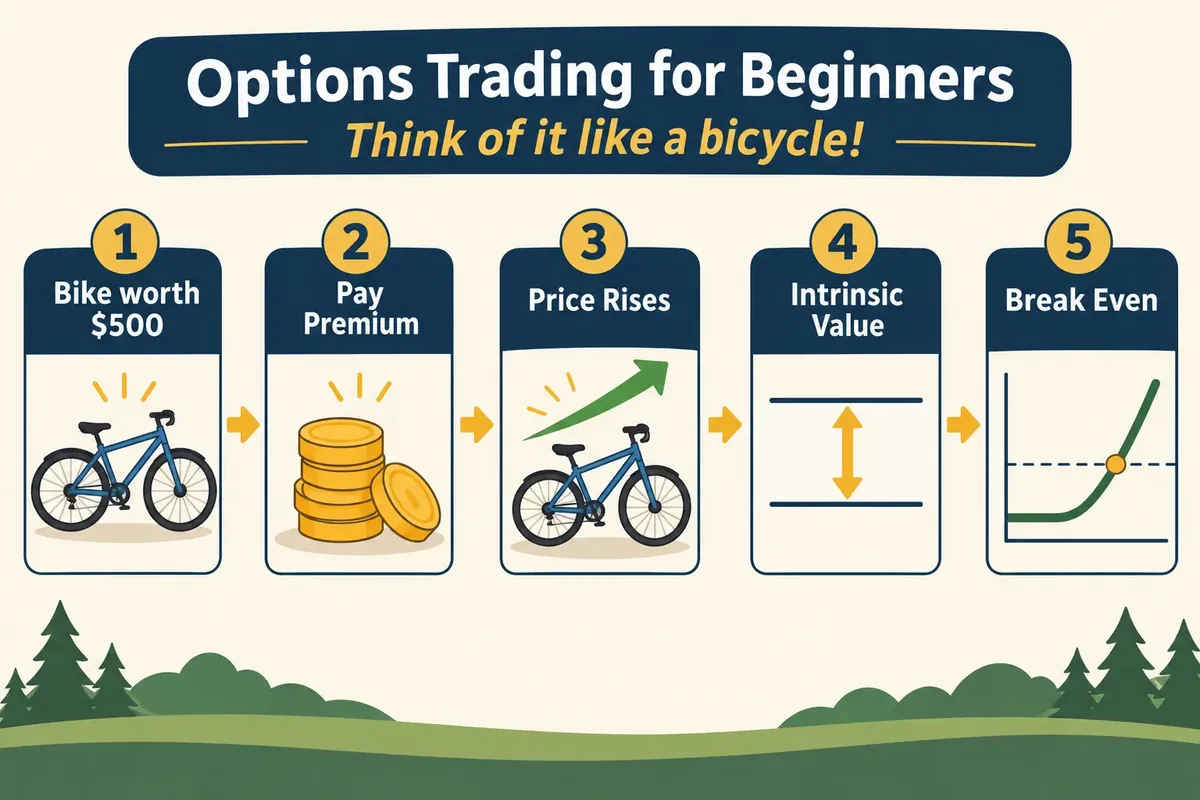
The bicycle example: a $500 call on a bike worth $700
He owns a bike worth $500. You want the right to buy it at $500 anytime in the next month. He agrees, but he's taking the bike off the market, so you pay him $20 for that promise. You've just bought a call option: strike $500, premium $20, one-month expiration.
The bike gets popular and the market price hits $700. You exercise, pay $500, and own something worth $700.
Intrinsic value and 'in the money'
That $200 gap between the $500 strike and the $700 market price is intrinsic value. Your option is now in the money, meaning exercising it has real value. You paid $20, you captured $200, so the economic profit is $180. On a $20 outlay. That's leverage doing what leverage does.
And if the bike goes out of fashion and nobody wants it? You walk. You have the right, not the obligation. Your maximum loss is the $20 premium. That asymmetry is the whole appeal of buying options.
The break-even price
A beginner trap hides here. The bike rising above $500 doesn't automatically mean you made money. You paid $20. At expiration, the bike needs to clear $520 before you're ahead.
Break-even for a call = strike + premium. For a put = strike − premium. Write that on a sticky note.
Puts as insurance
Flip it. You're scared the $500 bike collapses to $200. You pay Breitstein $20 today for the right to sell it to him at $500 anytime this month. That's a put option. He compares it to insuring the bike against theft (6:19): you hope you never use it, and paying for protection still makes sense.
Traders also buy puts purely to bet a stock drops. Same contract, different intent.
One contract covers 100 shares (a $2.50 quote costs $250)
One standard US equity option contract generally represents 100 shares. So an option quoted at $2.50 means $2.50 per share times 100 shares, or $250 before commissions and fees. Beginners see "$2.50" on a screen, click buy ten times, and discover they just spent $2,500.
An Apple $190 put is the right to sell Apple at $190. A $190 call is the right to buy it there. Same strike, opposite direction.
Implied volatility and time
Two forces price the premium besides the stock itself.
- Implied volatility is the market's guess at how much the stock will move. More expected movement means a higher premium, because the option has a better shot at ending up valuable.
- Time works the same way. A year-long right to buy the bike at $500 is worth more than a right that expires tomorrow. Every day that passes bleeds a little value out of a long option. That's time decay.
This is why you can nail the direction and still lose. The stock goes up, you were right, and the option still expires worthless because it didn't go up fast enough or far enough. Direction alone is not a trade.
The questions to ask before any options trade
Breitstein closes the lesson with the right frame: your job is to decide whether the price of the option is attractive (10:25). Before you click:
- What exactly am I predicting... direction, size of move, or timing?
- Is this premium cheap or expensive given the implied volatility right now?
- What's my break-even, and how likely is price to get there before expiration?
- What's my maximum loss, and can I eat it without flinching?
- What's my exit if I'm right? Most beginners plan the entry and improvise the exit.
If you can't answer all five, you don't have a setup. You have a lottery ticket with a strike price. Paper trade it first. And if you're sizing live positions, read the position sizing mistake that wipes out most new traders before you fund anything.
⭐ Top 5 Features We Love
Five things this lesson does better than most paid courses, each tied to a moment in the video or to the regulatory record.
1. One analogy, carried all the way through. The bicycle doesn't get abandoned after the intro. Strike, premium, intrinsic value, break-even, puts, time value... all of it hangs off the same $500 bike. That's teaching, not content.
2. The obligation point lands early. At 3:10 he's explicit: you have the right to buy, not the obligation. Beginners routinely think an in-the-money call forces them to come up with $19,000. It doesn't.
3. Break-even gets its own section. Most beginner videos explain calls and never mention that a stock rising isn't the same as you profiting (4:14). Skipping that is how people lose money while being technically correct.
4. Contract size stated plainly. "One standard US equity option contract generally represents 100 shares." Hedged correctly with "generally," since adjusted contracts exist. That $2.50-means-$250 example alone prevents a real category of beginner accidents.
5. No returns promised, anywhere. No screenshots of green P&L, no "I turned $1,000 into," no urgency. He names the real job at 10:25: decide whether the option's price is attractive. That's process over prediction, and it's rarer than it should be in this niche.
⚠️ Things to Look Out For
The video is honest about options and quiet about a few things that matter for a beginner about to fund an account.
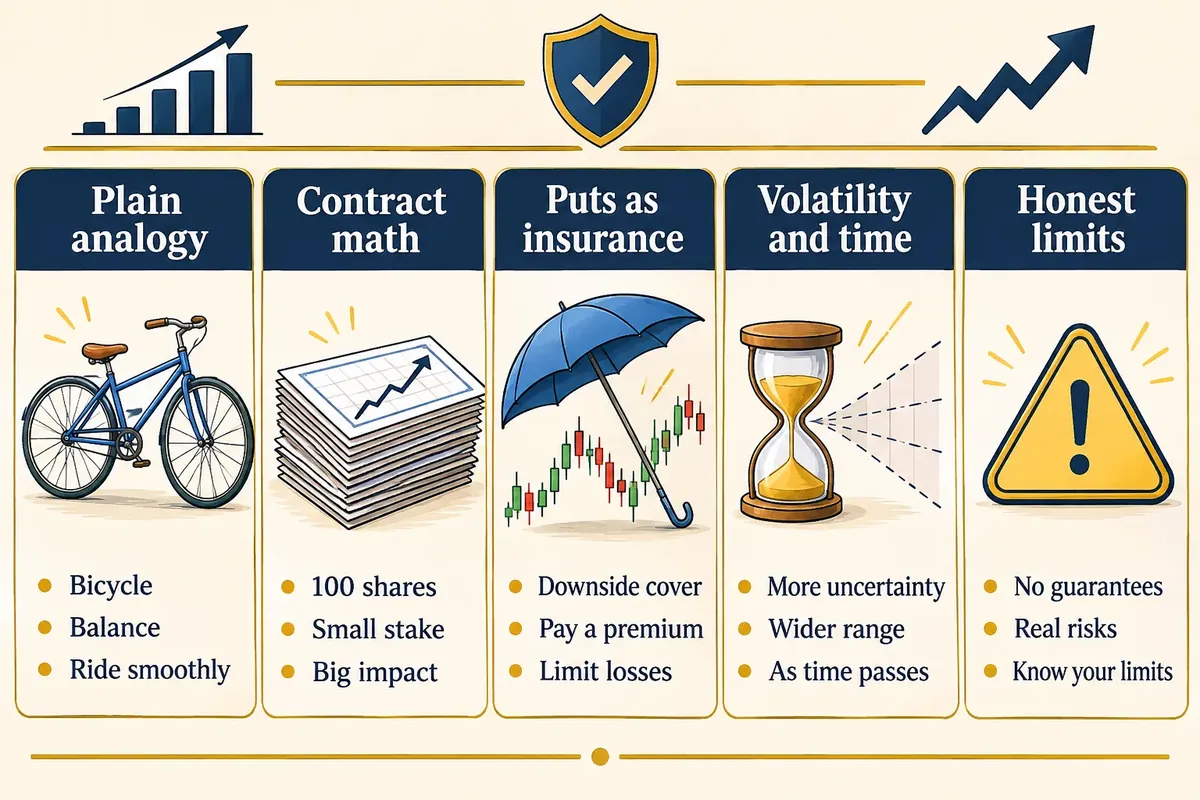
The $100M figure has no public receipt. No audited statement, no regulator filing, no brokerage document surfaced in public records. Treat it as a creator claim. The quality of the explanation doesn't depend on it, so don't let it do the convincing.
The paid Clear Street partnership sits next to the education. Disclosed, legitimate, and still worth holding in mind. Broker choice affects your fills and your costs, so compare independently... our best trading platform for options breakdown is a start.
Selling options is a different animal entirely. The video teaches buying, where your loss caps at the premium. The SEC warns that leveraged options strategies can produce losses exceeding your initial capital, and a naked call writer faces theoretically unlimited loss because a stock has no ceiling. His follow-up video on selling options is where that risk lives.
0DTE isn't covered, and beginners find it anyway. FINRA's guidance is blunt: same-day-expiry contracts are extremely sensitive to price moves and can lose the entire premium within a single session. The bicycle model does not prepare you for that.
Rules have edges. FINRA reminded firms that options expiring Friday, November 27, 2026 carry a 2:30 p.m. Eastern exercise-decision deadline because exchanges close at 1:00 p.m. that day. Half-days, early closes, and exercise cutoffs are real and they bite people who assume 4:00 p.m. always applies.
Who this isn't for: anyone who wants a ticker and an entry. There are none here. If you're hunting signals rather than understanding, you'll bounce in two minutes.
What Should Your First Options Trade Look Like?
Small, simple and boring. Options trading for beginners goes wrong fastest when the first trade is a cheap, far-out contract that needs a miracle. Breitstein's bicycle example works because it starts with the basics, and your first trade should too.
Pick a liquid stock or ETF
Choose something heavily traded, like a large index ETF or a mega-cap stock. Liquid options have tight bid-ask spreads, so you lose less just getting in and out.
Buy time, not lottery tickets
Pick an expiration at least 30 to 60 days out. Short-dated contracts lose value fast to time decay, which is the ice cube problem every beginner learns the hard way.
Stay near the money
A strike close to the current price costs more than a far-out one, but it doesn't need a huge move to pay. Cheap options are cheap because they usually expire worthless.
Size it like a loss
Assume the premium can go to zero. One contract at a $2.50 quote costs $250, as the video explains. Only buy what you're fine losing entirely.
Know your break-even before you click
For a call, it's the strike plus the premium you paid. If the stock needs to rise 15% in two weeks to break even, the trade is a hope, not a plan.
Write down the exit
Decide in advance: take profits at a set gain, or close if the premium drops by half. Options trading for beginners is mostly about not freezing when the position moves fast.
Paper trade this checklist for a few weeks first. Most brokers offer a simulator, and watching how premiums react to price, time and volatility teaches more than any article. Options trading for beginners should feel slow at first. Fast usually means expensive.
Flex or Cap? Our Verdict
Scored on the four questions we run every creator claim through.
| Test | Result |
|---|---|
| Receipts shown | Weak. A bicycle, not a statement. $100M is self-reported. |
| What's verifiable | Strong on content. Contract size, intrinsic value, break-even, volatility and time decay all check out against SEC and FINRA investor materials. |
| Risk disclosed | Good for buyers (max loss = premium), silent on selling risk and 0DTE. |
| Repeatable by retail | Yes. The concepts cost nothing to learn and apply at any account size. |
Verdict: Flex on the teaching. Need more receipts on the résumé.
As an explainer of options trading for beginners, it's the version you'd hand a friend who's about to do something expensive. As evidence that the man behind it made nine figures, it's one sentence on a screen. Judge the lesson on the lesson. Discipline beats prediction, and credentials you can't check aren't an edge.
What You Should Know Before You Try It
Five practical moves before your first contract.
Paper trade it first, for 30 days minimum. Trade the same strategy repeatedly in a simulator and track every outcome. If you can't be profitable on paper, live money just makes the losses faster. A trading journal template turns that month into data instead of vibes.
Size before you strategize. Decide the dollar amount you'd shrug off, then never exceed it per trade. Options premium is 100% loseable, so a "small" $250 contract is a full loss, not a dip.
Count every cost. Per-contract commissions, exchange and regulatory fees, assignment fees, and the bid-ask spread. On a $250 contract, a $0.10 spread is 4% gone at entry.
Know the tax shape. Most short-term options gains in a taxable US account are taxed as ordinary income, and wash sale rules can apply across substantially identical positions. Talk to a tax professional before year-end, not after.
Get options approval and read the ODD. Your broker will assign an approval level. The Options Clearing Corporation's "Characteristics and Risks of Standardized Options" disclosure document is required reading and it's free. Verify any claim at investor.gov or finra.org, not in a comments section.
Pick tools that reduce decisions, not add them. Six scanners is noise. If you're curious where software genuinely helps, we rank the field in our best AI trading tools of 2026 head-to-head, and options flow platforms get their own breakdown.
Keep reading on FullStack Alpha: our AI stock tool reviews, how traders automate rules like these, AI options tools compared side by side, and more Flex or Cap breakdowns.
Frequently Asked Questions
Can I start option trading with 1000 rupees?
Not in the US options market. Standard US equity contracts cover 100 shares, so most premiums run $50 to $500+ per contract, and ₹1,000 is roughly $12. US brokers also require options approval and typically a funded account. Indian traders use NSE index and stock options through a local broker, where lot sizes and margin rules differ.
What are options in the stock market for beginners?
An option is a contract giving you the right, not the obligation, to buy (a call) or sell (a put) 100 shares at a set strike price before a set expiration date. You pay a premium for that right. If you're a buyer and you're wrong, your maximum loss is the premium you paid.
Can you make $200 per day in day trading?
It's possible and it's not reliable. Research consistently shows the large majority of active day traders lose money over time, and daily results swing hard. Anyone quoting a steady daily number is describing an average, not an income. Build a process first and measure results monthly, not daily.
Why do 90% option traders lose money?
Mostly three reasons: they buy cheap out-of-the-money options with poor odds of reaching break-even, they ignore time decay so a correct direction call still expires worthless, and they oversize. Add commissions and bid-ask spreads and the math compounds against undisciplined traders.
How much money do day traders with $100,000 accounts make per day on average?
There's no credible average, because outcomes are not normally distributed and most participants lose. Profitable traders typically think in percentage terms per month, not dollars per day, and even then drawdowns are routine. Treat any flat daily dollar figure as marketing.
How much money has Lance Breitstein made?
He states more than $100 million in verified P&L across 16 years, including a decade at Trillium where he says he set the firm's single-year P&L record. That's his claim. No publicly accessible audit, brokerage statement, or regulator-verified performance report appears in the public record, so treat the figure as unverified.
How much money do you need for options trading for beginners?
You can buy one contract for a few hundred dollars, but having enough to trade small and survive mistakes matters more. Many brokers also require approval for options levels. Start options trading for beginners on paper, then with one contract at a time.
Are puts or calls better for options trading for beginners?
Neither is safer by default. Calls profit when price rises, puts when it falls or as insurance on shares you own, like Breitstein's example. Beginners often start with covered calls or protective puts because the risk is easier to see.
How long does options trading for beginners take to learn?
The basics take a few weeks: calls, puts, break-even and time decay. Getting comfortable with volatility and sizing takes months of paper trading. Options trading for beginners should stay small until those pieces feel routine.
The Takeaway
The bicycle works. Keep it. A call is paying for the right to buy something at an agreed price, a put is paying for the right to sell it, the premium is the cost of being wrong, and break-even is strike plus or minus that premium. That's 80% of what options trading for beginners requires on day one.
What the video can't give you is the part that decides whether you survive: a written set of rules, a position size you can repeat 50 times, and a journal that argues with you when you're lying to yourself. Breitstein teaches the mechanics well. The system is on you.
Do this today: open a paper account, buy one simulated call and one simulated put on a stock you follow, write down your break-even before you click, and check the result at expiration. Thirty of those and the jargon stops being jargon. Your market edge starts with the right tool. Stay alpha.
One video explained here. 200+ AI stock tools, scanners and brokers are catalogued in the FullStack Alpha directory, filterable by category, price and what they actually do.
Browse the directory → aistockpickerapps.com